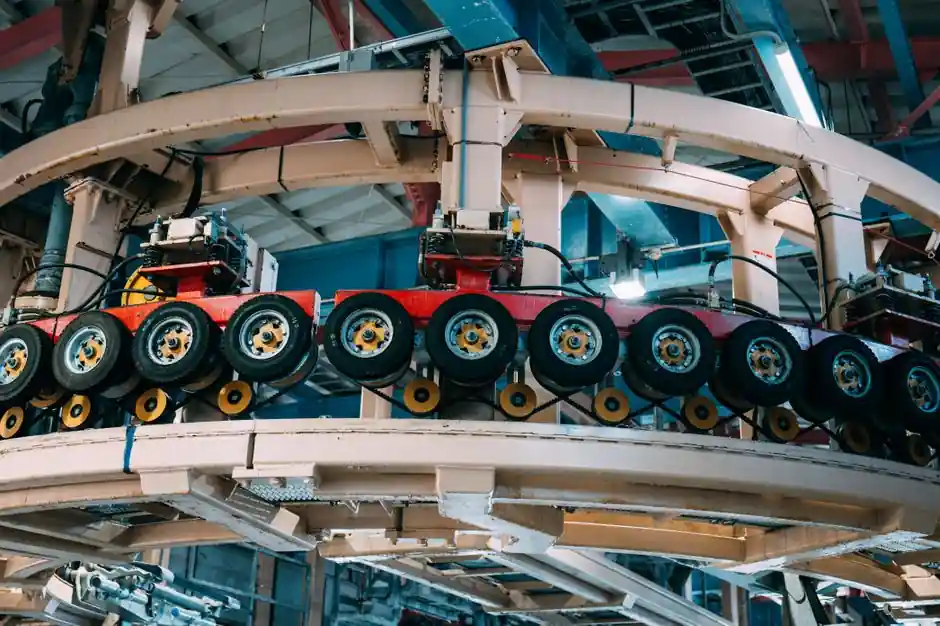
For a cold milling machine, a tracked undercarriage is the default configuration in 2026, because ground pressure on a half-lane cut is what determines cut depth consistency and operator comfort. Wheeled undercarriages show up almost exclusively on small-class (<500 mm drum width) planers working urban pothole and utility-cut jobs, where repositioning speed outweighs traction.
Tracked milling machines spread their operating weight (typically 14,000–40,000 kg for the 1 m and 2 m drum classes) over a track contact length that can exceed 2.5 m, which keeps ground bearing pressure in the 30–50 kPa range, low enough to work on prepared sub-base without pumping fines [S3]. Wheeled planers carry the same cutter load through four small contact patches, so PSI jumps by roughly an order of magnitude and cut-to-grade stability suffers on anything softer than full-depth asphalt [S3].
Ground Pressure and Traction: The Decisive Numbers
Tracked undercarriages deliver a wider footprint with considerably more ground contact than wheeled equipment, and the heavy undercarriage built around the track frame acts as a counterweight against the milling drum reaction [S3]. On a 2 m class Wirtgen W 200 or similar, the track shoe area approaches 4 m² in sum, so a 30-tonne machine sits closer to 0.07 MPa than the 0.3–0.4 MPa a comparably sized wheeled carrier would exert on the same ground [S2][S3].
Wheeled milling machines transfer their weight to four contact patches; the resulting point loading reduces flotation and makes the machine cut deeper on soft spots in the asphalt, which is the root cause of the uneven grade complaints that have pushed nearly all large milling machines back to tracks since the late 2010s [S2][S3].
Track Construction: Steel-Embedded Rubber vs All-Rubber
Steel-embedded undercarriages, made mostly of steel components, average a 1,000-hour lifespan, but can reach 2,000 hours in the right conditions and with disciplined maintenance [S5]. All-rubber track life, by contrast, runs about 1,500 to 2,000 hours on average and can reach as high as 5,000 hours in low-abrasion urban milling where steel rebar fragments and aggregate impact are minimised [S5].
Steel tracks weigh several hundred pounds more than rubber tracks, which improves traction and stability on uneven terrain, slopes, and slippery conditions; rubber tracks are easier on finished surfaces, less noisy, and absorb vibrations to give the operator a more usable shift [S4]. For cold milling, where the cut exposes aggregate and often rebar or mesh, steel-embedded compounds are the more common OEM fitment because the impact energy of the milling drum cycling tears through all-rubber compounds faster.
Component Wear: Rollers, Idlers, Sprockets, Pads
The undercarriage system on a milling machine comprises track pads, track chain, track roller, idler, carrier roller, and sprocket, and a failure in any one of those parts propagates quickly because milling loads are cyclic rather than steady [S1]. A broken or overly stretched track chain can render the machine immobile, with repairs often time-consuming and costly, and it also causes uneven wear on the sprockets and rollers downstream [S1].
Bottom rollers support the milling machine's weight and distribute it evenly on the track, while upper rollers or carriers keep the track from sagging between the sprocket and idler [S4]. On milling machines the lower rollers take the brunt of vibration from the drum, so a sealed-for-life roller is worth the upcharge; open designs that are self-cleaning can extend service life of some components by as much as 50%, which matters when abrasive milled material is constantly being thrown up into the frame [S5].
Rigid vs Suspended Undercarriage on Milling Machines
Milling machine undercarriages are almost universally rigid-mounted, because the cutter housing has to maintain a fixed relationship to the ground reference and any suspension movement between the tracks and the chassis would translate directly into cut-depth variation [S5]. Rigid-mounted systems have little-to-no suspension, so the effect of every bump is transferred through the entire machine and to the operator, but the trade-off is cut accuracy on a grade-controlled mill [S5].
Full-suspension undercarriages, more common on compact track loaders, would compromise the milling depth reference unless paired with active grade control, which most half-lane and full-lane mills are not. The few suspended-undercarriage milling concepts on the market pair the suspension with sonic or 3D grade sensors that re-reference the drum in real time; for anything below 1 m drum width, the cost and calibration overhead still does not pencil out.
When a Wheeled Undercarriage Still Makes Sense
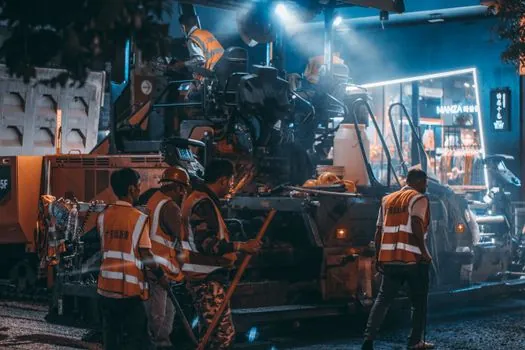
Wheeled cold milling machine packages (e.g. small Wirtgen W 35 Ri or similar 300–500 mm drum machines) win on three specific job types: high-frequency utility cuts, bridge-deck work where a steel track would mark the surface, and inner-city patch jobs where the machine rolls between cuts at 20–30 km/h instead of being trucked [S2]. On flat, hard, paved surfaces, weight distribution is not a large concern, and wheeled machines can travel between cuts far faster than tracked equivalents [S3].
Wider drums (1 m and up) on wheeled chassis become a stability problem because the cutter reaction moment grows with the square of the drum width, and the only way to keep the machine flat is to add ballast to the wheeled undercarriage, which erases the travel-speed advantage.
Selection Checklist and Cost Levers
On a criterion-based comparison: tracks win on ground pressure (30–50 kPa vs 300+ kPa), stability under cut load, and slope performance (typically 30°+ vs 15–20° for wheeled); wheels win on travel speed (20–40 km/h vs 4–7 km/h), lower undercarriage replacement cost, and the ability to roll on finished asphalt without scuffing [S2][S3][S4]. For a 2 m class mill doing highway work, total cost of ownership over a 5,000-hour life typically favours tracks despite the higher upfront, because the downtime cost of an undercarriage failure on a night-shift paving job dwarfs the parts premium.
Track tension is the single most-controllable wear lever: add tension for hard surfaces and loosen it for soft, muddy, or snowy conditions, and check tracks, links, pins, bushings, idlers, and sprockets regularly for wear and tear [S4]. For fleet operators, front-loading vs rear-loading cold milling machine selection interacts with undercarriage choice because rear-loaders put more reversing load on the sprocket and idler, which shortens track life by 10–20% versus a comparable front-loader.
Trackable signals to watch through 2026: OEM moves toward bolt-on, replaceable idler hubs to cut field-rebuild time, and any shift back to all-rubber compounds on mid-class mills if vibration-isolated drum housings mature enough to absorb the impact load that currently chews rubber up.