
Curvilinear tooth profiles such as HTD and GT spread load across a wider contact area than trapezoidal profiles, giving roughly twice the torque capacity per tooth at the same pitch [S1][S3].
Trapezoidal profiles (MXL, XL, L, H, XH, XXH in imperial; T2.5, T5, T10, AT3, AT5, AT10 in metric) still dominate general conveyance and low-to-medium duty positioning because they hold tighter backlash and cost less per meter [S2][S5].
Tooth Geometry and Where Stress Actually Lands
Trapezoidal teeth are straight-sided wedges, with sharp corners at the tooth root and tip; that geometry creates a stress concentration right at the belt tooth/pulley groove interface, which is why trapezoidal belts wear faster at high torque [S4][S10].
Curvilinear teeth, by contrast, round the root and use a deeper tooth, increasing the contact patch with the matching timing pulley groove and lowering unit pressure on the belt tooth [S3]. HTD pitch range runs 3 to 20 mm, with double-sided tooth options common for reversing drives [S3]. The standard trapezoidal tooth profile is controlled by ISO 5294:2012, while curvilinear profiles are largely vendor-specific [S4].
Backlash, Noise, and Positioning Accuracy
Backlash in a timing belt is the free play between belt teeth and pulley grooves, kept in deliberately to prevent binding on entry and exit [S4]. Trapezoidal profiles inherently produce less backlash than curvilinear designs, which is why they remain the default for registration and linear indexing where positional repeatability matters more than ultimate torque [S4][S5].
Curvilinear teeth engage more gradually, which cuts impact noise at speed but adds clearance, so a curvilinear drive trades some positioning precision for smoother meshing [S1][S5]. GT and GT2/GT3 push that further toward near-zero backlash, making them the standard pick for servo drives, CNC feed axes, and precision indexers [S1]. Practical noise gains are real: HTD profiles run measurably quieter than XL or L trapezoidal belts at the same linear speed [S7].
Load Capacity and Speed Ceiling

The deep, rounded tooth on HTD and GT profiles lets the belt carry higher shear loads before tooth jump, which is the reason curvilinear belts replaced trapezoidal belts as the default high-torque, high-speed synchronous drive after the 1970s [S3][S8]. Illinois Pulley & Gear notes that curvilinear belts need less installation tension for the same transmitted load, reducing bearing load and extending shaft-bearing life [S3].
Standard HTD pitch is offered in 3M, 5M, 8M, and 14M, with 14M HTD handling the highest torque class in the family and 3M covering miniature office-machine and instrument drives [S1][S3]. For comparison, the imperial trapezoidal family tops out at XXH at 1.125 inch (28.575 mm) pitch, but at that size the trapezoidal profile is rarely preferred over 14M or 20M curvilinear equivalents because of the stress concentration penalty [S2][S1].
Compatibility and Interchange Rules
Trapezoidal and curvilinear belts and pulleys are not interchangeable, even at the same pitch number, because the tooth flank geometry differs between the two families [S6]. HTD and STD (super torque drive) belts and pulleys are explicitly listed as non-compatible by the manufacturer [S6]. A belt marking a 5 mm pitch could be either T5 (trapezoidal) or 5M HTD (curvilinear), and swapping one for the other will produce rapid tooth shear [S1][S6].
Within a given profile family, manufacturers run their own patented variants, so even two HTD 8M belts from different vendors can have different tooth dimensions and are not always drop-in replacements [S5]. The safe rule when replacing an existing drive: match the original tooth profile and pitch marking exactly, or re-engineer the pulley [S1].
Decision Matrix: Trapezoidal vs Curvilinear vs Modified Curvilinear
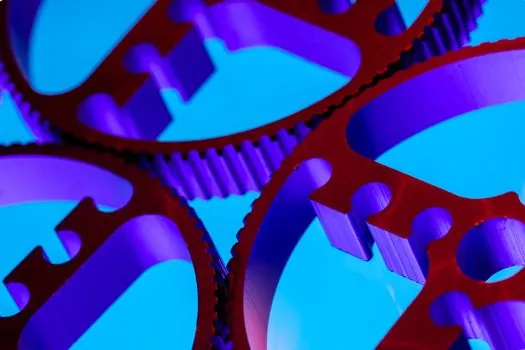
For a quick spec-side comparison, the three profile families line up as follows against the criteria that drive most selections [S1][S2][S5][S7]:
- Trapezoidal (MXL, XL, L, H, XH, XXH, T, AT): lower cost per meter, lowest backlash, narrowest torque ceiling, loudest at high speed, available in both imperial and metric [S2][S5].
- Curvilinear (HTD 3M to 14M, GT, GT2, GT3): higher torque per tooth, quieter running, deeper tooth reduces ratcheting, slightly higher backlash, metric pitch only [S1][S3][S5].
- Modified curvilinear (e.g., FHT, Poly Chain GT2 Carbon): highest torque and force capacity of the three, smallest tooth depth with greater flank angle, lets the belt land between teeth share load with engaged teeth, most resistant to ratcheting, metric only [S5][S7].
For light duty conveyance, packaging machinery, and office-equipment drives under roughly 1 kW, a trapezoidal XL or T5 drive is usually the cost-correct choice. For servo and CNC feed axes where near-zero backlash matters, step up to GT2 or GT3. For high-torque industrial machinery, hoists, and heavy conveyors, modified curvilinear (FHT-class) profiles outperform both HTD and trapezoidal on torque density and belt life, at a higher unit cost [S1][S5][S7]. More on the timing belt side of the drive geometry sits in the encyclopedia entry.
Selection Criteria and Sourcing Standards
Match the profile to three engineering numbers before picking a part number: continuous torque, peak torque (including shock), and the maximum linear belt speed. Add a fourth input, positioning accuracy in mm or arc-min, if the drive is part of a motion-control axis [S1][S4]. The standard trapezoidal profile geometry is fixed by ISO 5294:2012, which is the right reference for any imperial XL/L/H or metric T/AT spec drawing [S4].
Curvilinear profiles are governed by manufacturer specifications rather than a single ISO tooth-geometry standard, so the supplier's load-rating tables and torque-capacity curves are the controlling documents [S4]. For reverse engineering an existing drive, count teeth, measure pitch, and identify the profile family by tooth shape before ordering a replacement, since a misidentified profile is the most common root cause of premature tooth shear in field failures [S1][S6].
For high-torque indexing drives, the timing pulley PLD compensation rules across tooth counts and profiles feed directly into which curvilinear pitch is actually deliverable on a given shaft, and that decision sits one level upstream of the profile choice above.
Failure Modes and Field Limits
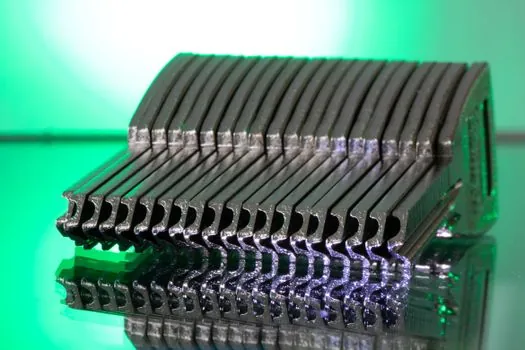
The dominant failure mode for trapezoidal drives running above their design torque is tooth root cracking, driven by the stress concentration at the sharp root radius [S4][S5]. Curvilinear drives instead tend to fail by ratcheting (tooth jump) when the belt is under-tensioned or the load exceeds the tooth shear strength, which is why HTD installations specify a higher minimum installation tension than equivalent trapezoidal XL or L drives [S3][S4].
Modified curvilinear profiles, by letting the belt land between teeth carry a share of the load, are the least likely to ratchet even under extreme overload, which is why they dominate processing and high-torque industrial lines [S5]. On the noise side, expect a 3 to 6 dB drop when swapping an XL trapezoidal drive for an HTD 5M curvilinear drive at the same linear speed, based on manufacturer comparative data [S7].
Spec-level background on the components involved: pressure transmitter.