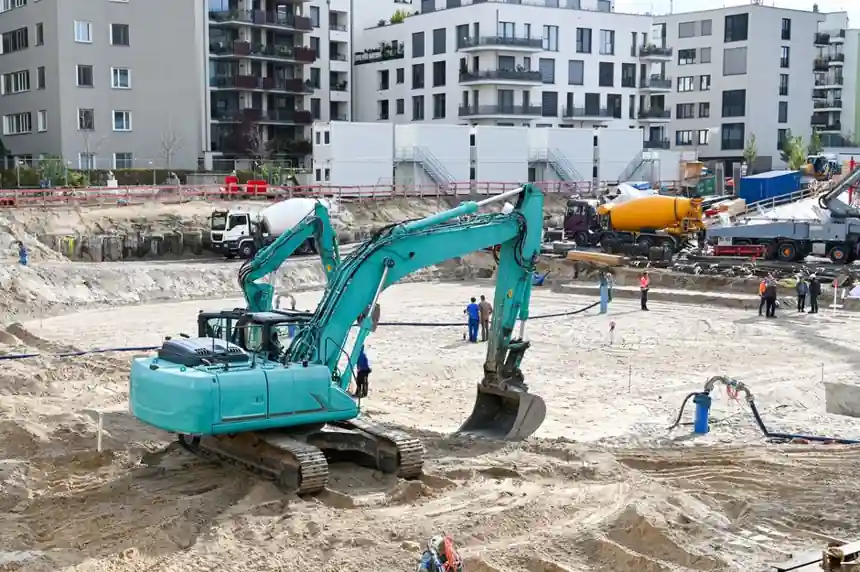
A truck-mounted mixer-pump combination integrates a drum mixer and a pumping unit on a single chassis, while the conventional setup pairs a dedicated concrete mixer truck with a separate truck-mounted concrete pump, often a boom pump, fed by the agitator truck [S5].
The integrated machine handles raw aggregate dosing, mixing, and pumping in one continuous process, eliminating the need for a ready-mix truck at the pour point [S2]. The split configuration keeps each function on its own purpose-built chassis, with output rates of 30 to 60 m³/h and 50 to 90 m³/h for the pump half depending on site scale [S3].
Where Each Configuration Actually Fits
Mixer-pump combinations dominate rural, remote, and developing-market projects where ready-mix concrete is scarce and haul distances are long, since the unit produces concrete from bulk materials at the pour point [S5]. A dedicated mixer truck paired with a truck-mounted concrete pump suits urban or infrastructure sites within batching-plant range, where high-volume pours and vertical delivery define the job [S4].
Contractors who need only placement reach, not on-site mixing, specify a trailer-mounted or boom pump that takes ready-mix from a transit mixer and pushes it 20 to 60 m horizontally or vertically [S1][S3]. The decision rarely comes down to a single spec; it pivots on whether the project has a stable concrete supply chain or must generate its own mix on the truck [S5].
Spec Comparison: Output, Reach, Drum, Power
Output bands separate the two configurations cleanly. Mixer-pump combinations typically run 20 to 60 m³/h with pumping pressure matched to short pipeline runs, while dedicated boom pumps paired with mixer trucks cover 30 to 90 m³/h plus boom reaches of 20 to 60 m for high-rise or wide-area pours [S3].
Drum capacity on the combination unit runs 4 to 10 m³, constrained by chassis payload limits, and larger drums force heavier axle loads that may exceed regional road-weight regulations [S3]. Engine power scales accordingly: mixer-pump packages run diesel engines in the 200 to 400 hp band, with higher horsepower reserved for thicker mixes and longer pipeline friction losses [S3]. For conventional setups, the mixer truck carries its own engine for drum rotation while the boom pump runs a separate diesel or, on fixed urban sites, a three-phase electric powerpack [S5].
Selection Criteria and Decision Matrix
Five criteria drive the choice, drawn from the September 2026 buyer guides: (1) concrete supply availability, (2) daily pour volume, (3) vertical and horizontal reach, (4) site access and turning space, and (5) upfront versus total cost of ownership [S3][S4].
A direct comparison from HAMAC's 2026 guide frames the trade-off: a mixer-pump trades pumping output and reach for mixing independence, while a trailer or boom pump trades mixing capability for higher continuous output and longer pipeline distance [S5]. The MachPlaza buyer's guide (2026-08) backs this with a side-by-side: a truck-mounted pump needs an external batch plant, costs less upfront, and fits urban work; a mixer-pump truck makes fresh concrete on site, costs more, and fits remote or rural sites [S3].
Site access often decides before specs do. A ground-level foundation with wide road access may need only a mixer truck with direct discharge, while a basement slab, upper floor, or pour behind an existing structure forces a pump and pipeline regardless of mix method [S4]. Practical measurements, including entrance width, turning radius, ground bearing, distance to the pour point, vertical lift, overhead utilities, and washout space, carry more weight than a request for "a medium machine" [S4].
Use Cases That Lock In One Choice
For house construction, rural roads, drainage works, small bridges, and remote sites without batching-plant access, a diesel mixer-pump combination is the standard answer, since it folds aggregate storage, mixing, and pumping into a single truck and removes dependence on ready-mix delivery [S5]. For high-rise buildings, large foundations, tunnels, and ready-mix pumping service work, the trailer or boom pump plus transit-mixer chain is the standard answer, since it focuses each machine on a single function and supports continuous long-distance delivery [S5].
Total cost of ownership reshapes the upfront-price comparison. A cheap combination unit that idles waiting for raw material staging can cost more over five years than a pricier dedicated pump that runs daily, once fuel, parts, downtime, and resale value are counted [S3]. Spare-parts stocking, service-team response time, warranty coverage, and operator training are the four after-sale variables that decide which buyer's unit keeps working through year five [S3].
Hydraulics, Chassis, and Integration Limits
On the combination unit, the hydraulic system drives both the drum and the pumping circuit, so valve and cylinder quality from names like Rexroth or Kawasaki, plus oil cooling sized for hot climates, determines long-term reliability [S3]. Chassis selection follows the same logic: Mercedes, Isuzu, HOWO, and Shacman are common bases, and a stronger chassis extends service life and holds resale value, while a cheap chassis saves money at purchase and costs more through the ownership cycle [S3].
For the split setup, the mixer truck's drum and the boom pump's hydraulic boom are independent systems, so a failure in one does not immobilize the other, a redundancy the combination unit cannot match. Conversely, the combination eliminates the transit-mixer scheduling step entirely, which on short rural pours can cut total placement time by removing a return-trip bottleneck [S2][S5]. For a deeper look at how the boom half behaves on tight sites, the concrete boom pump outrigger span versus boom reach sizing trade-off article maps the same geometry and access constraints from the pump side of the equation.
Power, Drum Sizing, and Road-Law Constraints
Engine power on the combination unit must cover both mixing torque and pumping pressure, so 200 hp suits small-batch, low-rise pours and 400 hp covers thick mixes and longer pipelines, with the trade-off being higher fuel burn [S3]. Drum size above 6 m³ on a combination truck pushes axle loads into ranges that require road-weight permits in many jurisdictions, so the buyer must check local limits before specifying [S3].
Power source on the pump side splits between diesel for gridless sites and three-phase electric for urban fixed locations where noise limits and emission rules apply, with the same diesel/electric split available on the trailer-pump half of a split configuration [S5]. The truck-mounted crane lifts below grade piece covers a related chassis-stability problem that also affects mixer-pump trucks working on soft ground or near excavations.
Track the after-sales network density of any shortlisted manufacturer, since parts availability and service response time dominate downtime risk more than initial purchase price, and request a written five-year cost projection including fuel, wear parts, and residual value before signing [S3].
For the relevant spec sheets and selection criteria, see truck mounted concrete pump.