
A crane-attached pallet fork is rarely rated at the host crane's full chart capacity; published attachments land between 3,307 lb and 6,613 lb depending on model, while host truck cranes routinely lift 10,000–30,000 lb at short radius [S5].
The attachment is the limiting link, not the crane boom. Self-leveling units, fixed-spread units, and adjustable-stop units all sit in that same 3,300–6,600 lb window, and selection hinges on tine geometry, load height, and whether the operator needs to clear 36 in, 40 in, or 48 in pallets [S2][S3][S5].
Why a Crane-Mounted Fork Cannot Match the Crane's Rated Lift
Host truck-mounted crane load charts are measured at the hook, with the load hung vertically and the boom free to rotate; a fork frame introduces a horizontal load arm that swings the centre of gravity forward of the boom tip, so the moment at the boom head is higher than the chart weight suggests [S5][S6].
Kinshofer rates the KM420-4840-6000-C self-leveling unit at 6,000 lb, with 1-1/2 in thick by 4 in wide tines, a 40 in maximum tine spread, and a 68 in maximum load height, all on a spring-loaded centre-of-gravity top arm that lets the unit self-level as the boom luffs [S3]. That self-leveling geometry is the structural reason the rating is what it is: the top arm is engineered to track the boom angle, which keeps the resultant load vector near the boom centreline, but only within the unit's stated geometry [S3].
For a host crane that could lift 20,000 lb at 10 ft radius with bare hook, the same crane fitted with a 6,000 lb-rated fork frame typically sees its effective capacity cut to roughly one-quarter to one-third of bare-hook at comparable radius, because the fork frame's own mass plus the moment arm on the tines consumes the headroom [S5][S6].
Self-Leveling vs Fixed vs Adjustable: A Three-Way Comparison
Self-leveling crane forks, typified by the Kinshofer KM420 line, use a spring-loaded upper arm that pivots to keep the load plumb as the boom angle changes, which removes the manual re-levelling step between lifts and reduces swing on the pallet rack face during truck-loading cycles [S3][S5].
Fixed pallet forks ship with a non-adjustable fork width and a single load-height envelope; they are cheaper, lighter, and lower-maintenance, but the operator must commit to one pallet size at the spec stage, which is workable for repetitive truck-loading of identical 48 in GMA pallets but wasteful if loads mix [S5].
Adjustable-stop units, such as the Star Industries crane fork line, accept 36 in, 40 in, and 48 in pallets via a movable stop and let the tine spread be set to suit the load, at the cost of an extra setup step and a slightly higher tare weight [S2][S7]. A direct comparison on four decision criteria:
- Rated capacity: self-leveling and adjustable both reach 6,000–6,613 lb at the top of the range; fixed units commonly sit at 3,307–5,000 lb because the simpler frame has less structural reserve [S3][S4][S5].
- Pallet-size flexibility: adjustable-stop units take 36/40/48 in pallets on one frame; fixed units take one size only; self-leveling units vary by model but the KM420-4840-6000-C ships set for 48 in nominal with 40 in max tine spread [S2][S3][S7].
- Cycle speed at the truck: self-leveling wins because the operator does not stop to re-trim the load between boom-up and boom-down; adjustable units add one stop adjustment; fixed units are fastest on a single SKU but lose any time saving when loads change [S5][S7].
- Price band: fixed and adjustable units commonly list in the $2,500–$4,000 range; self-leveling units like the Kinshofer KM420-4840-6000-C list at $4,380.00 as a single configured SKU [S3].
Where Crane Forks Beat a Forklift, and Where They Lose
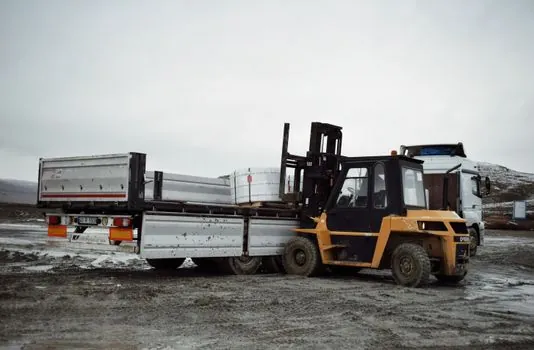
Crane forks convert a loader crane, boom truck, or mechanics truck into a one-shot pallet stacker substitute at the trailer, useful on sites where no forklift can reach, where the ground is soft, or where the lift must come from above rather than from a ramp [S1][S3][S7].
The trade-off is reach and cycle count. A truck crane with a 30 ft reach and 6,000 lb at-hook chart can place that 6,000 lb at the back of a trailer in a single lift, whereas a forklift needs a clear ramp and 8–12 ft of mast to do the same job, and that is before factoring ground pressure on soft yard surfaces [S3][S6].
Crane forks lose to a dedicated forklift on three metrics: vertical lift height (forklifts routinely stack 15–25 ft, crane forks are bounded by the boom geometry and typically operate below 68 in load-height on the attachment itself), cycle rate (a forklift can run 60–100 pallet moves per hour against roughly 10–20 for a crane on a busy yard), and the ability to drive into a trailer nose-first for a manual pallet jack hand-off at the far end [S3][S6].
Selection Criteria Buyers Actually Use
Three numbers drive a crane-fork buy more than any other: rated capacity, maximum load height, and maximum tine spread, and they should be matched to the heaviest standard pallet on site plus a 15–25% margin rather than to the crane's bare-hook chart [S3][S5].
Rated capacity. Pick a unit whose rating is at least 1.15–1.25 times the heaviest pallet the operation will handle; if the heaviest loaded pallet is 4,800 lb, the 6,000 lb-class self-leveling and adjustable units are the correct band, and a 3,300 lb fixed unit is a code and safety violation waiting to happen [S3][S5].
Maximum load height. The 68 in load-height figure on the KM420-4840-6000-C is the tallest pallet the frame will accept before the backrest starts to clash with the load or the centre of gravity climbs past the fork shoulder; sites that load tall drums or boxed goods need to confirm that figure against the tallest standard SKU [S3].
Maximum tine spread. The 40 in tine spread on the KM420-4840-6000-C sets the outer tine centres; for a standard 48 in GMA pallet the forks must reach past the bottom deck, and for 36 in or 40 in captive pallets an adjustable-stop frame is the cheaper answer [S2][S3][S7].
Frame mass and headroom. Self-leveling frames add 200–400 lb over a fixed frame of the same rating, and that mass subtracts directly from the host crane's net capacity at radius; buyers should request the frame's own weight from the manufacturer and apply it to the host crane's load chart before sizing the lift [S3][S6].
Capacity Derating in Practice: The 25–33% Rule of Thumb

Across the published line, the attachment rating is roughly 25–33% of a typical mid-size truck crane's bare-hook chart at the same radius, because the moment arm of the fork tines and the offset of the load's centre of gravity both consume headroom that the hook does not [S5][S6].
Reading a crane load chart the same way you would for a radius-versus-capacity decision is the right discipline: the chart value at the working radius and boom length is the upper bound, and the fork's own published rating is the lower bound, and the smaller of the two governs the lift, as laid out in the truck crane load-chart reading reference [S3][S5][S6].
Boom-section count and length also feed the derate indirectly: a longer multi-section boom deflects more under load, which tightens the radius at which a given chart value applies, and the telescopic boom length trade-off guide walks through how 3-section versus 5-section versus 7-section rigs change that headroom in practice [S3][S5].
Common Failure Modes and Operator Constraints
The four recurring failure patterns on crane fork lifts are: tine overload from a misread pallet weight, side-load from a load not centred on the tines, boom-side loading from a slewing motion while the load is high, and frame overload from using a fixed frame on a pallet size it was not built for [S2][S3][S6].
Tine overload. Tines are rated as a pair at a stated load centre, and exceeding that load centre by even 4–6 in drops capacity fast; operators should treat the load as concentrated at the actual centre of gravity, not at the geometric centre of the pallet, and the rule is the same one applied to forklifts, where a 5,000 lb forklift at 24 in load centre drops sharply past 30 in reach [S6].
Side-load. A pallet that hangs off one tine by more than the tine's lateral stiffness rating will rack the frame; adjustable-stop units help here because the stop keeps the load square against the backrest, but only if the stop is set to the pallet's actual footprint [S2][S7].
Slewing under load. Rotating the crane with the load high and the boom extended multiplies the moment at the boom head well past static conditions; the chart value at the working radius is for a stationary lift, and operators who slew through the lift without reducing the load are operating outside the chart [S5][S6].
Frame overload. Fixed frames used on a pallet size they were not specced for, or self-leveling frames used without the spring-loaded top arm correctly seated, are the most common field cause of bent tines and cracked backrests; the rated load must be read from the nameplate on the frame, not inferred from the crane's chart [S2][S3][S5].
Standards, Markings, and What to Ask the Vendor
No single industry standard governs crane pallet forks in the way ASME B30.5 governs mobile cranes, so buyers should request the manufacturer's load test certificate, the frame's tare weight, and the rated load centre on the tines before purchase, and confirm those numbers against the host crane's chart at the planned working radius [S1][S3][S5].
For host cranes operating in classified areas or on sites that fall under OSHA 1926.1416–1425 for crane operations, the attachment is treated as part of the crane's lifting system and must be on the crane's capacity chart or a supplemental chart provided by the attachment manufacturer; the absence of that supplemental chart is a red flag, not a paperwork gap [S1][S3].
For buyers comparing an attachment buy against leasing a dedicated electric pallet truck or a stand-alone forklift, the breakeven typically falls between 8 and 14 months on sites that already own a truck crane and load fewer than 30 pallets per shift, and the comparison sharpens further when the yard cannot host a forklift ramp safely [S1][S3][S5][S6].