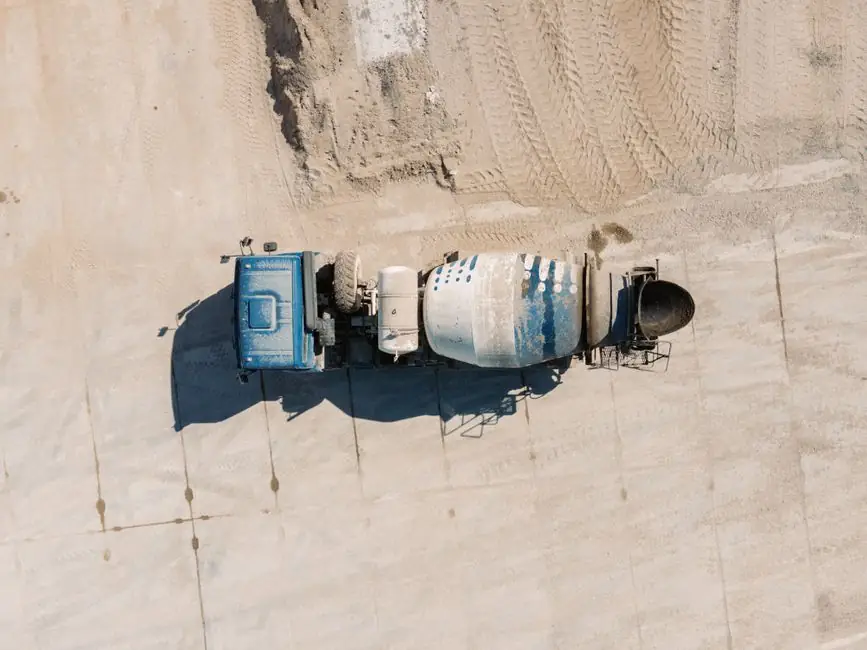
A truck-mounted boom pump needs a minimum 14 ft vertical clearance and at least 10 ft of access width to the setup point, with full outrigger spread commonly consuming 30-45 ft of front/rear width and up to 50 ft of length on larger classes [S1][S2][S4].
Tight urban lots, residential streets, and indoor placements drive selection toward compact boom pumps under 90 ft of vertical reach or trailer-mounted line pumps, which remove most outrigger geometry from the equation but trade away output, capping at roughly 15-50 yd3/hr [S1].
Minimum clearance envelope for a boom pump arrival
A boom pump traveling into a site must clear two separate envelopes: the drive path the truck chassis needs to enter, and the working envelope the outriggers and unfolded boom need to set up [S2][S3]. For a typical boom pump, the drive path requires 14 ft of height clearance and 10 ft of width to the setup point, per Keystone Gun-Krete's day-of checklist [S2].
Once on station, the outrigger box dominates. A small boom pump (under 90 ft reach) can typically set up in a tighter footprint than a 38 m or larger class, and Croft Concrete's reference table pegs the small class at up to ~85 ft vertical reach with 80-130 yd3/hr output, which keeps the truck on a residential street footprint [S1]. Operators should treat any number below 14 ft height or 10 ft width as a hard reject at the scheduling call, because the CPA Good Practice Guide treats site access as a hirer responsibility and lists "access to and egress from the site suitable for the size of the machine" as a baseline obligation [S6].
Outrigger box sizing: how ground footprint scales with boom class
Outrigger spread grows sharply with boom length because the same ground reaction that supports a 100+ ft vertical reach also concentrates point loads at each pad [S4]. Intelligent Concrete's reach guide puts the larger boom pumps at up to 45 ft of front/rear outrigger spacing and 50 ft of total setup length, which is roughly three times the minimum drive path width [S4].
For comparison, the typical working envelopes stack as follows:
Trailer line pump: no outriggers, hose-laid ground-level placement, access path is essentially the tow vehicle plus hose run; best for sites under 20 yd3 and tight gates [S1].
Small boom pump (under 90 ft vertical, 80-130 yd3/hr): compact outrigger box, fits residential streets and most single-lane urban setups [S1].
Mid-size boom pump (~38 m / ~125 ft class, 100-170 yd3/hr, the most common size in U.S. service per Knights Companies): requires a markedly wider outrigger spread and benefits from a 30+ ft radius of clear, level ground [S7].
Large boom pump (120+ ft vertical, 150-200+ yd3/hr, with 50-80 m and 70 m+ super-long classes operating on 7-section Z-fold booms): the full 45 ft x 50 ft box applies, plus strict ground-bearing capacity [S4][S8].
The CPA Good Practice Guide frames this as a hirer planning task: "consideration ought to be given to the optimum concrete placing boom size for site conditions," which the guide ties back to the outrigger footprint and the surrounding exclusion zone [S3]. The article concrete boom pump outrigger span vs boom reach walks through that span-to-reach trade-off in more detail.
Height and overhead hazards: power lines, trees, building eaves
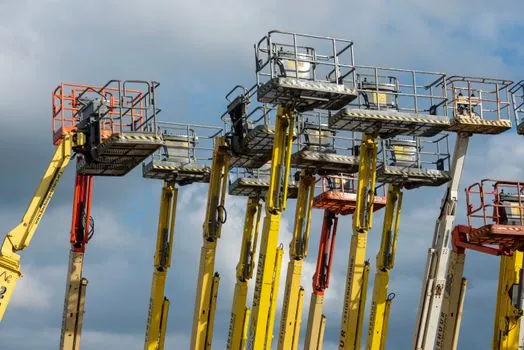
Beyond the 14 ft envelope, the boom's unfolding height and slewing radius introduce a second, larger overhead hazard zone that the 14 ft rule does not cover [S2][S4]. Intelligent Concrete notes that operators must check for overhead wires, tree canopies, and building eaves before unfolding, because the boom tip can easily exceed 100 ft once the arm is extended [S4].
OSHA classifies boom-contact incidents with energized power lines as caught-in/between hazards, and Fleet Rabbit's pre-operation checklist treats the absence of a confirmed overhead power-line clearance as a hard stop on the inspection form [S5]. For pours under or near distribution lines, the practical mitigation is a smaller boom class or a line-pump alternative, since neither option needs a 100 ft steel arm to swing into the pour area [S1].
Ground conditions and pad bearing capacity under each outrigger
Outriggers transfer several tons of point load per pad, and Keystone Gun-Krete flags soft ground, voids, and underground tanks as the most common cause of outrigger sink incidents [S2]. Soil type matters: stone and competent concrete handle standard pads, while peat, clay, and recently backfilled trenches require crane mats, steel plates, or a smaller machine [S2][S4].
For a quantitative anchor, a fully loaded truck-mounted boom pump represents a $300,000-$800,000+ capital asset, and a mid-pour outrigger failure costs $5,000-$25,000+ in cleanup, pipeline replacement, and concrete loss, which is why every inspection record must capture soil type, slope, and weather alongside the standard vehicle data [S5]. The CPA Good Practice Guide assigns the hirer the duty of confirming ground suitability and of providing firm, level pads capable of taking the machine's worst-case reaction, and it treats this as a non-delegable planning input [S3][S6].
Pre-arrival site survey: a checklist a contractor can run in 15 minutes
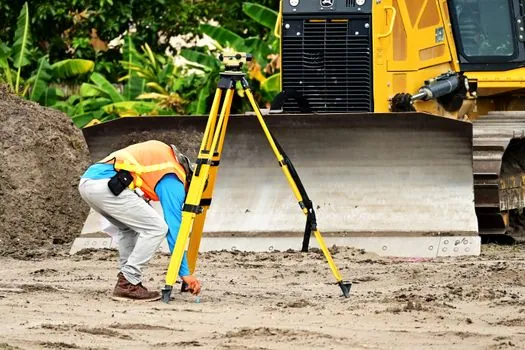
A working site-access checklist, derived from Keystone Gun-Krete's day-of form and the CPA Good Practice Guide's Annex 1 hire checklist, covers six items before the truck rolls [S2][S3]:
1. Drive path: confirm 14 ft vertical clearance and 10+ ft width from the street to the pour point, with no parked vehicles, dumpsters, or low-hanging signage in the lane [S2].
2. Setup box: confirm outrigger span for the booked boom class, allocating the larger of the two envelopes (30+ ft for mid-size, 45 ft x 50 ft for large) and checking that no part of the box crosses a slope, trench, or utility cover [S1][S4].
3. Overhead sweep: walk the unfolded boom radius and mark power-line, tree, and overhang conflicts; treat any line within reach as energized until the utility confirms otherwise [S2][S4].
4. Soil check: identify soft spots, recent fill, and underground utilities; stage crane mats if bearing capacity is uncertain [S2][S4].
5. Hopper access: reserve room for ready-mix trucks to feed the hopper and turn around, since mid-pour truck queuing can stall a 200 yd3/hr placement [S4].
6. Washout and PPE: locate a contained washout area away from drains, and confirm spotters, barricades, and PPE are on site before the boom unfolds [S2][S3].
Limitations and failure modes specific to access planning
Three failure modes show up repeatedly in incident records, and each traces back to a gap in the access survey [S2][S3][S5]. First, an outrigger set up on uncompacted fill or a buried utility trench, where the pad punches through and the boom collapses, an OSHA classified caught-in/between event with a fatality potential [S5]. Second, a boom unfolded into an energized distribution line that the survey missed, typically because the line was behind a tree canopy at drive-in height but inside the unfolded tip radius [S2][S4]. Third, a pump mobilized for a mid-size boom that turns out to need a 50 m+ machine because the placement is on the far side of an obstruction, forcing a partial remix, a second truck, and the resulting $5,000-$25,000+ cleanup cost [S5][S7].
The CPA Good Practice Guide also flags that traveling to and from the site, arrival, setup, pour, and demobilization each carry distinct access requirements, and the hirer must verify all five stages, not just the pour footprint, before the truck is dispatched [S3]. For operations that drop below the boom-pump threshold, the concrete pump truck encyclopedia page summarizes the chassis and boom configurations these access rules apply to.
Standards and sourcing for the access numbers cited above
Several of the figures used here come from operator guidance rather than a single binding standard, and the responsible way to use them is as planning minimums, not as code [S3][S6]. The 14 ft height and 10 ft width numbers originate with Keystone Gun-Krete's published day-of checklist, the 30-45 ft outrigger span figures originate with Intelligent Concrete's reach guide, and the boom-class output ranges originate with Croft Concrete's reference table [S1][S2][S4].
On the regulatory side, the British Concrete Pumping Interest Group's CPA Good Practice Guide "Safe Use of Concrete Pumps" (BCPG 0401, V3 July 2025) is the most current consolidated guidance and assigns site-access responsibility to the hirer; in North America, the Canadian Standards Association's CSA Z-151 "Concrete Pumps and Placing Booms" (published November 2009) is the analogous equipment standard for inspection and annual test regimes, and OSHA's caught-in/between classification covers the failure-mode outcomes in the field [S3][S9]. For hirer-side planning, the Irish Health and Safety Authority's guidance document on concrete pumping reinforces the same hirer obligation to verify access and egress against the machine size [S6]. The truck-mounted concrete pump encyclopedia entry ties these planning rules back to the equipment classes they constrain.
Track these two signals before the next pour: (a) the booked boom class's published outrigger span on the contractor's setup drawing, compared against the surveyed ground box, and (b) the local utility's response time on a power-line clearance request when the unfolded boom radius crosses a distribution line. Both numbers are confirmable in a single pre-pour call.
For the relevant spec sheets and selection criteria, see truck mounted crane.