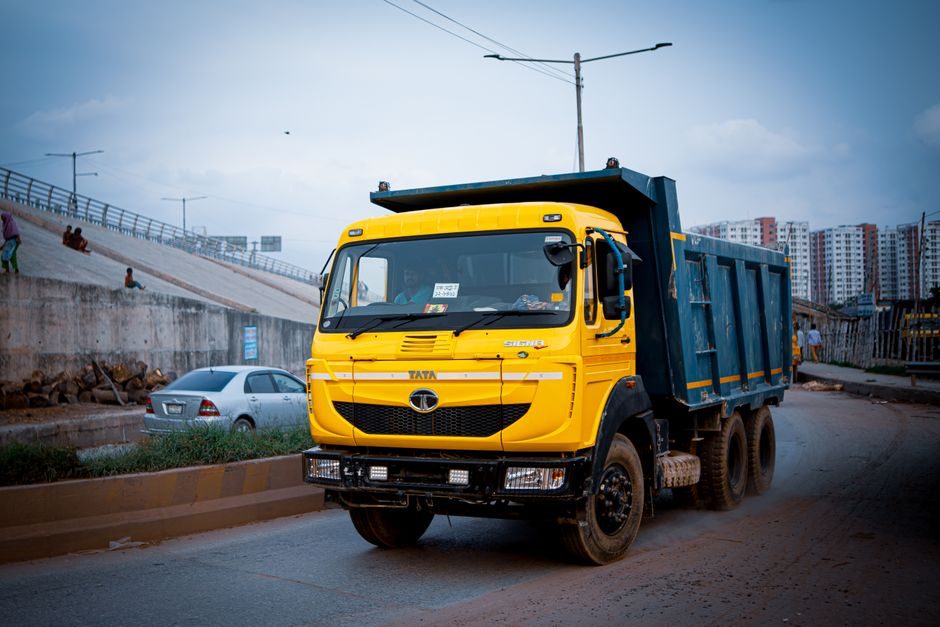
A 2026 truck-mounted concrete pump build is locked in by the spec sheet, not the brand decal: theoretical output in m³/h, concrete pumping pressure in bar, vertical reach in metres, chassis axle configuration, and boom section count together gate every other decision on the order form [S1][S2].
Across the active OEM catalogue, the working envelope runs from 90 m³/h short-boom units on three-axle chassis up to 160 m³/h high-pressure pumps on five-axle carriers, with vertical reach spanning 38 m (5-section) to 56 m (6-section) — for context, the wider concrete pump truck category covers the full boom-length range from 28 m to 86 m+. Selection is therefore not "which brand" but "which envelope fits the pour, the site and the road."
The Five Spec Gates That Actually Decide the Build
Three of the five gates — output, pressure, and reach — are the trio that every truck-mounted concrete pump datasheet opens with, and they are non-negotiable because they describe the physics of the placement problem, not optional features [S1][S2][S5].
Gate 1: theoretical output is rated in m³/h and is tied to the hydraulic pump displacement, the S-pipe changeover cycle, and the diesel engine power band. A 160 m³/h rating such as the CIFA K38L is achieved with a high-displacement open-loop hydraulic circuit driving twin 250 mm delivery cylinders; entry-level three-axle units sit in the 90–120 m³/h band [S1][S5]. Gate 2: concrete pressure, measured at the delivery cylinder outlet, typically runs 53–85 bar in the current catalogue; higher pressure widens the horizontal pumping distance and the vertical lift head but raises boom-pipe wear proportionally [S1][S2]. Gate 3: vertical reach is set by the boom geometry and chassis length, and is the single largest driver of the order price — a 38 m boom on the CIFA K38L is roughly 30–40% cheaper than a 56 m unit like the XCMG HB56 because the longer boom requires a 5–6 section roll-fold design and a heavier five-axle carrier [S1][S4].
Gates 4 and 5 — chassis axle count and boom section count — interact tightly. A 4-section boom typically allows a 3-axle chassis below 36 m vertical reach; any boom over 42 m almost always forces a 4-axle minimum, and 56 m+ units standardise on 5 axles to keep axle-load distribution inside road limits [S2][S4].
Output vs Pressure: The Trade-Off Most Spec Sheets Bury
OEM datasheets quote peak output and peak pressure as if they were independent, but they are coupled by the hydraulic power available from the carrier engine and the pump displacement — pushing one to its limit forces the other down, a constraint that becomes the single most common commissioning problem on site [S1][S2].
The CIFA K38L, for example, is published at 160 m³/h with a 53 bar concrete pressure, a combination that requires roughly 470 kW of available hydraulic power; the same chassis cannot sustain 160 m³/h at 85 bar, and the dealer will quote 85 bar only at derated output around 110–120 m³/h [S1]. A practical decision rule: if a pour needs >70 bar for high-rise pumping (vertical head + line friction above 150 m equivalent), plan on a 15–25% throughput derating from the headline m³/h number, and size the pump one tier above what the raw m³/h alone suggests [S2].
For a deeper cut on the same build, the Concrete Pump Truck 2026: Six Spec Gates That Decide the Build breakdown extends this with placement-rate and pipe-bore gates, and the Concrete Pump Truck vs Dump Truck: Spec Cut, Reach Bands and Fleet Choice piece lines the same reach bands against a dump truck fleet for site-mix logistics.
Chassis, Axle Load and Road-Legal Constraints
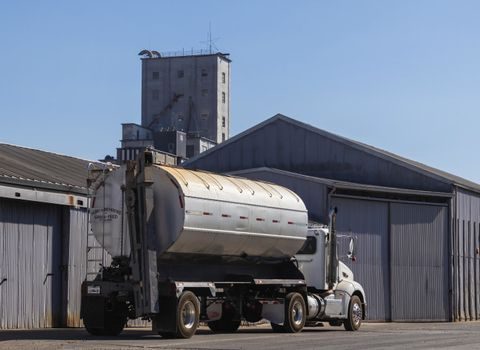
The chassis is not a footnote — it is half the order value, and the axle count, wheelbase, and GVW rating decide whether the unit can legally enter the site and the road network at all [S2][S4].
Current OEM build maps cluster as: 28–38 m boom → 3 axles, total mass 26–32 t; 40–52 m boom → 4 axles, 32–42 t; 56 m+ boom → 5 axles, 42–50 t [S2][S4]. The 5-axle HB56-class units push close to the 50 t EU/road-network limit once the upper boom section, counterweight, and pipeline are factored in, which means any add-on (extra counterweight blocks, larger hopper, on-board water tank) must be re-checked against the chassis GVW certificate before sign-off [S4]. Wheelbase and rear overhang drive site-entry constraints: a 56 m unit typically needs a 14 m × 6 m hard-standing pad for outrigger deployment, against 11 m × 5 m for a 38 m unit [S2].
Boom Geometry and Section Count
Boom section count — 4, 5, or 6 — determines not only the folded length and the deployment envelope, but also the working-radius height under power lines and the minimum unfolded height in a low-bay industrial shed [S1][S4].
5-section roll-fold booms dominate the 38–52 m segment, with the CIFA K38L as a reference 5-section 38 m design and the LP90.18.195DU as a representative 5-section industrial unit at the higher-pressure end of the catalogue [S1][S5]. 6-section booms are required for 56 m+ reach because the extra section lets the boom "elbow" tighter against tall structures, reducing the required tail-swing radius — important on constrained urban sites where a 5-section 52 m unit simply cannot open to its full envelope [S4].
For buyers cross-shopping pump units against raw-material haulers, the Dump Truck vs Truck-Mounted Concrete Pump: 2026 Spec Cut for Site Engineers comparison maps the same axle and payload logic onto a dump truck buy so a fleet manager can sanity-check both line items against the same road-legal envelope.
Selection Criteria by Use Case
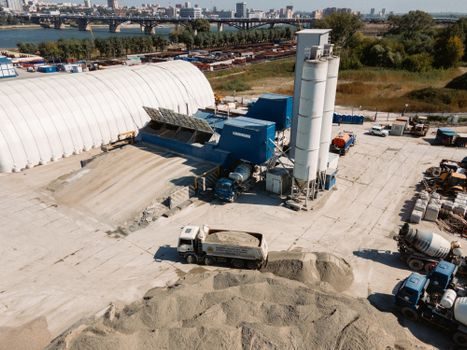
The five gates resolve differently depending on the dominant pour type, and the wrong envelope typically surfaces as either "boom too short, hand-pump the rest" or "output too low, cold joints in the slab" [S1][S2].
For low-rise residential and slab-on-grade pours, a 28–36 m boom, 3-axle chassis, 90–120 m³/h output, and 53 bar pressure is the standard fit; the boom folds inside standard 4 m bridge clearances and the unit drives on a class-B driving licence in most jurisdictions [S1][S2]. For mid-rise commercial and bridge decks, the 42–52 m / 4-axle / 130–150 m³/h tier carries the day, with a 5-section boom balancing reach and folded length [S2][S4]. For high-rise cores, dams, and infrastructure piers, 56 m+ / 5-axle / 150–170 m³/h units with 70–85 bar concrete pressure are the working baseline; these demand the 6-section boom geometry and a chassis at the upper end of the GVW envelope [S1][S4].
Manufacturer and Supply-Side Signals (2026-06-29)
The active supplier base for truck-mounted concrete pumps in mid-2026 is concentrated in three geographies, with distinct product strategies visible on the trade portals [S2][S3][S4].
European OEMs (CIFA as the cited reference) focus on the 38–52 m mid-reach segment with high-pressure circuits — the K38L at 160 m³/h × 53 bar is a representative product of this positioning [S1]. Chinese OEMs (XCMG, SANY, Zoomlion, Lovol, Shantui, and Shandong Honda Construction Machine as a representative supplier entry) cover the full 38–86 m range, with the HB56 as a typical 56 m / 5-axle / 6-section model and aggressive monthly supply capability reported on the B2B portals — a 1,500 PCS/month capability figure has been listed for the LP90.18.195DU through the Okorder platform as of the 2026-04-30 snapshot [S3][S4][S5]. Korean and Japanese presence is thin in the 2026 mid-reach segment on these portals; Liebherr and Putzmeister entries do not appear in the cited result set.
Limitations, Failure Modes and Sourcing Discipline
The most common ways a truck-mounted concrete pump purchase goes wrong in 2026 are not on the datasheet, but in the gap between the datasheet and the delivery ticket [S1][S2].
Three failure modes to plan against: (1) concrete pressure quoted at the cylinder, not at the boom-tip — line losses of 8–15 bar across a full 56 m boom mean the boom-tip pressure is materially below the headline figure; (2) output quoted at zero-piston-load, not at full pipeline head — derate 15–25% as discussed; (3) chassis GVW quoted bare, not in working trim — counterweight + pipeline + water tank can add 6–10 t over the dry-chassis figure, and a 5-axle unit near the 50 t EU limit has no headroom for an oversized hopper or auxiliary compressor [S1][S2]. On sourcing, OEM-direct catalogue pages (CIFA on DirectIndustry, XCMG/SANY/Zoomlion on the China B2B portals) give the cleanest headline specs; trading-platform listings (Okorder) show capability and lead-time signals but should be cross-checked against the OEM datasheet before any spec sign-off, since portal copy often reproduces the model code without the latest derating curves [S1][S2][S5].
Trackable signals for the next 90 days: the next DirectIndustry catalogue update for the K38L and HB56 model families (the 2026-05 snapshots are the most recent cited), and the next Okorder supply-capability posting for the LP90.18.195DU tier (last cited 1,500 PCS/month, 2026-04-30). A material change in either will be the cleanest leading indicator of price, lead-time, and 5-axle availability in the European and Chinese mid-reach segments.