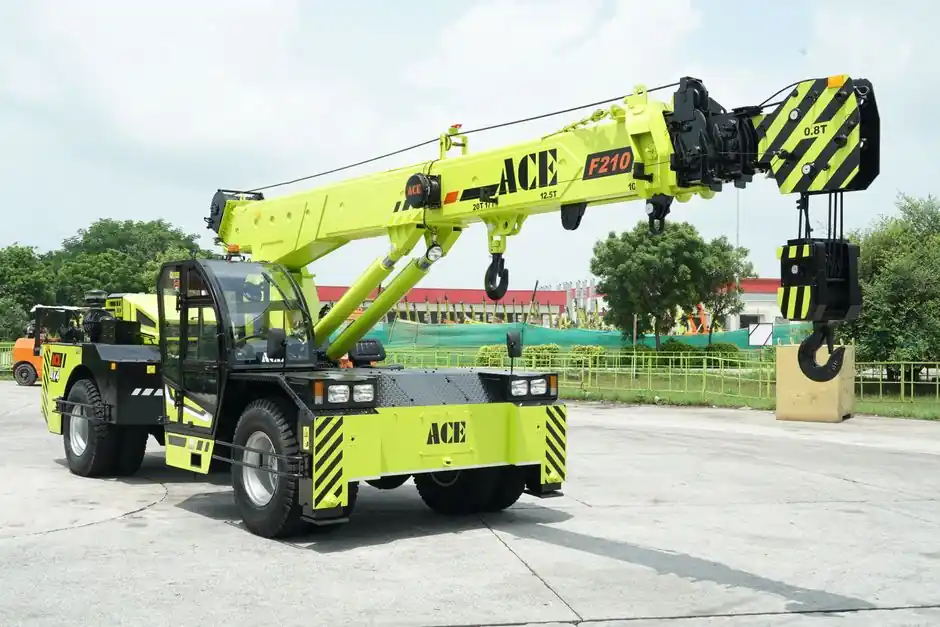
For fleet specifiers weighing a knuckle boom against a straight telescopic boom on a truck chassis, the decision is driven by lift geometry, not raw capacity: knuckle booms fold into tight stow envelopes and reach into low-clearance or over-obstacle positions, while straight telescopic booms use a permanently affixed hydraulic winch to lift vertically and hold suspended loads without drift [S1][S3].
Both designs qualify as truck-mounted cranes and can be installed across a wide chassis range; both still require a dedicated operator's license for that crane class [S1]. The largest knuckle boom models now exceed 300 tons rated capacity and are pitched by manufacturers as direct competitors to mid-size stiff booms [S5], so the old assumption that telescopic equals "more capacity" no longer holds across the board.
Boom Geometry and Stow Footprint on the Chassis
A straight telescopic boom on a truck is essentially a rigid stick extended by nested hydraulic sections, and the boom truck is normally mounted behind the cab with a short tail swing. Knuckle booms, also called articulating, folding, or loader cranes, use two or more boom segments separated by hinge joints that let the arm fold back onto itself for travel [S1][S6]. That folding action is what lets a knuckle boom crane be installed on almost any truck size class, from light-duty bodies to heavy tandem chassis [S1].
For service trucks and mechanics trucks, the knuckle geometry pays off when the operator needs to work off either side of the vehicle: the crane can be center- or rear-mounted, and the articulating arm can reach over the truck body to the curb or street side without repositioning [S2]. Stiff booms typically lock the operator into one working side, which is why most are factory-installed curbside even though some owners prefer streetside tool access [S2].
Lift Mechanics: Hook-at-Tip vs Permanently Affixed Winch
The single biggest functional split between the two designs is how the load is held. A straight telescopic boom truck carries a hydraulic winch permanently mounted to the boom, with wire rope running through the boom tip; the winch, not the lift cylinder, is the primary lifting mechanism, and it carries holding valves so a load can be suspended at height indefinitely without drift [S3]. This is the standard pattern in oil and gas, utilities, and any application where a load must be held at altitude while the crew works [S3].
A knuckle boom crane normally lifts with a hook at the boom tip and uses the extension cylinders plus the lift cylinder to position the load. The trade-off is precise fine placement, where telescopic booms win because the energy path goes winch then lift cylinder, putting less cyclic stress on the boom structure and wear pads [S3]. Over the service life, this is why telescopic boom trucks generally require less maintenance on the boom and extension system than knuckle booms of comparable duty [S3]. For suspended-load holding specifically, knuckle booms are designed for loading and unloading cycles rather than long-duration suspended holding [S3].
Working Height, Reach, and Work Platform Use
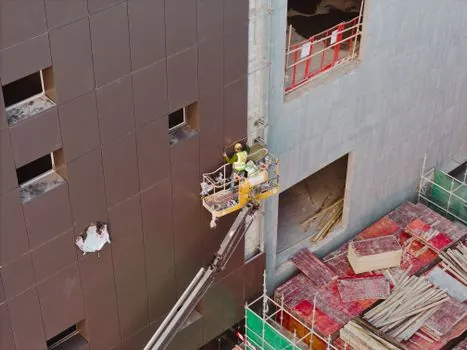
For personnel lifting, straight telescopic boom trucks are the stronger choice by a wide margin. A telescopic boom can be paired with a fixed or telescopic jib extension that adds up to 55 ft of additional reach, pushing total boom length to roughly 201 ft and working height to about 207 ft (65 m) when a work platform is attached [S3]. Articulated cranes in the same class are generally capped near 100 ft of boom length, so they cannot match telescopic units for high-elevation personnel work [S3].
Knuckle booms counter in the other direction. Their articulating geometry excels at horizontal reach and low-headroom lifts, the kind of pattern where you have to feed a load into a building opening, under a bridge deck, or through a service yard with overhead pipe [S1][S4]. For applications like timber handling, electrical equipment placement, and general construction material moves where the load is rarely a clean vertical lift, the knuckle boom's ability to switch tip attachments and change angle mid-cycle is a productivity multiplier [S1].
Operator Controls, Visibility, and Site Footprint
Telescopic boom trucks are usually controlled from either a fixed lower control station with manual or electro-hydraulic levers or via radio remote, with the operator either at the turret or inside an enclosed cab, which maximizes sightlines to the load and the landing zone [S3]. Knuckle booms typically have a side-mounted lower control station on the turret, so the operator stands on the ground next to the crane with reduced visibility during the lift [S3]. On congested utility or service-truck jobs, that visibility delta is a real safety consideration, not just a comfort one.
Site footprint also diverges. A straight telescopic boom wants outriggers set wide and a clear vertical column above the truck, while a knuckle boom can fold into a much tighter envelope, including reaching back over the truck body to work close-in loads that a stiff boom physically cannot access without repositioning the chassis [S1][S2]. Mechanics who service excavator booms and buckets in the field frequently cite the knuckle boom's ability to push pins in and out as a back-saver versus a stiff boom that needs the load placed precisely on the first try [S2].
Decision Matrix: Pick by Job Profile
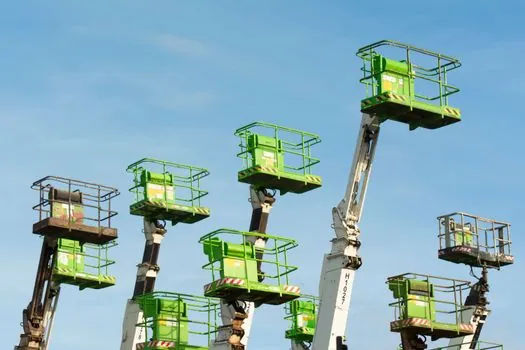
Specify a knuckle boom crane when the work is: load and unload cycles, low-headroom indoor or yard work, mixed tip attachments (grapples, clamps, buckets), tight truck body envelopes, and reach into or over obstacles. Specify a straight telescopic boom truck when the work is: vertical lift over height, sustained suspended load at altitude, personnel lifting in a work platform, fragile precision placement via winch, or any application where you need the boom and jib to reach 100+ ft working height [S1][S3][S5].
Capacity is no longer the discriminator it once was: knuckle booms now span light-duty t-types through super heavy range units exceeding 300 tons rated [S1][S5]. If your spec hinges on the truck-mounted crane class for general lifting service, knuckle is now the default. If your fleet overlaps with utility line work, sign installation, or any wheel loader support role that needs a work platform at height, the telescopic boom still owns that segment. For mixed fleets that include dump truck and backhoe loader service routes, the knuckle boom's flexibility usually pays back faster in reduced repositioning time, even with the higher boom-side maintenance cadence [S3].
Standards, Licensing, and Spec Verification
Both crane types require a dedicated operator's license for that crane class, and chassis selection should be cross-checked against the crane manufacturer's load chart and the truck's gross vehicle weight rating after the crane, body, and expected payload are deducted [S1]. For personnel-lift work platforms on telescopic booms, working height ratings near 207 ft (65 m) are achievable with a jib but must be confirmed against the specific OEM load chart, since adding the platform changes the rigging configuration [S3].
When writing the spec, request the OEM duty classification (light, medium, heavy, super heavy range), the rated capacity at minimum and maximum radius, the number of boom sections, the winch line pull and rope diameter for telescopic units, the available tip attachments for knuckle units, and the documented maintenance intervals for boom extension cylinders and wear pads, which is where knuckle booms accumulate most of their service cost versus telescopic units [S3]. For chassis pairing, treat the knuckle or telescopic crane as a system with the truck: outrigger spread, counterweight, and rear overhang all flow from the same load-chart math covered in outrigger span and counterweight layout, and the trade-off between three-section and seven-section telescopic booms directly affects stow length and reach, as detailed in telescopic boom length vs section count.