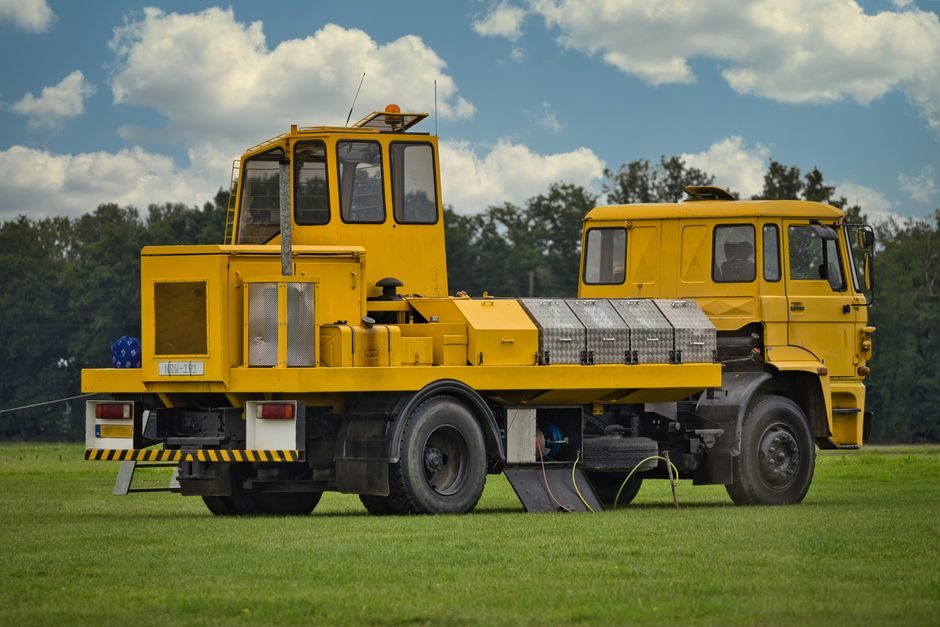
A truck-mounted concrete pump is a concrete placing system built onto a heavy-duty truck chassis, combining a boom, piston pumping kit, and outriggers in one road-legal package; current models deliver 90-190 m³/h output at 53-85 bar pressure [S1].
The format contrasts with stationary line pumps and with separate concrete pump truck and concrete mixer truck fleets: the boom and piston are self-contained on one carrier, so a single operator drives, sets outriggers, and pumps. Five major manufacturers (SANY, XCMG, SCHWING, Putzmeister, CIFA) dominate 16 of the latest catalog listings, with XCMG and SCHWING each showing 9 and 2 product lines respectively [S1].
Core Specifications: Output, Pressure, and Boom Reach
The current commercial spec envelope for a truck-mounted concrete pump spans 90 m³/h to 190 m³/h theoretical output, with 53-85 bar concrete pressure, paired with 4- or 5-section Z-folding or roll-folding booms between roughly 20 m and 56 m vertical reach [S1][S4]. SCHWING's M56-5 leads the high-reach end with 190/170/160 m³/h output at 85 bar and 3.0 m stowed width, sized for high-rise and industrial pours [S1]. At the compact end, Putzmeister's M20-4 delivers 150 m³/h at 83 bar with 75 kW (102 hp) hybrid drive, 19.8 m vertical reach, and 16.3 m horizontal reach in a package under 10,000 x 2,500 x 4,000 mm [S3]. CIFA's K38L targets mid-rise with 160 m³/h at 53-80 bar on a 6x4 chassis with 4,750 mm wheelbase [S4]. XCMG's HB52V runs 170 m³/h at 8 MPa (80 bar) with 324 kW prime power, using S-valve hydraulics for stable reversing [S1].
Advantages: Mobility, Set-Up Speed, and Boom Reach
The defining advantage of a truck-mounted concrete pump is that the carrier, boom, and pumping kit are one self-propelled unit, so transit-to-pour time is dominated by highway speed rather than by crane rigging or pipe-laying [S1]. SCHWING's S 38 SX claims it can "pump where other machines cannot reach" with 6,900-7,300 mm outrigger width and 163/137 m³/h dual-rate output, letting crews pour multi-story decks without adding pipeline [S1]. Putzmeister's M20-4 cuts set-up further with a TRC pedestal, stepless outrigger system, and 3.9 m unfolding height, fitting it into halls, tunnels, and renovation sites where a larger boom cannot deploy [S2][S3]. The hybrid M20-4 also lists the iONTRON electric drive option, reducing on-site diesel runtime and exhaust inside enclosed structures [S3]. XCMG's HB30V and HB52V are factory-matched to dedicated chassis, so the boom, hopper, and S-valve pump share a single hydraulic reservoir and control architecture, simplifying commissioning versus a trailer pump paired with a separate prime mover [S1].
Disadvantages: Weight, Footprint, and Capital Cost

Same-package integration is also the main constraint: the truck-mounted concrete pump has to satisfy axle-load and gross-vehicle rules for road travel, which caps hopper size, boom length, and counterweight on a single chassis [S1]. SCHWING's M56-5 carries 3.0 m stowed width, and the Putzmeister M20-4 still needs 3.8 m support width in standard mode (2.6-3.8 m in iSC mode), so on dense urban sites the outrigger pad plan can still be a deal-breaker [S1][S3]. Power demand is non-trivial: the XCMG HB52V draws 324 kW from the carrier engine, and the SANY SYG5231THBCS 370C-10 uses a SANY-DEUTZ power pack sized for 70-120 m³/h dual-rate pumping at 7-12 MPa, both of which lift fuel use and Tier 4/Stage V aftertreatment cost [S1]. Capital cost is higher than a stationary line pump of equal output because the buyer pays for chassis, boom hydraulics, outriggers, and a road-certified operator seat; SANY alone lists more than 4,000 in-service units in Greater China as a reference installed base, which signals volume but also the procurement scale needed to amortize the asset [S8].
Comparison: Truck-Mounted vs Stationary vs Trailer Pumps
For spec-driven selection, the three formats line up against four decision criteria. Truck-mounted concrete pumps win on mobility and integrated boom (90-190 m³/h, 20-56 m reach, one operator) but lose on per-cubic-meter capital cost and on outrigger footprint versus a stationary line pump [S1][S3]. Stationary line pumps and trailer pumps (such as SCHWING's S 20 at 111 m³/h, 70 bar) are cheaper to buy, can be paired with a separate boom or pipeline, and fit remote sites where no road-going chassis is available, but they need a crane, a towing vehicle, and a pipe-laying crew for every move [S1]. Mixer-truck-mounted pumps such as Putzmeister's M20-4 (hybrid 110/150 m³/h, 78/83 bar) blend a small drum with a compact boom, suiting renovation and shotcrete jobs but capping maximum pour rate below a dedicated boom pump [S2]. The rule of thumb: if the job is high-rise, large-radius industrial, or bridge-deck pours above 100 m³/h, a truck-mounted boom pump is the right tool; if the job is long horizontal runs or repeated pours on a single pad, a stationary or trailer pump is the lower-cost answer [S1][S2].
Selection Criteria: Chassis, Drive, and Boom Geometry
Three parameters govern whether a truck-mounted concrete pump fits a site. First, chassis configuration: the Putzmeister M20-4 mounts on 2-axle or 3-axle Mercedes or Volvo chassis, and CIFA's K38L uses a 6x4 layout with 4,750 mm wheelbase for tight urban turning; the XCMG HB30V and HB52V use factory-matched heavy-duty chassis rather than customer-supplied ones, so spec sheets report carrier power directly (203 kW and 324 kW respectively) [S1][S3][S4]. Second, drive and emissions: diesel is the default, but hybrid and full-electric iONTRON drives are now catalog options on compact-class pumps, which is a procurement choice that depends on indoor ventilation rules and noise limits at the pour site [S2][S3]. Third, boom geometry: Z-folding booms (CIFA K38L) suit low-headroom set-up, roll-folding booms suit higher reach, and the 4-arm ZR boom on the M20-4 keeps unfolding height at 3.9 m, which is a hard constraint when working under existing structures [S2][S3][S4].
Use Cases and Failure Modes on Site
The truck-mounted concrete pump is built for pours where a single setup covers a large footprint: multi-story decks, industrial floors, bridge piers, and tunnel linings. SCHWING's S 38 SX markets directly to warehouse and industrial-building floors where the boom's horizontal reach replaces pipeline [S1]. Putzmeister's M20-4 is positioned for halls, tunnels, renovations, and line jobs with restricted set-up [S2]. The recurring failure modes are boom-fold interference with overhead lines or scaffolding, outrigger sinkage on unprepared ground (mitigated by the M20-4's stepless outrigger and iSC 2.6-3.8 m support width), and hydraulic overheating during sustained 80+ bar piston cycles, which is why closed-loop reversing circuits and reversing-buffer logic are standard on SANY and XCMG units [S1][S3]. Compared to a general dump truck or a reach truck on the same site, the concrete pump adds the requirement for clean water flushing at end-of-pour, a hopper grate to catch oversize aggregate, and a dedicated washout area - all things to budget when planning the pour calendar.
Standards, Sourcing, and Market Signal

Truck-mounted concrete pumps are not governed by a single harmonized product standard, but the carrier chassis, boom hydraulics, and engine emissions fall under regional vehicle and engine rules (such as EU Stage V and US EPA Tier 4 for diesel power packs referenced on XCMG and SANY units, and ECE road-vehicle type approval for chassis configuration) [S1]. Manufacturer data sheets publish output in m³/h and pressure in bar or MPa, with the conversion fixed at 1 MPa = 10 bar - the SANY SYG5231THBCS 370C-10's 7-12 MPa rating is therefore 70-120 bar at the concrete cylinder [S1]. On the supply side, the global truck-mounted concrete pump market is tracked as a sub-segment under "Truck-Mounted Concrete Pumps, Stationary Concrete Pumps, Specialized Concrete Pumps" with a 2025-2034 forecast window, indicating that major OEM directories still treat truck-mounted units as a distinct category from stationary and specialized pumps [S7]. Two trackable signals to watch are (1) the rollout of hybrid and full-electric drive options on compact-class pumps, exemplified by Putzmeister's iONTRON on the M20-4, and (2) the SCHWING historical milestone of the 1957 first 2-cylinder concrete pump, which is the engineering lineage today's M56-5 inherits and which sets the design floor for any replacement boom-pump program [S3][S9].
Background reading: Vibration Meter vs Analyzer: Spec Map, Use Cases, and Selection Logic.