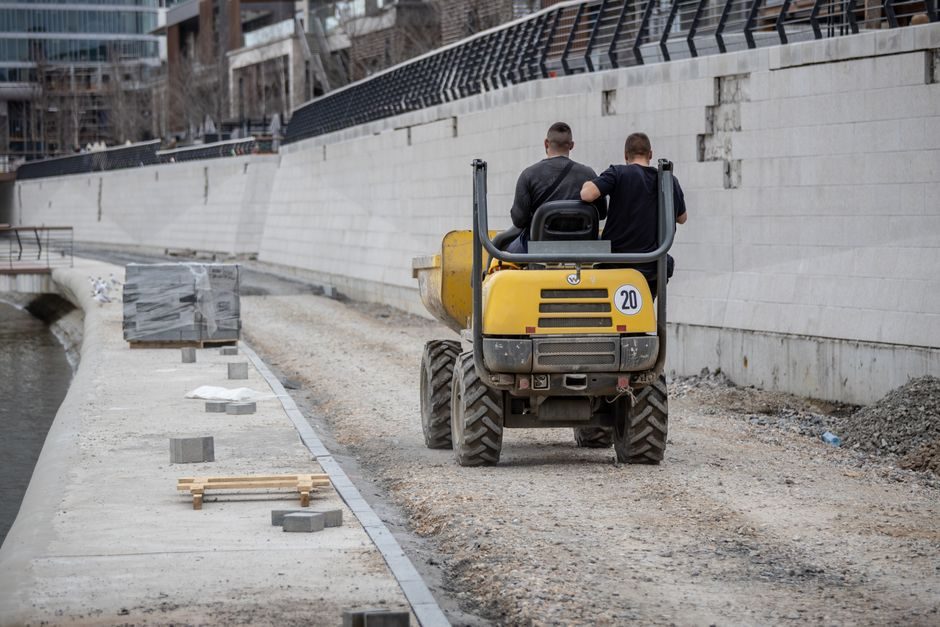
A truck-mounted concrete pump is installed correctly when the outrigger footprint, boom unfolding envelope, and chassis envelope all clear the site before the first cubic metre is poured; the Putzmeister M20-4's 2,500 mm × 10,000 mm × 4,000 mm (W × L × H) envelope and 3.9 m Z-fold unfolding height let it enter hall pours that exclude longer chassis [S1]. Output alone (110-150 m³/h on the M20-4, 90-160 m³/h on the CIFA K24L) does not decide site acceptance [S1][S2].
Across the current catalogue, installation constraints are dominated by 4-section Z- or M-folding booms on 2- to 3-axle chassis, with stepless outrigger systems (Putzmeister TRC pedestal) and open- or closed-circuit pumping units (CIFA K-series) as the dominant variants [S1][S2]. Mid-size 25 m class units such as the AS5190THB25W add 100 m³/h displacement with electrohydraulic boom-vibration damping and X-H outriggers for narrow sites [S3]. The full set of installation parameters on a truck-mounted concrete pump is the only contract that matters between supplier and site.
Outrigger Geometry: Pad Area, Spread, and Load-Bearing Substrate
Stepless outriggers on the Putzmeister M20-4 allow any leg position within the support envelope, which is what enables sub-3.9 m unfolding in restricted halls and tunnels [S1]. The CIFA K24L is specified for small jobsites, underground parkings, basements, and indoor pours where the 4-section boom and adjustable outrigger footprint fit before pumping starts at 70-80 bar [S2]. Sub-base failure under outrigger pads is the dominant cause of boom-pump tip-overs, so verification of pad area, soil bearing capacity, and timber/steel spreader plates is the first acceptance test on every pour. On uneven ground, the X-H shaped outrigger pattern used on units like the AS5190THB25W is explicitly designed for narrow worksites with asymmetric support [S3].
Acceptance criteria: outrigger jacks must lift the chassis tyres clear of the load (no visible deflection under full boom load), level indicators must read within the OEM green band, and each pad must sit on compacted substrate or a rated spreader plate. When the substrate is soft clay, backfill, or recently backfilled trench, the pump is NOT a candidate for in-situ stabilisation — relocate, mat, or refuse the pour.
Boom Unfolding Envelope vs Building Geometry
Boom envelope, not vertical reach, is the controlling installation parameter for indoor and tunnel pours. The Putzmeister M20-4 Z-fold boom unfolds at 3.9 m height, which is the headline spec that lets it work under low-clearance halls where 5-section RZ booms cannot [S1]. CIFA's 4-section K24L boom is positioned for "deep castings, digs, underground parkings and basements" with manoeuvrability in confined headroom [S2]. Where vertical reach matters more than headroom, the XCMG HB56's 55.7 m placing height and 5-section RZ optimised boom are the 56 m class benchmark listed in the current product index [S6].
Acceptance criteria: the swept envelope of the boom (including hose-end whip) must be plotted against the structural opening before the truck is spotted; any clash with steel, glazing, or overhead lines forces a different boom geometry, not a different operator. The relationship between chassis footprint, outrigger spread, and unfolded boom radius is what separates a concrete pump truck that can be installed from one that cannot.
Chassis Selection, Axle Count, and Drive Configuration
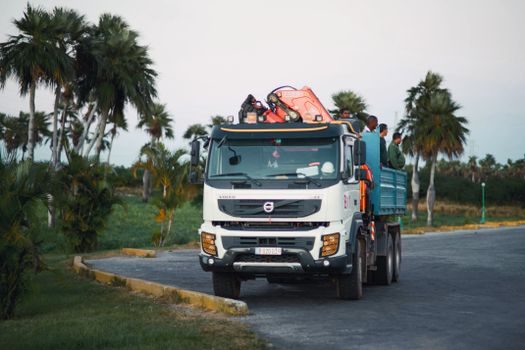
Chassis envelope and axle count set the road-going envelope and therefore the installation envelope. The Putzmeister M20-4 is built around the requirement that "this machine can be operated where no other machine can be set up" — halls, tunnels, renovations, line jobs — and an optional iONTRON hybrid drive is available with a 3-axle chassis [S1]. CIFA K-series truck pumps can be installed on 2- or 3-axle trucks depending on outrigger load and road-regulatory weight, with both open- and closed-circuit pumping units offered on the K24L [S2]. Chinese-market units in the Qingong International and Hongda ranges use heavy-duty FAW JIEFANG chassis with 6-cylinder diesel engines (DEUTZ or domestic alternatives) and an automatic accelerator for fuel economy [S4][S7].
Selection rule: a 2-axle chassis is acceptable on the K24L when the axle load stays inside the road envelope; a 3-axle chassis becomes mandatory on longer booms (M36-4 and up) and on hybrid variants. For jobs where a boom pump cannot be installed at all, a trailer-mounted unit (e.g. the K36L-5 or the trailer pump lines from Foshan Lianjiang) is the documented fallback [S2][S8].
Pumping Circuit, Pressure Selection, and Hydraulic Acceptance
Two hydraulic decisions dominate commissioning. First, open vs closed circuit: the CIFA K24L can be equipped with either, with closed-circuit preferred for high-pressure, continuous-duty pours and open-circuit for boom-dominant, intermittent flows [S2]. Second, pressure range: the M20-4 runs 78-83 bar (1,131-1,204 psi) on its .11H and .15iLS core pumps [S1]; the K24L runs 70-80 bar (1,015-1,160 psi) [S2]. Both ranges cover the standard structural-concrete delivery pressures used in building and infrastructure pours; pressures above 85 bar indicate high-pressure variants used for long horizontal runs or high-rise booms above 50 m class.
Acceptance criteria: the automatic high/low pressure switch-over must be exercised (AS5190THB25W specifies this as a standard feature, with stepless regulation up to 100 m³/h) [S3]. Differential-pressure induction in the open-loop hydraulic system is the diagnostic signal for hose-block or piston-wear conditions; the SANY SYMC controller on the 25 m class surfaces fault type and protection status on a colour graphic display [S3]. The piston auto-retract function (also on the AS5190THB25W) is the field test that confirms the wear-plate and cutting ring are serviceable before the pour [S3]. When piston-side leakage exceeds OEM tolerance during this test, replace the wear parts — do not "manage" with seal adjustment.
Power, Engine Match, and Energy-Saving Logic
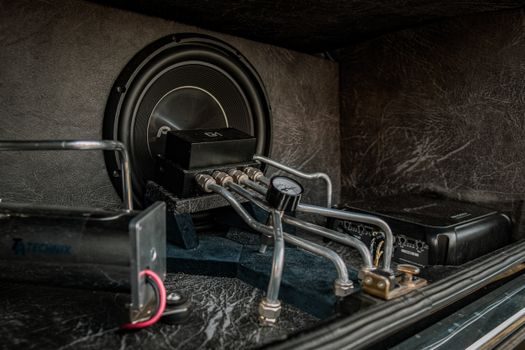
Engine load matching is now a documented OEM feature rather than an operator skill. The AS5190THB25W uses a "computer controlled energy saving technique" to match engine power to pump load, claimed to save 20% oil consumption on average [S3]. Putzmeister's iONTRON hybrid drive (option on the 3-axle M20-4) is the electrified variant for sites that restrict diesel runtime, including indoor and tunnel pours [S1]. Hongda's heavy-duty FAW JIEFANG chassis pairs with DEUTZ or domestic 6-cylinder diesels and an automatic accelerator, balancing horsepower, fuel economy, and reliability [S7].
Acceptance criteria: throttle response must be smooth across the full displacement range (stepless regulation 0-100 m³/h on the 25 m class), and the controller must show stable engine load without hunting at constant pump output. Where site regulations cap diesel runtime, the iONTRON hybrid is the only currently documented alternative drive on a production truck-mounted boom pump [S1]. For comparison, the broader concrete mixer truck driveline discussion sits in a separate article — drum rotation and pump hydraulics share the engine but follow different acceptance tests.
Controls, Safety, and Commissioning Sequence
Putzmeister's Ergonic 3 control is the documented control system on the current M-series, and the AS5190THB25W uses the SANY SYMC controller with anti-tilting control as standard [S1][S3]. The CIFA K-series emphasises structural boom design — "each section was designed to have maximum structural resistance, reducing to a minimum areas subject to stress" — which is the OEM's structural acceptance claim for the boom before any site test [S2]. Electrohydraulic buffer, differential pressure induction, and full-hydraulic directional control are the published sub-systems on the 25 m class, with the OEM claiming small directional-control impact and high reliability from this layout [S3].
Commissioning sequence that holds across the product range: (1) outrigger pad and level check, (2) boom unfold at low pressure with no concrete, (3) prime the system with grout/slurry, (4) confirm automatic switch-over between high and low pressure, (5) verify the auto-retract of concrete pistons (the field test for wear-plate condition) [S3]. If any step fails, the installation is incomplete — return to outrigger step rather than press on. Refusing a pour on commissioning failure is cheaper than replacing a tipped boom. For spec-driven selection beyond installation, the concrete pump truck pros, cons, and spec-driven selection page covers the broader comparison set.
Standards, Sourcing, and When to Walk Away from an Installation
No single harmonised international installation standard for truck-mounted concrete pumps is named in the public product data, so installation must follow the OEM's own pedestal, outrigger, and commissioning manual — Putzmeister, CIFA, SANY, XCMG, Zoomlion, and Hongda each publish their own sequence [S1][S2][S3][S5][S6][S7]. Component standards do appear at the wear-parts level: replacement seal kits (Putzmeister BRF/PM/NIIGATA lines, Schwing BP2 family, CIFA DN178/200/230/250), cleaning balls in 2"-8" natural rubber, and high-manganese-steel boom elbows are the documented consumables used during commissioning and routine maintenance [S3].
Walk-away conditions: outrigger pad on uncompacted fill without engineered matting, boom envelope clash with structure, no documented OEM manual on site, no slope/level indicator reading within OEM green band, or piston auto-retract test that fails on the first cycle. Each of these is an "escalate or replace the pump" trigger — none of them is a "manage on site" condition. Track the next two signals: (a) any new Putzmeister Ergonic 3 firmware revision that changes the auto-retract acceptance test, and (b) the 2027 Intermat CIFA booth (21-24 April 2027, Paris) where K-series updates are scheduled to be shown [S2].