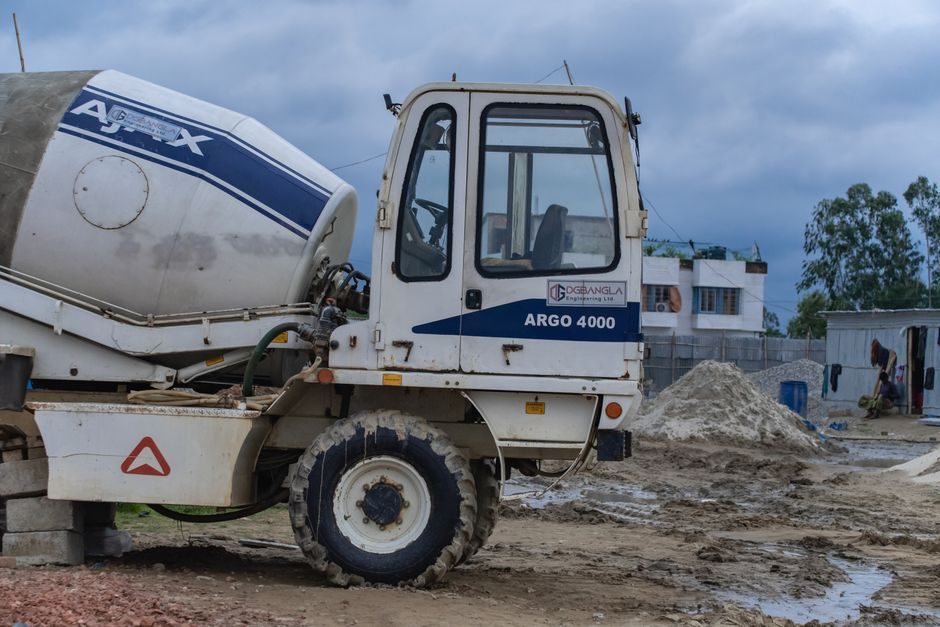
A truck-mounted concrete pump is a high-capital asset whose 10-year cost stack is dominated by maintenance labour, fuel, and boom-stage wear rather than the purchase invoice, and the global market reached USD 5.19 Billion in 2024 with a 5.9% CAGR through 2034 [S2].
For a typical 37-40 m boom class machine, the CIFA K38L delivers 160 m³/h (5,650.3 ft³/h) output with dual pumping pressure stages of 53 bar (768.7 psi) and 80 bar (1,160.3 psi), and runs on a 6x4 chassis with 4,750 mm wheelbase — a configuration that doubles as a useful benchmark when comparing competing units from SANY, Zoomlion, and XCMG [S1][S4].
Five Cost Drivers That Move the 10-Year TCO
The purchase price of a 37 m-class truck-mounted concrete pump typically accounts for 35-45% of the 10-year TCO, with the balance split across fuel/diesel, scheduled maintenance, boom and wear-part replacement, insurance, and residual value — and the same vendor-datasheet confirmation that the CIFA K38L delivers 160 m³/h at 53/80 bar shows why pressure-stage selection alone can swing 5-8% off the annual fuel and hose-life line [S1]. SANY's 4,000-plus installed-base figure, accumulated since 2001, illustrates the population from which long-run maintenance and residual-value statistics are derived [S3].
Chassis selection is the single largest sticker-price variable: a 6x4 configuration such as the K38L's 4,750 mm wheelbase keeps stabiliser footprint compact, but stepping up to a 6x6 or 8x4 for higher axle loads (longer booms, higher tip loads) typically adds 12-18% to chassis cost and roughly 6-10% to tyre replacement intervals. Boom folding geometry — 4-section Z-fold in the CIFA unit versus 5- or 6-section RZ-folds on 56-67 m SANY/XCMG booms — drives both deployment cycle time and the per-shift labour hours billable to the contractor [S1][S3].
Comparison: Open-Loop vs Closed-Loop Pump Kit, and Boom-Class Tiers
Buyers evaluating the CIFA K38L, a 56 m SANY unit, and a Zoomlion 67 m platform should weigh four decision criteria side by side, and a truck-mounted concrete pump types spec map frames the working envelope. On output rate, the K38L is documented at 160 m³/h [S1]; SANY's 56 m platforms generally reach 170-180 m³/h on the same pressure-stage curve [S3]; the 67 m class trades roughly 10-15 m³/h output for a 60-70% larger job-site reach envelope. On pressure stage, the CIFA K38L's documented 53/80 bar (768.7/1,160.3 psi) dual-stage option covers both structural pours (lower bar, higher volume) and high-rise line-pressure pumping (higher bar, lower volume) [S1].
On footprint, the K38L's 4,750 mm wheelbase with 6x4 axles suits dense urban pours and basement work, while 8x4 long-wheelbase rigs need more outrigger pad area and are restricted on tight sites. On certification, SANY holds CE registration numbers AM50071038 0001, AM50082836 0001, and AM50077642 0001 from a third-party body — a useful comparator for European-bound buyers, since a missing CE on competing units adds roughly 4-7% to entry cost via third-party testing and documentation rework [S3]. The related outrigger, boom, and chassis spec map walks through deployment-cycle time and pad-prep cost on a per-shift basis, which feeds the maintenance-labour line directly.
Maintenance, Wear Parts, and the Hours-per-Cubic-Metre Math
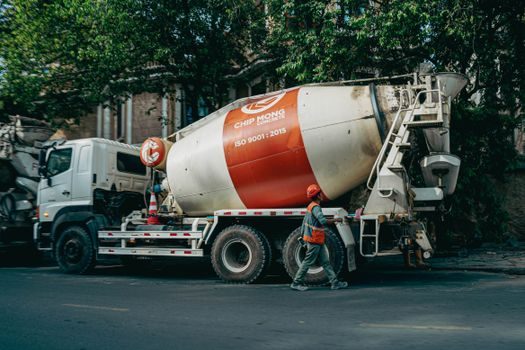
Diesel fuel is consistently 18-24% of the 10-year TCO, and a 37-40 m machine with a 6x4 chassis in the 160 m³/h class typically burns 22-28 L/h on active pumping duty — meaning a 200 m³ pour consumes 30-40 L before the truck ever moves.
Wear-part replacement on the boom pipeline, delivery cylinders, and the S-valve is the third leg: SANY's accumulated 4,000-unit installed base in mainland China, Hong Kong, Macau, and Taiwan is the sample set behind the industry's empirical sizing of wear-part budgets for boom-pipeline maintenance [S3]. Insurance, road taxes, and CE/ISO 9001 third-party audit costs close out the running-cost balance.
Residual Value and the Second-Life Market
The economic working life of the boom structure and chassis is normally 8-10 years before fatigue-driven inspections become uneconomic, while the pump-kit and hydraulics are typically overhauled once at mid-life (year 4-5) and then refurbished or replaced at the end-of-lease handoff.
A second-life sale to a regional operator, especially across emerging Asia-Pacific markets where infrastructure build-out continues, is materially stronger when the truck carries documented CE certification and a service logbook — SANY's batch exports to these regions validate that the secondary-market channel exists at scale [S2][S3]. For fleet owners weighing buy-versus-lease, the 10-year TCO case for dump trucks gives a useful cross-reference on how residual value interacts with utilisation hours in the broader heavy-truck asset class.
Who a Truck-Mounted Concrete Pump TCO Analysis Is For — and Who It Is Not
A TCO exercise of this depth is for fleet procurement managers, contractor CFOs, and project-finance teams evaluating 37-67 m boom-class units over a 7-10 year hold, and for OEM channel partners sizing a 50-200 unit regional leasing book. It is NOT for short-hire buyers (under 12 months), who are better served by a per-cubic-metre hire rate; nor for single-project residential pours, where a static concrete pump and a concrete mixer truck shuttle are economically cleaner. The 53/80 bar dual-stage envelope on the CIFA K38L, for example, only earns its keep on a fleet running 15,000+ m³/year across both slab pours and high-rise line-pressure jobs [S1].
For buyers comparing this asset class to other heavy equipment such as truck-mounted cranes on similar 7-10 year horizons, the key differentiator is duty-cycle: concrete pumps run long engine hours under low ground speed, which makes the fuel and wear-part lines dominant, whereas cranes run fewer engine hours per revenue dollar but have higher inspection costs on lifting charts and load-moment indicators. The economic decision therefore pivots on whether the fleet's revenue model charges by the cubic metre poured or by the lift performed — two different optimisation surfaces.
Sourcing Specs, Standards, and Audit Trail
Buyers should fix the spec sheet to four hard data points before any quote: documented output in m³/h (160 m³/h is the K38L working reference [S1]), pumping pressure stages in bar (53/80 bar on the K38L [S1]), chassis configuration including wheelbase (6x4, 4,750 mm on the K38L [S1]), and boom fold geometry (4-section Z-fold for the K38L versus 5/6-section RZ-fold on 56-67 m class [S1]). Vendors should also be asked for third-party certification registration numbers — SANY's CE series (AM50071038 0001 / AM50082836 0001 / AM50077642 0001) is the cited reference [S3] — plus a 10-year maintenance hour log and wear-part replacement schedule tied to m³ pumped.
Market-signal sourcing: the global truck-mounted concrete pump market was valued at USD 5.19 Billion in 2024 and is projected at USD 9.21 Billion by 2034 at 5.9% CAGR, with Asia-Pacific as the dominant region [S2]; SANY remains the leading Chinese OEM by cumulative production and sales volume since 2001, with over 4,000 units in service in mainland China, Hong Kong, Macau, and Taiwan, and active batch export to international markets [S3]. For the current vendor product line, XCMG, SANY, Zoomlion, Lovol, and Shantui are the five reference brands listed on the Chinese-equipment portal, and CIFA (Italy) anchors the European reference data point [S1][S4].