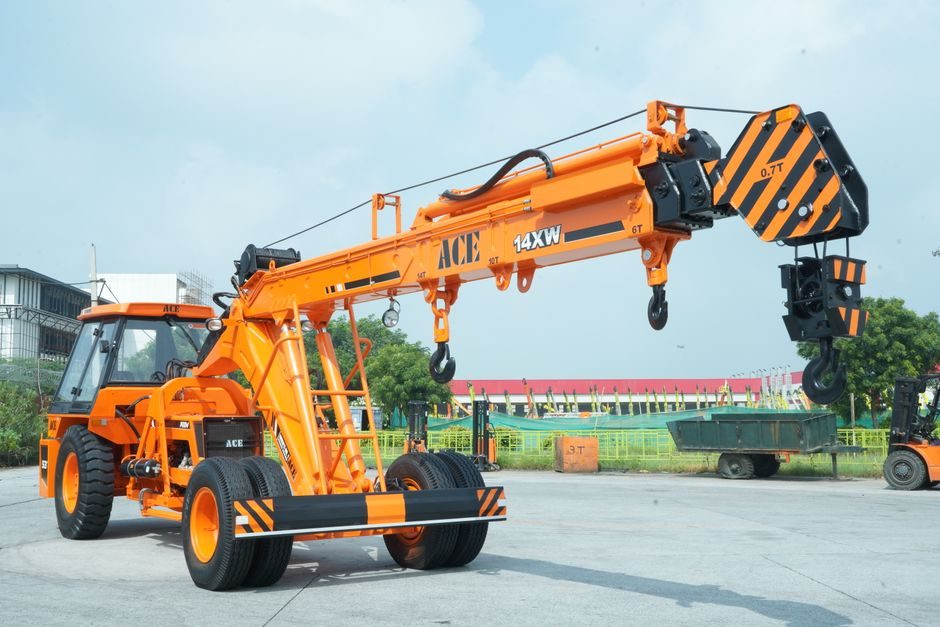
A truck-mounted crane is selected by load, reach, axle count, travel speed, weight and stowage envelope — not by brand. Current OEM data lines up across three operating bands: 14 t class yard units such as the Kesla Z14 CITY with 8.08–10.10 m working height [S2], 17 t class articulating loader cranes like the Hiab iX.188 HIDUO at 15.3–17.9 t capacity [S3], and heavy telescopic 50–250 t machines with 48–70 m booms [S1][S4].
For fleet buyers, the first gate is the licence and road envelope: anything beyond roughly 3 axles and ~26 t GVW in the EU needs national oversize/overmass permits, which immediately pushes the spec conversation toward axle count, drive power and travel speed rather than pure lifting chart. The Liebherr LTC 1050-3.1E, a 3-axle 50 t telescopic, drives at 85 km/h and weighs 7 t in crane mode, illustrating how a high-capacity crane is still road-mobile when axles and total mass are managed [S1].
Load Class and Boom Geometry: 14 t vs 50 t vs 250 t
Load class is set first, then boom type follows. Folding/boom-loader cranes dominate the 1–25 t range because they stow tight against the cab and keep centre of gravity low — the Kesla Z14 CITY and Hiab iX.188 HIDUO both sit in this band, with the Hiab tipping at 15,305.7–17,949.3 kg capacity and 1,946–2,786 kg own weight [S2][S3]. Above roughly 30 t, telescopic booms win on reach and clean rigging: the Liebherr LTC 1050-3.1E delivers 50 t max with a 39 m horizontal reach and 48 m working height on a 3-axle chassis [S1].
For true heavy-lift, 5-axle telescopics like the Tadano AC 5.250-2 take over: 250 t max load, 13.4–70 m working height, 390 kW / 530 hp drive engine, 80 t counterweight — a machine designed for plant and infrastructure erection rather than road transits under load [S4]. The numeric gap between a 14 t yard crane and a 250 t heavy-lift is roughly 18×, and that gap dictates the chassis, counterweight and axle conversation before any brand shortlist.
Axle Count, GVW and Road Permits
Axle count is the hinge between capacity and road-legality. A 2-axle rigid truck can carry a 1–16 t loader crane in most jurisdictions without special permits, which is why this class dominates municipal and forestry fleets; Foton's 1–16 t range on a Class II chassis typifies that envelope. Three axles open the door to roughly 30–60 t capacity, with the Liebherr LTC 1050-3.1E showing 3 axles for 50 t and an 85 km/h travel speed — a deliberate balance between crane performance and European road rules [S1].
Five axles and above, as on the Tadano AC 5.250-2, push the unit into heavy haul territory where route surveys, axle-load distribution and escort vehicles are baseline cost items [S4]. Fleet planners should fix axle count from GVW and permit tolerance, then read the OEM load chart — not the marketing brochure — for the residual capacity at full boom and full radius.
Drive, Power and Travel Speed

Drive engine power scales with total mass and axle count. The 50 t Liebherr LTC 1050-3.1E uses 243 kW (330 hp) for an 85 km/h cruise, while the 250 t Tadano AC 5.250-2 needs 390 kW (530 hp) to move a heavier chassis and 80 t counterweight [S1][S4]. The point is not the horsepower figure but the matching of engine output to GVW and duty cycle — under-powered carriers lose time on approach roads and overheat on grades, even if the crane itself is correctly sized.
Electrification is now reaching the upper end of this segment. The Liebherr LTC 1050-3.1E is described as compact, electric, electro-hydraulic in its OEM listing, signalling that emission-controlled sites and indoor/night work are already a design driver, not a future option [S1]. Buyers in low-emission zones should treat the electric drive option as a spec line in itself, not as an afterthought.
Working Height, Reach and Rigging Time
Working height and horizontal reach are the two numbers that determine site fit. The Kesla Z14 CITY's 8,080–10,100 mm working height covers 2–3 storey building work and tight yard lifts [S2]. The Liebherr LTC 1050-3.1E pushes to 48 m working height and 39 m horizontal reach — enough for 10–12 storey steel erection and standard wind-turbine maintenance lifts [S1]. The Tadano AC 5.250-2's 13.4–70 m working envelope covers industrial chimney and bridge-segment work where radius, not just mass, dominates the chart [S4].
Radius matters because load drops sharply as boom extends. Always read the OEM load chart at the radius the job actually needs, not at the minimum-radius sweet spot. Counterweight is the second lever: 80 t on the Tadano 250 t unit illustrates how a 32% counterweight-to-capacity ratio is used to push capacity out to mid-radius [S4].
Stability Control, Hydraulics and Operator Aids
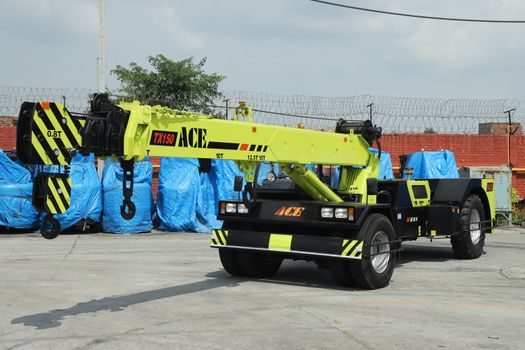
Stability control is no longer optional on loader cranes. Both the Kesla Z14 CITY and Hiab iX.188 HIDUO listings name stability control as a baseline feature on hydraulic loader cranes in the 14–18 t class [S2][S3]. For telescopics, the OEM data here is thinner, but the same pattern holds: outrigger monitoring, load-moment indication and slewing limits are now standard on EU-spec units.
Operator aids — variable-amplitude hydraulics, slewing brakes, and on higher-end models electro-hydraulic control such as that fitted to the Liebherr LTC 1050-3.1E — directly affect rigging time and crew size [S1]. One operator with a load chart and a good LMI can replace a second banksman, which is the kind of saving that should be priced in alongside the crane's purchase cost.
Sizing Comparison Across the Three Bands
Across the three operating bands, the decision criteria line up cleanly. The Kesla Z14 CITY and Hiab iX.188 HIDUO cover urban and forestry work at low cost per lift, with sub-3 t crane mass and 8–18 m booms that fit standard 2-axle trucks [S2][S3]. The Liebherr LTC 1050-3.1E covers 30–50 t class building and energy work with 48 m reach and 85 km/h self-drive capability on 3 axles [S1]. The Tadano AC 5.250-2 covers 100–250 t heavy lift with 70 m working height, 80 t counterweight and 5 axles, at the price of permit and escort overhead [S4].
Buyers who only need a yard loader should not buy a telescopic. Buyers who need to erect steel at 40 m should not buy a folding boom. Match the band, then the model — and use the OEM load chart, not the brochure headline, to confirm the radius you actually lift at. For broader fleet planning across mobile plant, the same axle/GVW logic that governs a truck-mounted crane also drives the spec of an aerial work truck or a dump truck on the same site.
What the Buyer Should Verify Before Signing

Before purchase, three documents carry the most weight: the OEM load chart for the exact chassis-boom-outrigger combination, the national road-permit envelope (axle load, overall length, overall height), and the maintenance package (boom extension cylinder seals, slewing ring, LMI calibration cycle). Current OEM listings from Liebherr, Hiab, Kesla and Tadano all expose load, working height, total weight and power on a single data sheet, which is the minimum a spec engineer should demand [S1][S2][S3][S4].
Track two signals in the coming quarters: the rollout of more electric-drive truck-mounted cranes beyond the Liebherr LTC 1050-3.1E, and any tightening of EU axle-load rules that would shift the 3-axle / 5-axle boundary. Used inventory on the Machinio truck-mounted crane category remains a useful price-band reference when new-unit lead times stretch [S6]. For further reading on adjacent heavy-equipment selection, see this crawler crane sizing and selection field guide and an aerial work platform sizing walkthrough.