
The decision tree runs in this order — duty class (wind/pick-point/travel), max single-pick load, max radius, max hook height, ground pressure, then transport/erect envelope — and any one of those gates can shrink the candidate list from 40 machines to 3 before brand ever enters the picture [S2][S3].
Definition and Scope: What Counts as a Crawler Crane
A crawler crane is a self-propelled crane running on continuous steel tracks (crawler undercarriage) with a lattice or telescopic boom, a superstructure-mounted operator's cab, and a separate counterweight stack [S2]. The defining trait is mobility on soft ground without outriggers: track shoes spread the load over a long footprint, typically giving ground-bearing pressures of 30–100 kPa, which is roughly 4–10× lower than an equivalent-capacity rubber-tyred mobile crane on outrigger pads [S1][S4].
Two boom families dominate the segment. Lattice-boom crawlers (e.g. Manitowoc 14000, Liebherr LR 13000) reach 200–300 m combined boom + jib and dominate wind, petrochem and bridge erection where the lift is high and infrequent. Telescopic-boom crawlers (e.g. Grove GHC55) trade peak height for fast setup and partial-width travel with a load on the hook, suiting utility and commercial work [S3][S5].
Load-Chart Reading: Where Real Capacity Lives
The published load chart is the contract — read the line that matches your reeving (parts of line), boom length, and counterweight configuration before you read the headline tonnage [S2]. A 250-tonne-rated lattice crawler can drop to under 40 t at full radius on its longest boom, and over 80% of the chart varies with the counterweight stack selected, not just the boom angle [S2][S4].
Two technical points decide chart use. First, the slewing moment on flexible ground is non-trivial: published charts assume a level, prepared pad, and slewing-induced dynamic amplification can shave 10–15% off the static value when the machine is on reclaimed or saturated soil, which is the standard case behind the Yang et al. multibody study on slewing stress [S4]. Second, reeving changes the chart block completely: doubling parts of line halves line pull but only works if the hoist drum, boom-head sheave, and block are rated for the higher load class [S2].
Selection Criteria: Five Gates That Cut the List
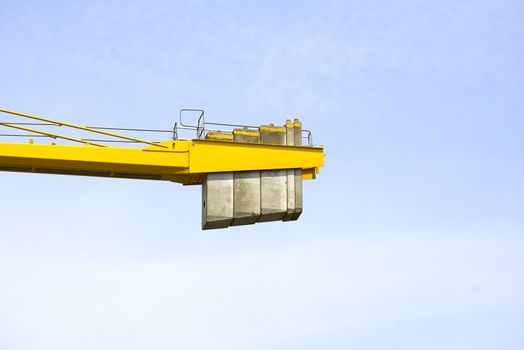
Gate 1 — Max single-pick load at worst radius. Take the heaviest pick, find its radius and height, and read the chart with full counterweight and the longest boom that still meets the height; a 1.25× safety margin on rigging weight is baseline practice [S2][S4]. Gate 2 — Ground-bearing pressure. Sum machine mass + counterweight + pick, divide by the contact area of the track shoes (length × 2 × shoe width); compare to allowable soil kPa from a geotech report, not a guess. Soft-pad solutions (matting, crane mats) are a standard mitigation when the soil class is poor [S1][S4].
Gate 3 — Travel with load. Telescopic crawlers like the Grove GHC55 class can pick-and-carry short distances at low speed on prepared surfaces; lattice crawlers generally cannot [S5]. Gate 4 — Transport envelope. A 300 t lattice can split into truckable 40 t modules; a 1,600 t-class machine needs 60–80 trailers and a heavy-lift logistics plan, and that alone can rule out sites with road or bridge restrictions [S3]. Gate 5 — Wind and environmental rating. Most EU-spec crawlers derate above 20 m/s at boom head; site-specific shutdown limits are normally written into the lift plan, not read off the OEM brochure [S2][S3].
A useful 4-way comparison on the main options for the same ~80 t pick at 20 m radius:
• Lattice boom crawler: lowest ground pressure, highest chart at full radius, slowest to rig (1–2 days).<br/>• Telescopic boom crawler: faster setup, can pick-and-carry, ground pressure higher by 30–50% in like-for-like class.<br/>• All-terrain mobile crane on outriggers: faster road transit, but ground pressure 4–10× higher and needs full matting on soft ground [S1][S2][S3].<br/>• Rough-terrain crane: cheapest to mobilise, lowest chart on long radius, single-pick limits around 50–80 t.
Who It Is For — and Who It Is Not
Crawler cranes are built for heavy single-pick work on unprepared ground: wind turbine erection, petrochem module lifts, bridge girder setting, port and shipyard work, and large infrastructure foundations where outrigger matting would be impractical [S2][S3]. Hire fleets in the UK and Europe concentrate around the 80–750 t lattice class, with telescopic crawlers from 30–120 t covering the commercial and utility segment [S3].
They are the wrong pick when the job is high-cycle indoor work, low-headroom factory lifts, or road-only transit between many short-duration sites — that is the mobile crane or aerial-work-platform envelope, and the comparison is not close on cycle time or mobilisation cost. For smaller mobile lifts at height, a mobile crane or an AWP-class machine is the lower-cost answer, not a 200-tonne crawler.
Limitations and Failure Modes Specifiers Hit

Three failure modes show up again and again. (1) Ground pressure is misread: a 1,200 t crawler on tracks can still exceed allowable soil kPa on weak fill, and track shoes punch through when ground pressure is not checked against the geotech report [S1][S4]. (2) Chart is read at the wrong reeving: an 8-part reeving chart does not apply to a 4-part block, and the actual capacity at radius is roughly half of what was assumed [S2]. (3) Transport and assembly time is underestimated: a 600+ t lattice crawler needs 3–5 days of assembly with an assist crane, which can dominate the project schedule on short contracts [S3].
Slewing on soft ground is its own failure mode: Yang, Qu, Yu and Xie's multibody dynamics study shows that slewing moment on flexible soil can produce boom-base stress transients well above the static chart value, which is why a growing share of operators specify a finite-element or multibody check on critical lifts rather than relying on the OEM chart alone [S4].
Standards and Sourcing Levers
Selection sits on top of four standards families: EN 13000 for crawler and mobile crane design and testing, ASME B30.5 for mobile and locomotive crane operation on the North American side, FEM 1.001 / 1.004 for European duty classification, and EN 16228 for foundation and ground-bearing verification on site [S2][S3]. Lift-plan sign-off, not just machine selection, is where most of these standards bite on a real project.
On supply, the UK and European hire market is dominated by Liebherr, Manitowoc (including Grove and Potain), Sennebogen, and Tadano (including Demag) for the lattice and heavy telescopic classes, with Chinese OEMs (XCMG, Sany, Zoomlion) covering much of the sub-300 t segment — verified across the 2024–2025 dealer and hire listings in [S3] and the [S5] used-equipment index. For used stock, the Grove GHC55 class (55 US-ton telescopic crawler) is one of the most visible entries on the US used market, with 3 units listed in Ohio and Connecticut at the 2025-11 cut-off [S5]. For more on adjacent lifting and access machinery, see the spec-driven picks in marine-grade aerial work platforms and the AWP sizing and selection guide.
Verify the exact load-chart page revision, the counterweight configuration, and the track-shoe width in the OEM's serial-number-specific chart PDF before signing the lift plan — a used machine's chart is the manufacturer's revision tied to its serial number, not a generic brochure figure [S3][S5].
For component-level specifications, see crawler crane.