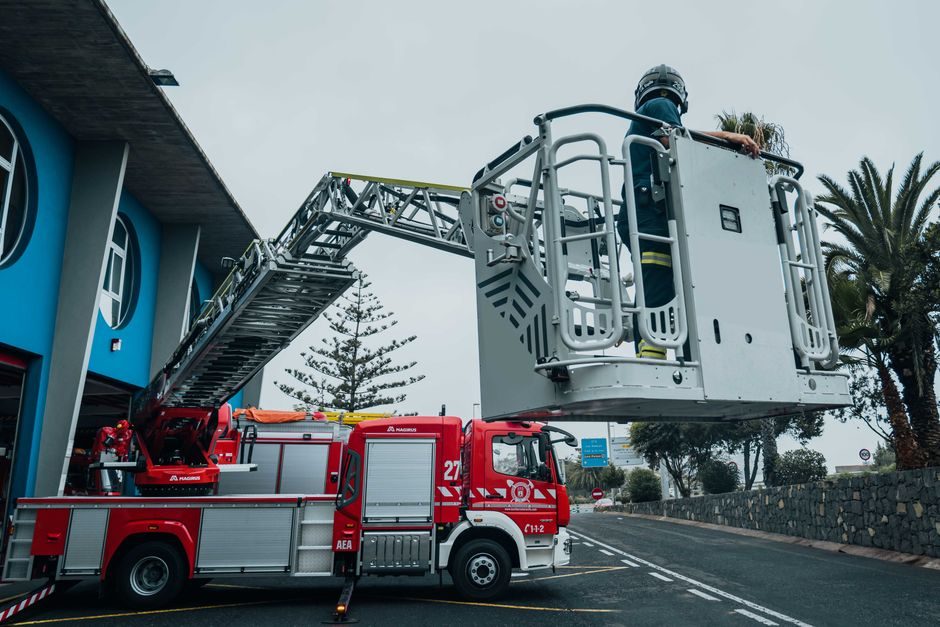
Specifying an aerial work platform starts with four hard numbers — working height, platform capacity, duty cycle and travel surface — and the 2026 supplier map on DirectIndustry lists 43 electric and 16 diesel units across boom, scissor, mast and vertical-mast categories, with the 74 portable models outnumbering 4 fixed-install units by roughly 18-to-1 [S1].
Selecting from that map means filtering on working-height (min to max range), platform load (kg or lb min/max inputs), motor type and application tag (interior, exterior, narrow-aisle, supermarket, agricultural) before any brand or price conversation begins [S1]. Hangzhou Sivge, founded 1995, and Changsha Skyboom Heavy Industry (24 product lines on the index) illustrate the spread between mast-lift specialists and high-reach boom OEMs serving that same spec envelope [S2][S1].
Working height, platform height and the reach envelope
Working height = platform height + roughly 2 m of operator reach, so a 6 m platform floor delivers an 8 m working envelope; 8 m platform = 10 m working; 10 m platform = 12 m working — a linear 1:1+2 m rule consistent across scissor, mast and single-mast aluminum builds [S3].
The DirectIndustry supplier index filters accept a working-height range in metres or feet, letting buyers match a specific lift class to a job envelope without a manual conversion step [S1]. The Sivge single-mast aluminum line, for instance, is engineered so the retracted envelope clears a "common gateway," meaning the stowed height must fit a standard industrial door opening while the elevated position still serves a two-person crew at height [S2][S3]. For a primer on the broader platform family, see the aerial work truck reference entry covering vehicle-mounted boom and bucket variants.
Load, deck size and crew sizing
Platform load is the second filter on the supplier index, entered in kg or lb, and a scissor deck rated 250–500 kg typically accepts two workers plus tools, whereas a single-mast aluminum lift is generally rated for one operator and light material — the Sivge double-worker design explicitly contrasts with single-mast units whose "working stability and load/elevating-height are superior" to the single-mast baseline only in specific duty ranges [S3].
Add 25% margin to the calculated live load (worker mass + tools + materials) before sizing the deck; on a 230 kg rated platform that pushes the design figure to ~290 kg, which is the rule most rental fleets apply before releasing a unit to a two-person crew with a tool bag. Changsha Skyboom's 24 product lines cover this range with multiple deck sizes and load ratings rather than one platform at multiple prices, so buyers who know the required deck load and platform dimensions can shortlist two or three model numbers before the quote stage [S1].
Power source: electric AC/DC, diesel, dual-fuel and manual
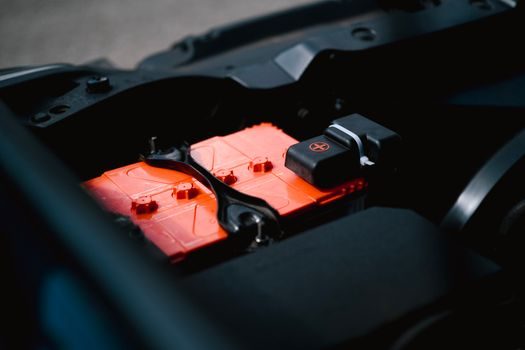
The 2026 supplier index reports 43 electric and 16 diesel aerial platforms, with a smaller hybrid/dual-fuel tail, and the duty environment drives the choice more than price alone [S1]. Electric units are required for indoor, supermarket and narrow-aisle applications — the index tags interior, supermarket and narrow-aisle as distinct use cases for electric drives [S1].
Diesel 4WD boom lifts remain standard for rough-terrain and exterior construction, where the 4-wheel drive, oscillating axle and grade-climb envelope (typically 30–45%) exceed what an electric scissor can deliver on unprepared ground. Single-mast aluminum lifts in the Sivge catalogue use a hydraulic system sourced as original Italian-imported, with an anti-explosion (rupture) valve on the lifting cylinder as the standard safety item — that valve locks the cylinder if a hose fails, holding the platform in place rather than letting it free-fall [S3]. Battery-electric scissor lifts now routinely spec 300+ lift cycles per charge at rated load, and AC drive motors have displaced DC on most new builds, but a buyer who needs three-shift duty should still confirm charger type, battery chemistry (lead-acid vs Li-ion) and the IP rating of the drive electronics before signing.
Terrain, mobility and chassis choice
Portable (towable or push-around) units dominate the 2026 index at 74 models versus 4 fixed units, and the chassis type — manual push, self-propelled, vehicle-mounted or truck-mounted — is the next filter after power [S1].
Self-propelled scissor lifts on solid rough-terrain tires add grade climbing and 4WD, but they also add roughly 1.5–2× the bare-chassis weight of an equivalent electric slab scissor, which matters when the unit has to cross a slab floor rated at a specific axle load. For warehouse duty on smooth concrete, a portable single-mast or vertical-mast lift with a small footprint (often under 1 m × 0.8 m) is the workhorse, while outdoor steel erection or shipyard work calls for an articulating or telescopic boom on a diesel 4WD chassis — those are 13 of the 14 product lines from one Turkish OEM on the 2026 index [S1].
Selection criteria vs platform type: a 4-row compare
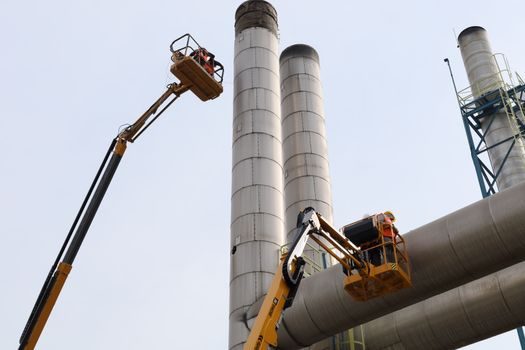
Lining the four main types against working height, typical load, terrain and duty: [S1]
• Vertical mast / single-mast aluminum: 4–12 m working height, 125–230 kg load, smooth indoor slab, 1–2 person light maintenance. Compact stow, low noise, no exhaust — the default inside a finished warehouse [S1][S2][S3].
• Scissor lift (electric slab): 6–14 m working height, 250–500 kg load, smooth indoor/outdoor slab, 2-person crew with tools. The workhorse for new-build fit-out and mechanical/electrical installation [S1].
• Articulating / telescopic boom (diesel 4WD): 10–40+ m working height, 200–450 kg load, rough terrain and outdoor, 1–2 person reach-over work. Dominates construction, shipyard and facade-access work, with 13 telescopic and 4 articulating boom lines in one OEM's catalogue alone [S1].
• Truck-mounted / aerial work truck: 12–30 m working height, 200–400 kg load, road-legal chassis, multi-site utility crews. Bridges the gap between a self-propelled boom and a vehicle fleet — see the aerial work truck reference for chassis, outrigger and stability spec bands.
Standards, safety spec and operator rules
ANSI A92.20 (US), EN 280 (EU) and CSA B354 (Canada) are the three design standards a buyer will see quoted on a nameplate, and most Chinese OEM catalogues (Sivge, Skyboom, Holdwell) are designed to the EN 280 family for export-grade units [S2][S4].
EN 280 covers structural design, stability, load sensing, guardrail height (≥1.1 m), toe-board height (≥0.1 m) and the emergency lowering function, and a unit without a documented EN 280 or ANSI A92.20 build should not be specified for any application where a fall arrest harness is the secondary protection. For complementary floor and material-handling kit around a lift, the platform trolley and platform scale reference pages cover the load and weighing ancillaries commonly specified alongside elevated work.
Failure modes, limits and what to verify at the quote

Three failure modes cause most field incidents: overload (deck load exceeded, often by a second worker added on site), slope exceedance (a unit rated for, say, a 2° static slope deployed on a 4° ramp), and outrigger/spacer misuse on a boom lift. Sivge's anti-explosion valve on the lift cylinder directly addresses the hose-burst failure mode by clamping the cylinder, and buyers should confirm that valve is fitted on any mast or scissor quote where the platform travels above 4 m [S3].
Holdwell's "one-stop" model, covering boom, scissor and vertical-mast new and used, and Sivge's integrated hydraulic system with Italian-sourced valves, are representative of how OEM warranty and parts support are bundled at the quote stage [S4][S3]. Verify at the quote: load-test certificate, EN 280 or ANSI A92.20 build standard, nameplate serial, anti-burst valve on the lift cylinder, battery type and capacity, charger voltage/phase, tire rating, and a written duty-cycle statement from the OEM.
Sourcing reality, lead time and unit economics
The 2026 supplier map clusters strongly around Chinese OEM cities — Hangzhou (Sivge), Changsha (Skyboom) — and a long tail of European and Turkish builders, with the used-rental channel growing on platforms such as Holdwell's new-and-used portal [S2][S1][S4].
For a deeper cross-reference on Chinese OEM sourcing economics, the forklift supplier map breaks down the same factory cluster under a different spec envelope, and the height/terrain/power buyer guide expands on the three-filter decision tree used in the selection rows above. Direct-order lead time on a standard electric scissor from a Chinese OEM typically runs 30–45 days ex-works, with a 20-foot or 40-foot container holding 4–8 units depending on deck size and mast height, and a 30% deposit plus 70% against copy of B/L is the standard payment pattern in 2026.