
A truck-mounted crane is a carrier-truck with a hydraulic loader crane behind the cab or on the rear deck, sized in road-construction fleets from 1 t up to 16 t lift capacity according to Foton truck-crane product data [S6].
Road-building buyers separate the category from a mobile crane: the truck loader crane is rated only to lift on and off its own deck, and the standard driver licence covers operation below the 10 t threshold, with a separate Vehicle Loading Crane high-risk work licence required above it [S1].
Knuckle boom vs stiff boom: which fits which road job
Knuckle-boom truck loader cranes fold into a Z-shape with an articulating outer boom, letting the hook reach over fences, into fourth-storey window openings, or above traffic cones on a live carriageway [S1]. For urban road works where the rig parks on a single lane and feeds barriers, kerbs, or manhole rings, the knuckle-boom profile typically wins on footprint.
Stiff-boom (telescopic) truck loader cranes use a single extending boom with a hook on cable, the same geometry used in vehicle-recovery and many Foton-class 1-16 t builds [S6]; they trade the articulation for longer vertical reach and a cleaner rating chart at full extension. The trade-off is direct: the knuckle-boom reaches around obstacles, the stiff-boom reaches past them.
For most road-construction lifts (concrete pipes, light pole erection, rebar cage handling) the boom-type call is footprint versus reach, not raw capacity.
Capacity, outriggers, and the rating chart the salesman won't show you
Every truck loader crane ships with a load chart, and that chart is the spec, not the headline maximum. A typical published chart drops from a theoretical 5,850 kg at minimum radius with outriggers fully extended to 1,040 kg at full horizontal extension [S1]. Halve the radius, multiply the capacity; extend the boom, divide it. Road crews that ignore this routinely overload the back of the truck.
Outrigger spread is the second gate: most newer truck loader cranes are deployed from a control station on each side of the vehicle, then handed to a remote radio control so the operator can stand clear of the load [S1]. On a road shoulder, half-spread outriggers on loose subgrade cut the chart rating further, which is why crews on asphalt or compacted base have a real spec advantage over crews working on rain-softened formation.
A practical rule from the loader-crane class, not a regulation: the headline 16 t number on a Foton-class stiff-boom is reached only at close radius on fully extended outriggers, which on a live carriageway is rarely the geometry you actually have [S6].
Power take-off, controls, and what the carrier truck actually does
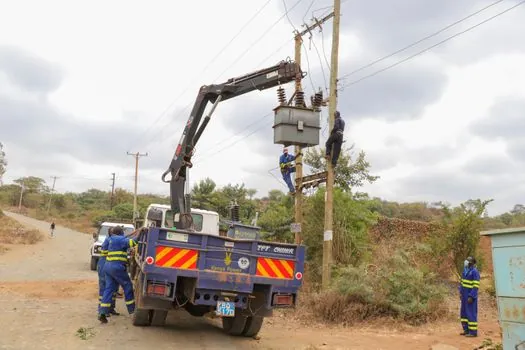
Power flows to the crane through the truck's power take-off (PTO), which means the carrier engine is also the hydraulic source: the loader crane is not a standalone machine, and the chassis spec drives the upper. Slew drives and winch drives for the upper are a known sub-assembly market, with Bonfiglioli publishing a dedicated truck-mounted-crane drive package covering both rotation and lift winches [S3].
Remotes are now standard on most new builds, with the operator able to run all crane functions except outrigger deployment from outside the cab [S1]. That separation of outrigger deploy (manual at the side panel) from lift/slew/luff (radio remote) is the safety pattern road contractors should spec in writing, not assume.
The carrier itself is a 4x2 or 6x4 commercial truck chassis, and Foton-class 1-16 t builds document that the chassis selection, axle count, and tyre rating are part of the lifting system, not separate [S6].
Where road construction actually uses a truck loader crane
Road-building applications line up directly with the standard truck loader crane use-case list: loading materials at site (geotextile rolls, kerb stones, timber formwork), recovering or delivering small plant, lifting concrete pipe sections, augering and standing light poles or sign posts, and inspection of overhead gantries with a personnel cage [S1]. Each of these is a self-load job, which is exactly what the truck loader crane class was designed for.
The category stops making sense when the lift goes beyond the deck, for example setting bridge beams, lifting gensets onto a gantry, or placing large manhole frames; at that point the truck-mounted crane class ends and a mobile or all-terrain crane takes over. Crews that try to use a 10 t loader crane as a beam erector usually lose the chart and the outrigger pad in the same afternoon.
For continuous placement work alongside the paver, a separate road-roller train handles compaction, but the loader crane is the unit that keeps the kerb, pipe, and pole supply moving in front of it.
What to check before you sign the PO
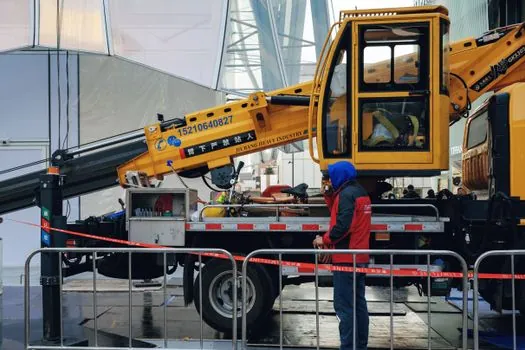
Five gates, in order: (1) max lift at the radius you will actually work at, taken from the chart, not the brochure; (2) outrigger spread required to reach that chart value, and whether the site geometry allows it; (3) PTO type and continuous hydraulic flow the chassis can deliver; (4) operator licence class (under or over 10 t), because above 10 t the operator must hold a Vehicle Loading Crane high-risk work licence unless directly supervised by one [S1]; (5) parts and slew-drive service network for the upper, since the crane supplier is often different from the truck OEM.
For comparison across the common product types: knuckle-boom loaders win on footprint and reach-around for urban road jobs; stiff-boom loaders win on long vertical reach for pole and sign work; telescopic truck cranes such as the Terex all-road product line are a different class, used when lifts exceed the loader-crane envelope and you still need road mobility [S2]. The market splits knuckle-boom and stiff-boom as the two product types within the truck-mounted crane category, with on-road, rough-terrain, and all-terrain as the terrain splits [S5].
Limits, failure modes, and what the standard does not cover
The standard truck loader crane is rated for self-loading only, not for lifting items onto a separate vehicle, scaffold, or structure; using it outside that envelope is the most common path to a tip-over [S1]. Soft formation under the outrigger pads, unlevelled truck, and side-slope parking all reduce the chart value beyond what the operator can read on a slope meter.
Knuckle booms add a second failure mode: articulation joints wear, and a worn knuckle pin can let the outer boom drift under load; this is mechanical, not hydraulic, and the load chart still says nominal. Annual pin inspection is the practical gate, not the hourly meter.
Buyers should also note the licence cut-over at 10 t: the same crane on a different carrier can flip the licence requirement, and contractors who ignore that expose themselves to both the operator and the job site [S1].
Sourcing and where the category is heading
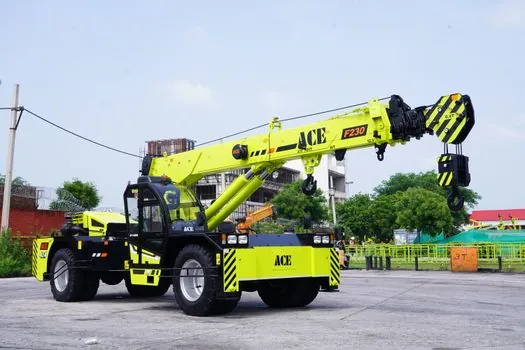
Used Terex truck cranes, including the T-750-class all-road carrier, remain a liquid secondary market for contractors that need road mobility beyond a 16 t loader crane and do not want a full all-terrain crane [S2]. Chinese OEMs including XCMG, Zoomlion, and Foton's in-house loader-crane line continue to populate the 1-16 t loader-crane segment, with Foton's own spec sheet covering municipal, coal-mine, and landscaping applications as standard reference points [S6][S4].
For road-construction buyers comparing adjacent equipment, the truck-mounted concrete pump covers placing work and shares the same carrier-truck logic, while the broader construction tools and dump truck categories set the chassis and hauling context the loader crane rides on. Adjacent selection logic for the larger machine class is laid out in the crawler-crane reference, which applies when the lift escapes the truck loader crane envelope.
Next to watch: any operator-licence rule changes around the 10 t cut-over in the local jurisdiction, and the next loader-crane model releases that move radio-remote to standard across sub-10 t builds rather than optioning it.
For related coverage, see PTFE selection for aerospace seals and bearings: 2026 spec gates.