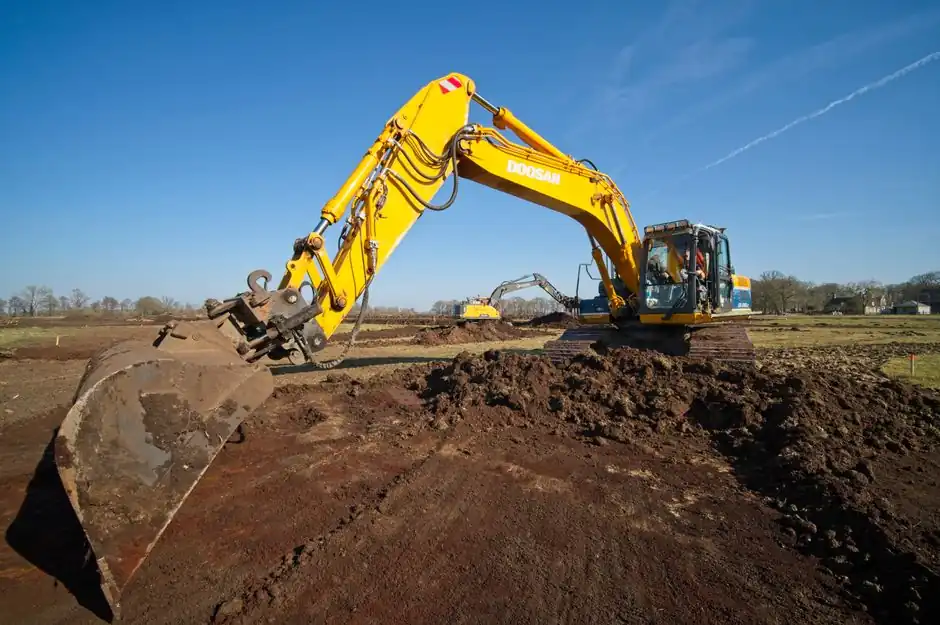
UK hire fleets are supplying telescopic crawler cranes from 25t up to 220t and lattice units from 70t to 300t for winter ground-works, with the smaller telescopic machines increasingly specified for municipal snow-removal and site-clearance contracts where access is tight [S1].
Operator-controlled, rubber-tracked carriers are dominating cold-region selection because ground-bearing pressure of 8–12 kPa (typical for 80t–150t lattice classes) keeps the machine above frozen subgrade without shearing the surface crust, a behaviour that wheeled mobile crane outriggers cannot match on soft snow [S2].
Why Crawler Tracks Outperform Outriggers on Snow and Frozen Subgrade
Track contact length on a 100t lattice machine is typically 4.0–5.2 m per side, distributing the 90–120 t working mass over a continuous footprint rather than the four point loads of an outrigger pad, and a widely cited 8–12 kPa average ground pressure for that class falls well below the ~20 kPa that a comparable wheeled mobile crane imposes through 600 mm outrigger pads [S2].
On frozen ground the engineering concern is the opposite of soft soil: a crawler does not puncture the frost crust because its load is spread over the full track length, and once the spring thaw sets in the same low ground pressure limits rutting on saturated thaw-weakened subgrade [S1][S2]. Snow density of 100–400 kg/m³ is lower than most soils but yields a smaller friction coefficient (≈0.15–0.30 for packed snow) so the track's 1.4–1.8 m shoe width becomes the limiting factor for lateral stability on side slopes, not the outrigger capacity of a wheeled rival [S2].
Size Class vs Snow-Removal Duty: 25t Telescopic to 300t Lattice
Selection in cold-region snow work maps to lift class as follows. 25–80t telescopic units handle single-axle snow-blower attachment lifts, sign-gantry service, and plough-blade changeout in lanes 3–4 m wide where the boom can be retracted to a 9.5–12 m transport length to fit municipal depot doors [S1].
70–150t lattice units are the workhorse for clearing rail-yard snow-piles (where single-event lifts run 8–20 t per bucket of compacted snow) and for handling ice-breaker attachments weighing 4–6 t at 14–18 m radius [S2]. The 220–300t lattice class is reserved for dam-spillway access jobs, ski-resort lift-tower erection in deep winter, and emergency replacement of collapsed roof structures where 40–60 t at 30 m radius is the working envelope, a duty cycle similar to civil-infrastructure piling but with cold-soil splice restrictions on boom pinning [S1][S2].
Cold-Start Package and Hydraulic Fluid Selection Below -20°C
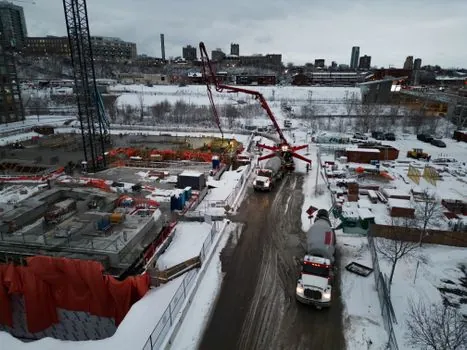
Three engineering items separate a generic fleet machine from a snow-rated one: engine cold-start rated to -30°C with block heaters and synthetic SAE 0W-30 crankcase oil, hydraulic fluid in the ISO VG 22–32 winter grade (replacing the ISO VG 46 summer fill), and grease change to a synthetic lithium-complex NLGI #1 rated to -40°C [S2].
Track-chain tension must be re-set after the first 10 operating hours once the undercarriage warms; a chain that runs correctly at +20°C will be over-tensioned and bind at -25°C because the steel track contracts roughly 11 mm per 10 m of length across a 60°C swing, and that thermal contraction is what cracks pin bosses on machines that skip the cold-soak pre-checks [S1]. The lattice-boom pin-spreading tool in the cab tool-kit must include cold-rated impact sockets (typically -40°C Charpy) because standard Cr-V sockets become brittle below -20°C and have been documented to shatter when used to free a frozen boom-pin [S2].
Ground Pressure, Matting, and Side-Slope Limits
Working slope on packed snow should be capped at 8–10° for telescopic machines and 5–7° for lattice machines with full boom extended, because the centre of gravity of a lattice unit with a 36 m main boom and 18 m jib sits 4.5–5.5 m above the tracks, well above the ~3.0 m CG of a telescopic in retracted configuration, and any cross-slope beyond 5° requires the operator to slew uphill before each lift, not after [S2].
For operations on river-ice or on ski-lake ice, hire firms in the UK and Northern Europe pair a 100t lattice crawler crane with 2.0–2.4 m timber mat bog-mats under each track to spread the load across a 6 m² footprint, taking the contact pressure below 20 kPa and meeting the working-ice capacity rule that ice must be ≥300 mm of clear blue ice (not white ice) for a 90 t machine [S1][S2]. A similar matting logic shows up in the spec gates used for landfill crawler crane work, where the ground pressure envelope is the controlling variable, not the chart capacity. Where the duty is actually pipeline trenching through snow-covered right-of-way, the pipeline-construction selection logic applies because the lift envelope is more constrained than the ground-pressure envelope.
Operator Certification and Site-Specific Winter Controls
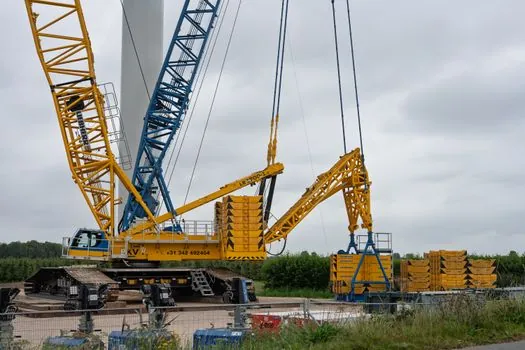
Hire providers running CPCS-accredited operators in cold-region contracts require a documented cold-weather familiarisation pass that covers the cold-start sequence, the undercarriage warm-up cycle, and the boom-pin freeze-check, on top of the standard A64 CPCS crawler crane above-10t endorsement that UK sites demand [S1].
A spec that consistently gets missed in procurement documents is the requirement for an enclosed, heated cab with positive-pressure ventilation, because at -20°C operators otherwise cannot keep the front glazing clear enough to see the load line, and the typical 4–6 kW diesel-fired cab heater draws enough fuel that the machine's 8 h cold-weather fuel tank (about 400 L) becomes a hard limit, not the engine's 12 h duty cycle [S2]. For municipal depot work where the lift envelope is smaller but the access envelope is tight, the urban-infrastructure selection logic applies because pick-and-carry radius and street-width are the constraints, not the chart capacity.
Standards, Inspection Intervals, and What to Write Into the Rental Contract
The relevant inspection regime in a 2026 UK winter contract is the thorough examination at 12-month intervals or after 8,000 operating hours (whichever is first) under LOLER for the lifting function, plus manufacturer-recommended cold-weather service items, and a daily pre-use check that records ambient temperature, track tension, hydraulic-fluid temperature after warm-up, and any ice build-up on the boom heel pin [S1].
Three clauses that should be in the hire order: (1) confirmation of -30°C cold-start package and winter-grade hydraulic fluid, with documented fluid grade printed on the machine data plate, (2) provision of timber or composite bog-mats sized to keep ground pressure at or below 20 kPa on the actual subgrade, not the design assumption, and (3) operator CPCS card plus cold-weather familiarisation record delivered before site mobilisation, not on day one of the lift [S1][S2]. Cross-check these against a port-and-terminal spec sheet if the unit is also being considered for quay-side winter stockpile clearance, because the corrosion and tidal-ice criteria in that selection gate are more demanding than a pure snow-removal contract, and the two duties should not be silently merged into a single hire order.
Track the next 60–90 days for: hire-fleet announcements of 25–80t telescopic units with factory-fitted -30°C kits entering UK and Nordic depots, and any 2026 revision of LOLER thorough-examination intervals that changes the 12-month cadence for cold-region-only machines; the standard revision date has not been published as of August 2026 and should not be cited as scheduled.
For the relevant spec sheets and selection criteria, see crane scale.