Pipeline-spread crawler cranes in 2026 cluster in three capacity bands, 80-150 t, 200-300 t, and 300-360 t, with lattice booms of 64-86 m and tracked ground-bearing pressure held below 1.0 kg/cm² on timber matting or bog mats [S1][S3].
Pipeline right-of-way work is the dominant duty for 80-150 t machines, while 200-300 t units handle mainline valve stations, hot-tap tees, and river/road crossings, and 300-360 t units cover compressor-station module lifts and HDD pull-back operations [S3][S4].
Pipeline spread vs. station work: which capacity band fits the scope
On linear mainline spreads, the working lift envelope is 18-32 t at 12-18 m radius for 36-48 in. pipe handling, sucker-rod bails, and sideboom tractor support, a duty well inside a 100 t-class crawler crane such as the Sany SCC1000A-6 (100 t max, 64 m boom, 396 t·m max moment) [S3].
Compressor and pump-station work shifts the envelope to 80-180 t at 8-14 m for packaged-module sets, prefabricated headers, and pig-launcher barrels, which is where 200-300 t lattice crawlers like the SCC2000A-2 (200 t max, 85 m boom, 1152 t·m moment) and SCC3200A-2 (320 t max, 86 m boom, 1820 t·m moment) are specified [S3]. Selection logic is radius-first: at 12 m the SCC3200A-2 still lifts roughly 2.0-2.4× the SCC1000A-6, so the larger machine is mandatory when module weights exceed about 140 t at full station footprint [S3].
Ground-bearing pressure, matting, and tracked undercarriage width
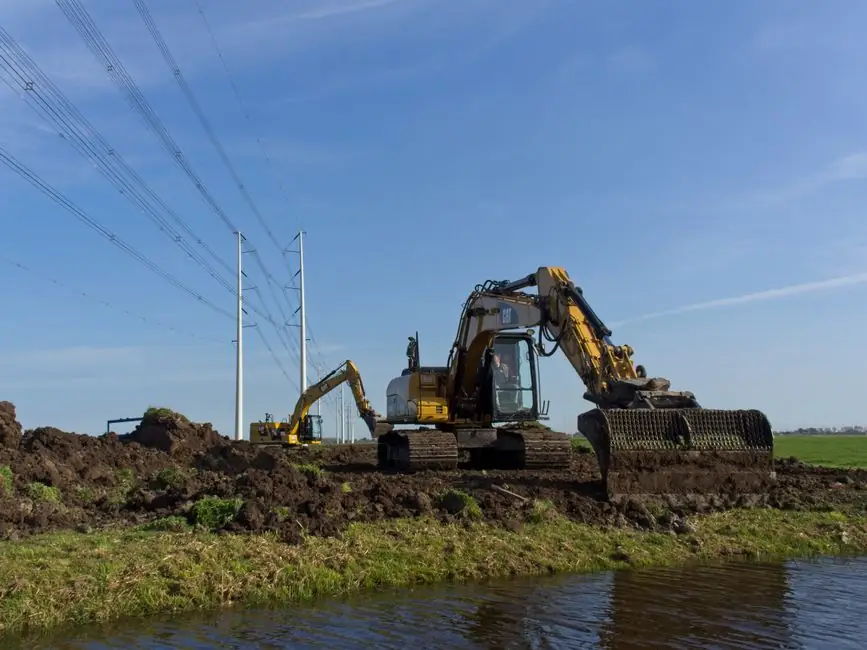
Pipeline rights-of-way run through saturated topsoil, muskeg, clay, and river-bend approaches that commonly deliver 0.4-0.6 kg/cm² bearing capacity, so the crane's nominal ground-bearing pressure must be cut with bog mats, crane mats, or 8-12 in. laminated timber pads to stay under roughly 1.0 kg/cm² [S1][S5].
Standard 80-150 t crawlers sit near 0.9-1.1 kg/cm² barefoot, while 300 t-class units climb to 1.3-1.6 kg/cm², which is why wide-tracked variants and 3.5 m boom-base extensions (such as the Manitowoc MLC650 3.5 m boom attachment) are spec'd for soft-right-of-way work [S1]. Without engineered matting, the crawler crane will punch through the right-of-way subgrade, which is the single most common cause of pipeline-spread crane tip-overs [S5].
Boom reach, jib, and lattice inserts for lift planning
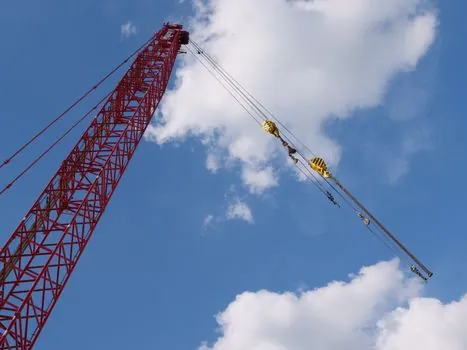
Mainline valve assemblies, meter skids, and launcher/receiver barrels are typically set at 14-22 m radius, while 56-66 in. mainline hot-tap tees can push the lift to 24-30 m, so a 64-86 m main boom is the standard fitment across all three capacity bands surveyed [S3].
Fixed jibs of 12-36 m extend the working envelope for flare-stack erection, vertical pipe-rack modules, and tank-shell lifts, and modular boom inserts (Manitowoc's Wide Boom Plus kit, luffing-jib attachments, and VPC-MAX configurations) let a single machine cover both 100 t and 300 t duty cycles on a multi-station project [S1].
Over-water and elevated-trestle pipeline duty
When a pipeline crosses open water or a tidal flat, the cranes must first build the access trestle that they then travel on, a duty that requires the same two machines to walk 1,000-1,500 ft over freshly driven pile caps without losing level [S1].
Trestle-loaded lifts demand a wider track frame (3.5-4.5 m), reduced pick weights, and strict 1°-per-30 m longitudinal-level limits, with operators required to re-level the machine on every new bent before slewing [S1]. The 275 t Liebherr LR 1250.1 and 331 t LR 1300.1 SX units, both 2022-2023 fleet acquisitions for the U.S. crane-rental market, are the workhorses for this duty class [S1]. For spec work that crosses into adjacent lifts and pile-driving, the construction tools feed at the project yard is sized off the same crane-class data.
Manoeuvrability, transport, and right-of-way drive-through
Each spread move covers 30-80 km of right-of-way per day, so cranes must self-load onto lowboy trailers in 4-6 axle-line configurations without disassembly, with the heaviest single-lift component (boom base, upperworks, or carbody) capped at 36-42 t to stay inside standard 12-13 t/axle road limits [S3].
Self-erect times of 30-45 minutes, hydraulic track-width adjustment, and removable counterweight slabs are the three features that separate a pipeline-rated crane from a generic mobile crane on the spec sheet [S3]. The 100-150 t class dominates mainline work because it can drive through 6 m corridor pinch-points, where a 300 t lattice unit needs 9-12 m of cleared lane and additional clearing crews [S3].
Standards, safety gates, and pre-lift inspection
Pre-operational checks cover engine, brakes, hydraulic systems, and tracks before every shift, with load-chart re-verification per ASME B30.5 for every radius and configuration, and a 2-block, anti-two-block, and load-moment-indicator (LMI) test on every assembly [S5].
Operator certification per NCCCO (or the regional equivalent) plus continuous training on radius-versus-weight planning is the human-factor gate: a heavier load always needs a smaller radius, and exceeding the charted envelope is the second leading cause of pipeline-spread tip-overs [S5]. Wind limits of 35-45 km/h for lifts and 20-30 km/h for walking, plus lightning stand-down within 10 km, are the field-standard stop-work triggers in 2026 spread manuals [S5].
Vendor landscape, used-fleet pricing, and 2026 sourcing signals

For example, a 2018 Sany SCC1500C (150 t class) sits in the active resale channel, and a 25 t compact crawler crane (Taishan Construction Machinery) lists from a Shandong OEM at the small-project end of the market [S8][S9]. For quarry-side and heavy-lift cross-spec work that often shares a fleet with pipeline spreads, the crawler crane selection for quarrying: 2026 spec gates article provides a parallel data set, while HDD pipe-pull planning overlaps with the data center steel pipe selection: spec gates for 2026 builds data on large-diameter line-pipe specifications.
Track the Liebherr LR 1300.1 SX and Manitowoc MLC300 VPC-MAX fleet additions by the ALL Family of Companies and Quality Cranes LLC through 2026 Q4 for current U.S. Gulf Coast spread availability, and watch for new Sany SCC-series OEM stock rotation on Juyi International's 318-listing crawler crane inventory as a leading indicator of 100-200 t pipeline spread pricing in the secondary market [S1][S2][S3].