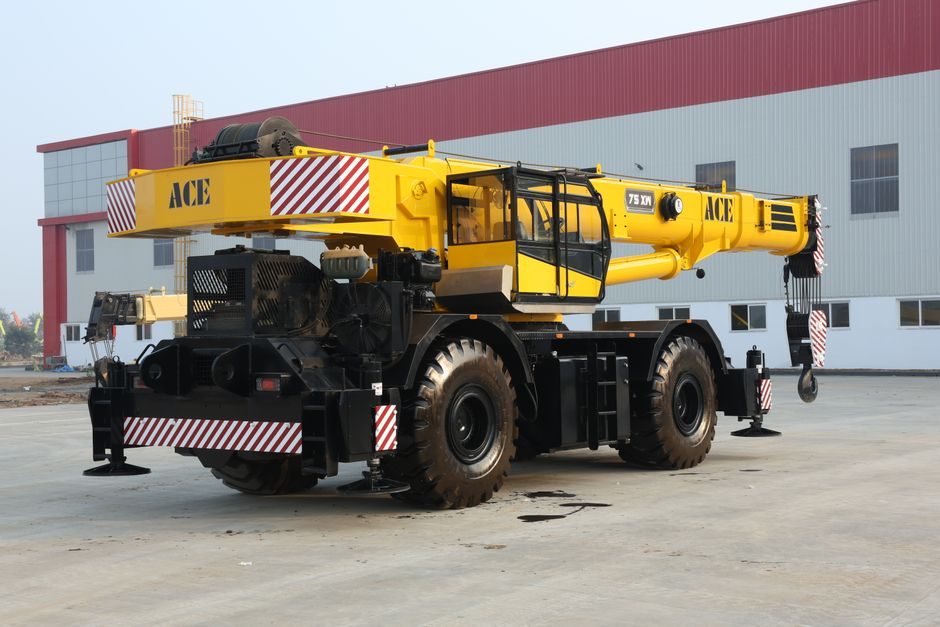
Three supply tiers define the 2026 truck-mounted crane market: Chinese OEM clusters covering roughly 3-12 t capacities at landed prices from US$5,000 to US$20,000 per unit, Indian fabricators quoting 5-50 t lifting capacity with 10-40 m boom length and 360° continuous slewing, and European premium makers — led by Tadano Faun GmbH with 21 active truck-mounted crane model lines on its manufacturer profile — holding the higher-capacity and all-terrain segment [S1][S2][S4].
The unit ships as a carrier chassis plus a hydraulic loader crane; lifting capacities span 1 t on the lightest Foton-based utility builds up to 50 t on Indian-engineered units, with slewing rotation almost universally 360° continuous and engine power ratings from 80 hp at the bottom end to 250 hp+ on heavier 3-axle and 4-axle carriers [S4][S10]. For background on the equipment class itself see the truck-mounted crane reference page.
Capacity and Boom-Length Bands You Can Quote to Procurement
Indian supplier data shows a consolidated spec band: lifting capacity 5-50 tons, boom length 10-40 m, jib extension 3-15 m, lifting speed 0-60 m/min, with 360° continuous slewing as the default rather than a cost option [S4]. The same listings group applications by load-capacity class — 10-15 t, 15-20 t and 20-25 t — confirming the typical procurement cut-points used by mid-size contractors and rental fleets [S4].
Chinese telescopic-boom models cluster at 3.2 t, 5 t, 8 t and 12 t, the four capacity steps most commonly listed as featured products by Xuzhou-based BOB-LIFT, while folding-boom (knuckle) models from the same supplier family cover the 5-8 t urban-delivery segment [S3][S5]. On the lightweight end, Foton-chassis utility cranes (福田随车吊) cover 1-16 t and are pitched at municipal works, coal-handling, landscaping and non-disassemblable load transport — the canonical Chinese sub-16 t use-case list [S10].
Manufacturing Cluster Geography and Audit Status
Three Chinese clusters dominate the export catalog: Xuzhou (Jiangsu), Suizhou (Hubei) and Ganzhou (Jiangxi). Xuzhou BOB-LIFT Construction Machinery Co., Ltd. self-describes as a high-tech enterprise covering design, development, manufacture and sales of truck-mounted, marine and pickup cranes [S3]. Hubei Shenbai Special Purpose Vehicle Co., Ltd. (Suizhou) and Ganzhou Jianghuan Car Manufacturing Co., Ltd. (Ganzhou, Shahe Industrial Park) both register as Manufacturer/Factory on Made-in-China, confirming in-house chassis-up builds rather than assembly-only operations [S6][S7].
Export-side due-diligence is uneven: Anhui Tengchang Construction Machinery Co., Ltd. holds Diamond Member and Audited Supplier status with ISO 9001:2015 certification, while several mid-tier listing pages on the same portal show no third-party audit flag, so procurement specs should be cross-checked against an EN 13000 or equivalent crane-standard conformance statement from the mill, not the trading-platform banner [S9]. For broader fleet context — how a dump truck integrates with a truck-crane rig on construction sites — see the related equipment reference.
Price Bands and What You Actually Get for the Money
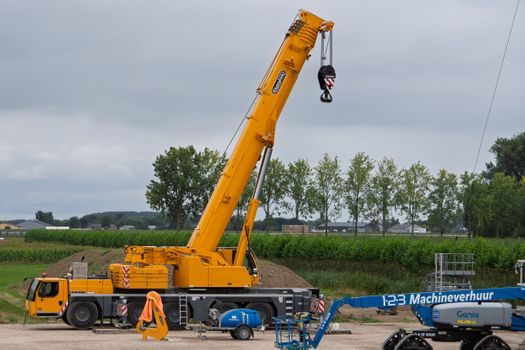
Hard price data from Made-in-China 2026 listings puts the cheapest telescopic 8 t units (SQS200G-4 hydraulic straight-arm mini truck crane) at US$5,000-15,000 with a 1-piece MOQ, and factory-direct folding-boom 5-8 t models at US$19,000-20,000, both FOB China and both with on-platform video verification [S9]. Indian listings use a get-quote model with no posted unit price, reflecting a build-to-order chassis configuration where engine power (80-250 hp) and boom length are sized per RFQ [S4].
European premium pricing is not published on the public profile pages and is sold through dealer channels, but the 21 active model lines on the Tadano Faun GmbH manufacturer page indicate a long-tail catalog covering all-terrain, heavy-duty and special-purpose variants above the 50 t mark where Chinese pricing data thins out [S1]. The price gap between the US$5,000-20,000 Chinese tier and the European premium tier is typically 5-10× at equivalent capacity, driven by load-moment safety margins, slew-bearing quality, outrigger geometry and operator-cab certification rather than raw lifting number.
Specification Comparison: Chinese, Indian and European Tiers
On four procurement criteria, the three tiers split cleanly. (1) Lifting capacity: Chinese telescopic range 3-12 t as standard catalog; Indian range 5-50 t including 20-25 t mid-heavy; European (Tadano Faun) catalog extends well above 50 t into all-terrain and heavy-lift [S1][S3][S4]. (2) Boom configuration: Chinese vendors push telescopic and folding-knuckle as the two product lines; Indian listings show 10-40 m booms with 3-15 m jib extension; European catalog covers lattice, telescopic and special-purpose geometries [S4][S5][S9]. (3) Audit/QA: only some Chinese suppliers carry ISO 9001:2015 and Audited Supplier status, others list none [S9]; Indian listings are unverified on the same portal; European OEMs are CE-marked under EN 13000 for crane safety by default [S1]. (4) Lead time and MOQ: Chinese suppliers offer 1-piece MOQ with on-portal video proof; Indian suppliers operate quote-only with longer build cycles tied to chassis OEM (Tata, Ashok Leyland, BharatBenz); European units are typically 4-9 month factory orders via dealer [S4][S9].
Selection Criteria by Use-Case
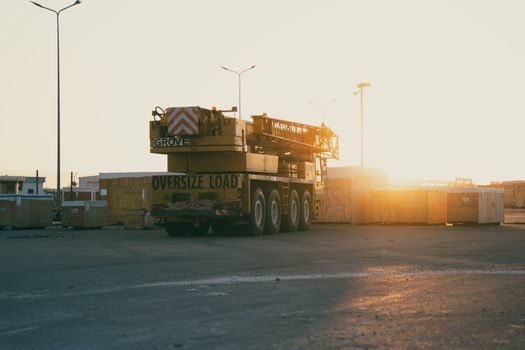
For municipal landscaping, light utility lifts and 1-5 t day-rate work, the Foton-chassis and BOB-LIFT 3.2-5 t telescopic lines are the cost-efficient default, with the Chinese cluster offering factory-direct pricing and a 1-piece MOQ [S5][S10]. For construction-site general lifts in the 10-25 t band, the Indian tier becomes competitive because 360° continuous slewing, 10-40 m boom and 80-250 hp engine power map onto the 3-axle carrier configurations most rental fleets already run [S4]. For aerospace, wind-energy component handling and pulp-and-paper log-yard duty — covered in depth in this truck-mounted crane for pulp and paper spec cut — the Tadano-class all-terrain units with rated load moments in the 80-250 t·m band are the working spec, and Chinese catalog data does not credibly cover that envelope [S1].
Failure Modes and Constraints to Bake Into the RFQ
Three recurring risks show up across the 2026 supplier pages. First, load-moment indicator (LMI) calibration documentation: Chinese factory listings rarely publish the LMI model, EN 13000 conformity statement or the test-load certificate, all of which the European tier ships as standard — request these as a TQR gate before PO. Second, outrigger spread versus chassis width: a 10-40 m boom at 20-25 t capacity needs a 4.5-5.5 m outrigger spread to keep ground-bearing pressure under 80 kPa on typical job-site soils, and this number is rarely on the listing page. Third, slewing-bearing provenance: 360° continuous slewing is universal, but the difference between a domestic Chinese slewing ring and a Liebherr/Schaeffler-grade bearing is the dominant reliability variable over a 10-year service life, and the catalog does not disclose it. For comparison with self-erecting tower-class machines — different equipment but with overlapping chassis and slewing-bearing supply chains — see the crawler crane sizing field guide. [S1]
Standards, Verification and Trackable Sourcing Signals
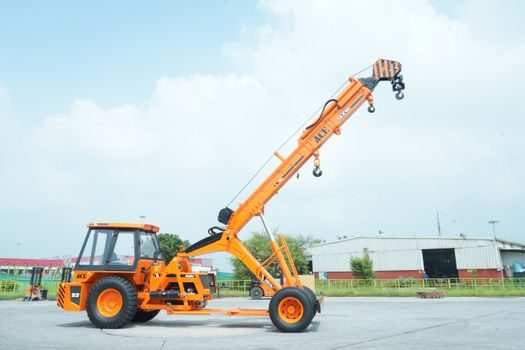
The governing European standard for crane safety on this class is EN 13000, with CE marking under the Machinery Directive; for the truck chassis itself, the applicable frame is ECE R29 (cab strength) and the local axle-load rules of the destination market. Chinese suppliers operating in the audit-supplier tier typically hold ISO 9001:2015, with platform verification via on-site video rather than third-party test certificates [S9]. Trackable signals for the next sourcing cycle: (a) whether Anhui Tengchang and similar Diamond-Member vendors extend their published model count past 8 t telescopic into 12-16 t articulated builds, and (b) whether the Hubei Shenbai and Ganzhou Jianghuan chassis-up factories begin posting EN 13000 or CE declarations on the showroom pages [S6][S7][S9].
The shortest path to a defensible buy order in mid-2026 is to lock capacity and boom geometry first (10 t / 30 m for general construction, 25 t / 40 m for heavy-rental, 50 t+ for all-terrain), then require the LMI model, outrigger spread, slewing-bearing make and EN 13000 / ISO 9001:2015 certificate number on every quote — three of those four items are not on the catalog page and will surface only on a direct RFQ to the named contact at BOB-LIFT, Hubei Shenbai, Ganzhou Jianghuan or the relevant Tadano Faun dealer.
For component-level specifications, see truck mounted concrete pump.