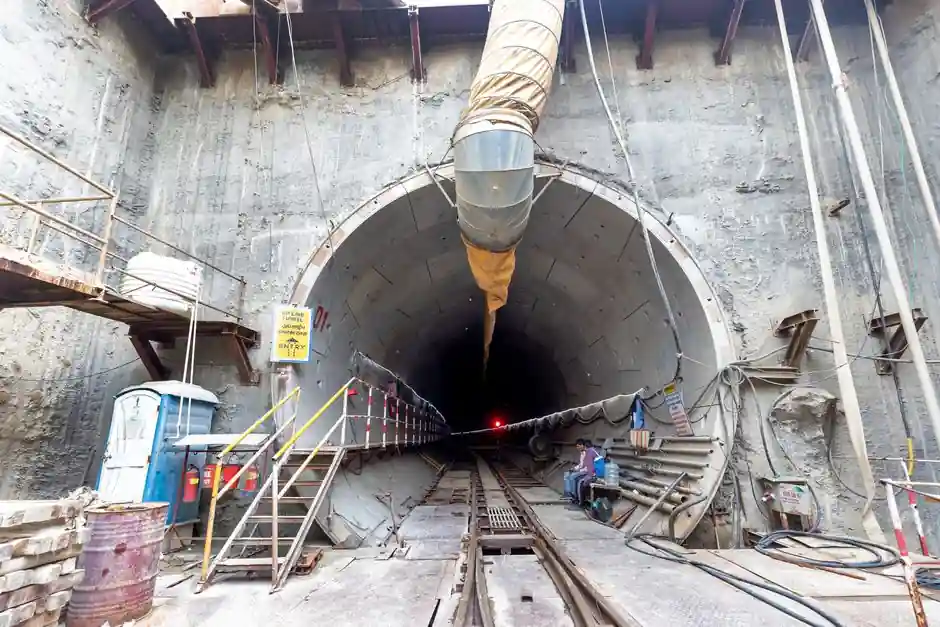
For tunnels in hydropower, railway and highway work, a vehicle-mounted wet-spraying machine on a wheel-loader chassis with a dual-power diesel/electric drive and a two-stage slewing boom is the current best fit, solving the limits of small portable wet-sprayers in long, large headings [S1].
Selection is driven by three gates: concrete pump hydraulic pressure (up to 32 MPa on truck-mounted line pumps, 320 bar in heavy pumping modules) [S2], hose pressure rating versus pipeline length, and the boom reach required to cover the three-bench ring-cut face without dead zones [S1][S2][S3].
Why tunnel work breaks a road-spec concrete pump
Booms that cover a road interchange are not enough inside a tunnel: the face is narrow, the ceiling is low, and a single boom arc leaves uncovered zones on the bench, invert and shoulders [S1].
The wet-spraying truck design responds with a two-stage boom on a movable slewing pillar, giving double slewing, double telescoping and double tilting articulation plus wireless remote control, so the operator can hold flatness and rebound down on a three-bench ring excavation with core soil [S1].
Hydrostatic mechanical transmission on the diesel travel side lets the unit pull up to the face and retreat quickly between cycles, while the electric-driven hydraulic system runs the boom and shotcrete pump on external power with lower vibration and lower noise, important in confined tunnel air [S1].
Hydraulic pump pressure and displacement gates
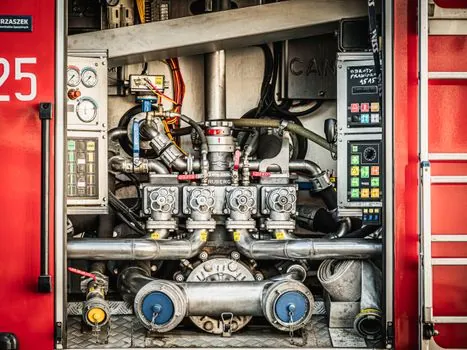
Axial-piston hydraulic pumps dominate modern concrete pump circuits because of their high pressure tolerance, variable displacement and compact envelope, exactly the envelope a long tunnel pipeline demands [S2].
Concrete moves through 100–150 mm delivery lines only if the hydraulic circuit holds system pressure against pipe friction and head; truck-mounted concrete line pumps run hydraulic system pressure up to 32 MPa, and heavy pumping modules reach 320 bar (32 MPa) maximum hydraulic pressure [S2].
Displacement must be matched to output volume: K3V/K5V series axial-piston pumps span 63 to 280 cm³ per revolution, and REED B-Series concrete pumps cover 71 to 180 cc/rev pump output, so engineers pick displacement by the m³/h target at the working pressure point, not by pump nameplate alone [S2].
Wet-spray shotcrete pump sizing for tunnel use
The on-board shotcrete pump on a wet-spraying truck is sized for large volume, large cylinder diameter and long stroke, which directly lowers concrete pulsation and improves adaptability to stiff, accelerator-dosed mixes used in NATM tunnel linings [S1].
Dilute-flow pneumatic conveying lets the machine accept concrete mixtures with relatively low cementitious and admixture dosage, reducing material cost per metre of finished lining [S1].
Accelerator dosing is automatically matched to the concrete volume passing through the pump, which trims accelerator consumption and stabilises early strength on the sprayed layer, a key parameter in tunnel cycling time [S1].
Boom coverage, mobility and control logic
A two-stage boom with a movable slewing pillar covers the three-bench ring excavation method with no dead zones, and the spraying manipulator carries double slewing, double telescoping and double tilting joints plus wireless remote, so the operator can hold flatness and rebound on a curved crown [S1].
Mobility comes from a wheel-loader chassis, with excellent passability on tunnel muck floors and convenient maintenance access for hydraulic and electrical service [S1].
Control is built around an industrial computer with remote-controller primary control and a host electric cabinet as backup; partial intelligence covers automatic vehicle levelling and hydraulic fault diagnosis, which matters when the unit is parked on uneven bench surfaces [S1].
Hose, pipe and delivery-line spec gates
Concrete pump hose selection is its own gate: hose pressure rating, end fitting type, wear-cover spec and bend radius must be matched to the pump’s maximum line pressure and to the chosen pipeline diameter, otherwise hose life collapses inside the first 200 m of bore [S3].
For a tunnel pump truck, single- and twin-wire hydraulic hoses on the boom, plus the concrete delivery hose at the boom tip, are typically specified in matched pressure classes; spec sheets list working pressure, burst pressure, end fitting standard and abrasion cover material so the engineer can verify the hose class against the pump’s 32 MPa circuit [S2][S3].
Installation practice inside a tunnel emphasises clean coupling faces, correct gasket seats on the boom tip reducer, and routing that avoids sharp bends that raise local pressure drop; spec guides explicitly flag incorrect fittings and over-bending as the dominant failure modes for delivery hose in tunnel pumping service [S3].
Decision map: wet-spray truck vs truck-mounted line pump for tunnels
For primary tunnel lining work (NATM shotcrete on the crown, bench and invert in the same cycle), the wet-spraying truck on a wheel-loader chassis with electric-drive shotcrete pump and two-stage slewing boom is the better fit, because it combines placement, mobility and air-quality control in one package [S1].
For long-distance concrete supply behind the face, where the same mix feeds invert segments or mass placements through fixed steel pipe, a truck-mounted concrete pump truck with axial-piston hydraulics at 32 MPa and a separate truck-mounted concrete pump feeding a pipeline is the correct split, with the concrete mixer truck supplying the hopper at the face [S2].
For comparison on a tunnel job: the wet-spraying truck scores on mobility, blind-area-free coverage and lower diesel exhaust inside the heading; the truck-mounted line pump scores on raw delivery distance, steady pressure and pipeline diameter flexibility. Muck haul and segment delivery still need a dump truck on the parallel access adit, separate from the concrete train.
Selection checklist engineers should run before signing the PO
Confirm the boom envelope covers the full three-bench face with no dead zone, with wireless remote and host-cabinet backup control [S1].
Verify the hydraulic pump is an axial-piston unit with displacement and pressure rating matched to the 32 MPa / 320 bar circuit and the target m³/h, not just to engine horsepower [S2].
Check that the shotcrete pump cylinder diameter and stroke support the planned m³/h with accelerator auto-dosing, and that the control system logs hydraulic faults for maintenance [S1].
Cross-check the concrete pump hose pressure class, end fitting standard and bend-radius spec against the maximum pump line pressure and the longest pipeline run on the planned tunnel alignment [S3].
For road-side jobs outside the tunnel portal, the same spec logic transfers to a road-spec boom, and selection criteria for those builds are laid out in a parallel concrete pump truck selection map for road construction [S2].
Trackable signals to watch next: hydraulic pump displacement offerings in the 200–280 cm³/rev class for higher-output tunnel pumps, and OEM moves toward electric-driven shotcrete modules that can be fed by tunnel construction power, both already visible in current product lines [S1][S2].