
Demolition pours in 2026 are not just bigger, they are more constrained: infill slabs over rubble sub-base, basement reinstatement behind retained walls, and high-reach structural repair on partially-stripped buildings, all of which stress a pump truck's reach, weight, and output envelope differently than a green-field slab [S1][S2].
The practical envelope for truck-mounted concrete pumps on demolition-class work runs from 24 m to 70.2 m vertical reach per OEM lineups, with placement rates of 30 to 80 m³/h for boom pumps and 15 to 30 m³/h for trailer line pumps [S2][S3]. A concrete pump truck selected on those three axes (reach, rate, ground pressure) is usually the difference between a clean pour and a stuck outrigger.
Demolition-Site Selection Criteria Beyond Reach
Demolition sites fail pump trucks in three recurring ways: undermined sub-grade under outrigger pads, overhead conductor proximity from partially-stripped structures, and restricted approach for the boom truck itself, which is why the access review must precede the boom-length decision [S1].
Total weight matters because truck-mounted boom units in the 32 to 52 m class run 25 to 60 tonne on the road, and that load sits on four outrigger pads whose ground-bearing capacity has to be checked against any basement slab, service trench, or backfilled excavation left by the demolition [S3]. A 1.5 to 3 tonne truck-mounted concrete pump on a towable trailer is the only option that can sit on a suspended deck or a recently-cured basement slab without a matting survey.
Output rate is the second decision gate, and 30 to 80 m³/h is the published boom-pump window; for demolition infill under 20 m³, the line-pump bracket of 15 to 30 m³/h is more economical because minimum charges apply below roughly 8 to 10 m³ regardless of actual on-pump time [S3].
Boom Length Versus Site Geometry
Vertical reach from 24 m to 70.2 m is the headline OEM spec for concrete pump truck fleets in 2026, but on a demolition pour the working figure is horizontal reach plus an extra 2 to 3 m of headroom over any retained wall or scaffold [S2].
Most residential and small-commercial demolition reinstatement in the US and Australia runs through 24 m to 32 m boom units, with $1,200 to $2,300 per half-day being the typical rate band; 32 m to 52 m booms push to $1,800 to $4,500 per half-day and are only justified when a longer boom replaces pipeline-and-crane staging on the same pour [S3]. Above 52 m, the rate climbs past $4,500 per half-day and the truck weight moves into a class that often needs a separate route survey to the site.
A 24 m boom is the floor for any demolition pour that needs to clear a single-storey retained wall, and is also the most common unit in mixed-fleet yards; 32 m is the practical minimum for a two-storey partial strip-out, and 38 to 47 m units are reserved for tower-crane replacement pours where boom unfolding range exceeds what a line pump can deliver [S1][S3].
Line Pump Versus Boom Pump on Rubble Sub-Grades
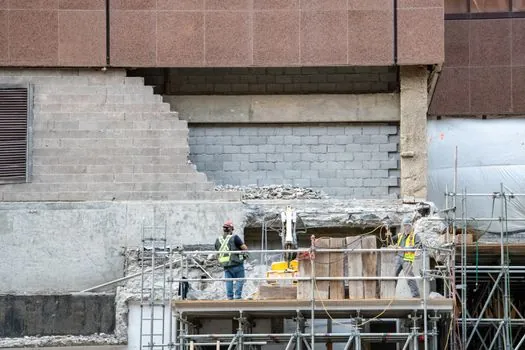
Trailer line pumps at 1.5 to 3 tonne tow weight and 15 to 30 m³/h output are the default answer for demolition infill where the approach road is too narrow for a boom truck or the pour footprint is below 8 to 10 m³ [S3].
For pours over 20 m³ on tight urban demolition sites, the practical compromise is a 24 m boom truck set up on the street with 60 to 80 m of steel pipeline and rubber hose run into the basement, which trades boom reach for pipeline friction loss but keeps the truck weight off the suspect slab. Standby charges of $200 to $400 per hour apply whenever the concrete supply is delayed and the pump is on site waiting, and on demolition pours those delays are common because the batch plant often has to detour around street closures.
Choosing wrong here is expensive: a 52 m boom truck stuck on a 6 m lane with a 40 m³ pour behind it burns the entire half-day rate in setup, while a line pump on the same pour finishes in 3 to 4 hours and leaves margin for the washout. A concrete mixer truck dispatch window has to be coordinated with the pump mobilisation so the agitator does not arrive while the boom is still unfolding, which is the single most common cause of standby charges on demolition work [S3].
Demolition-Specific Failure Modes and Constraints
Three failure modes dominate pump-truck work on demolition sites and each is preventable with a 10-minute site check: undermined outrigger pads, overhead conductor contact during boom unfold, and pipeline blockage from oversize aggregate in the mix [S1][S3].
Outrigger failure is the highest-consequence risk: a 32 to 60 tonne boom truck on four pads transmits roughly 8 to 15 tonne per pad depending on reach extension, and any backfilled trench, service pit, or basement lid below the pad must be identified before setup. A dump truck or reach truck used to clear rubble from the staging area does not reduce the point load, so the pad survey stands regardless of the cleanup method.
Overhead conductors on partially-stripped structures are the second recurring cause of boom-fold incidents, and a 24 to 32 m boom unfolded within 5 m of any 11 kV or 33 kV line is a documented strike risk; the practical mitigation is to specify the boom length from the truck's final setup point, not from the curb. Pipeline blockage from oversize aggregate is the third, and the fix is to coordinate the mix design with the pump operator before the batch is loaded, not after the first 5 m³ has stalled in the line [S1][S3].
Cost and Mobilisation Benchmarks for 2026
Published 2026 pricing for concrete pumping on demolition-class work in Victoria shows $850 to $1,400 per half-day at the floor for trailer line pumps and $1,400 to $2,200 for full-day line-pump hire; 24 m boom pumps sit at $1,200 to $1,800 per half-day, 32 m units at $1,600 to $2,300, and 52 m and above at $1,800 to $4,500 [S3].
On-site time for a typical 30 m³ demolition slab pour with a 32 m boom is 3 to 4 hours from operator arrival to departure, against a 6 to 8 hour window for a 60 m³ multi-bay pour; the operator typically arrives 30 to 60 minutes before the concrete delivery to prime the line with cement slurry and verify the placement plan with the demolition contractor's crew [S3].
Minimum charges apply for pours below 8 to 10 m³ regardless of actual on-site time, because pump deployment and travel carry fixed costs that do not scale with pour volume; a 4 m³ basement infill billed at half-day line-pump rate is the rule, not the exception. The standard scope of supply covers the operator, a labourer at the discharge hose, the prime slurry, and washout; standby, additional pipeline, and re-mobilisation for a second pour are usually itemised separately [S3].
Who a Pump Truck Is (and Is Not) For on Demolition
A truck-mounted boom pump is the right call on demolition pours over 20 m³ with clear truck approach and a 24 to 70.2 m reach requirement, and the wrong call on suspended slabs, narrow lanes, or any sub-grade where the 25 to 60 tonne truck weight has not been verified against outrigger-bearing capacity [S2][S3].
A trailer line pump is the right call on infill below 20 m³, on basement or podium pours with no truck approach, and on any site where the only available setup point is a recently-cured structural slab rated below 8 tonne per outrigger equivalent. Pumping is not the right call for a 3 m³ patch pour where a wheelbarrow and chute are still faster and cheaper, and on any demolition pour over $4,500 per half-day where crane-and-bucket would mobilise for less than the boom-pump minimum.
For demolition contractors sizing their first pump, the practical rule of thumb in 2026 is one 32 m boom truck and one 1.5 to 3 tonne line pump in the fleet: the boom covers the high-reach structural pours, the line pump covers the basement and podium infill, and the two units share the standby and washout crew across most weeks. To extend that selection logic into adjacent equipment, see the urban concrete mixer truck spec map for 4x2 versus 6x4 chassis and 3 to 12 m³ drum sizing and the theodolite spec map for concrete layout work on retained structures. For demolition-class breaking work upstream of the pour, the demolition hammer selection criteria set the cycle time that the pump truck's output rate has to match.