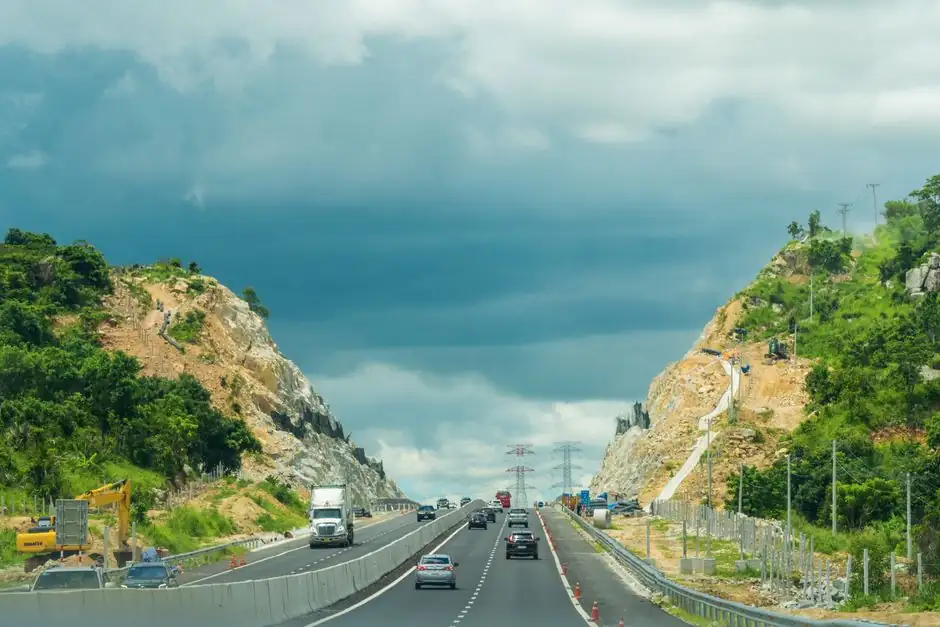
Concrete pump trucks for road construction in 2026 are selected primarily on four engineering axes: boom reach, chassis axle count, theoretical output, and pipeline delivery distance. For roadway work, the working envelope is dominated by horizontal run plus the need to feed bridge decks, culvert headwalls and elevated interchange piers, which is why 36-42 m boom pump trucks on 6x4 or 8x4 chassis are the most common production configuration referenced in current selection guides [S2][S3].
Industry guidance from June 2026 frames the decision as a match between total pour volume, single-unit delivery efficiency, daily working hours, and the structural category of the work [S1]. Road projects in practice span short rural access lanes (where a trailer pump on a 12-60 m³/h output bracket may be the lower-capex answer) and long elevated viaducts (where 42-52 m booms and 8x4/10x6 chassis are specified) [S4][S2]. Compared with a concrete mixer truck selection for port and terminal operations, pump-truck specification is set by placement geometry, not by haul mass.
Boom Reach Tiers and Where Each Fits on a Road Job
Current selection tables classify pump trucks by vertical reach: 24 m serves up to roughly 6-7 floors, 28-32 m up to 8-9 floors, 36 m up to 10 floors, 42 m up to 12-13 floors, and 47-52 m up to 15-16 floors, with a rule of thumb of about 3 m per floor [S2]. On roadway work, these vertical tiers translate to deck and pier height: 24-32 m units cover most at-grade bridge decks and single-level interchanges, 36-42 m units cover two- to three-level interchanges and typical flyover piers, and 47-52 m units are reserved for long-span elevated sections where a single set-up position must feed a wide pour footprint [S2].
Longer booms also mean a larger stabilizer footprint and stricter ground-bearing requirements, which road crews must verify before set-up [S3]. The reference guidance is to prioritize long-boom machines where site conditions permit, because a single long boom can replace multiple short-boom relocations on a continuous deck pour [S1]. For a tight urban road widening with overhead power lines, a 24-28 m short-fold unit typically beats a 42 m unit that cannot deploy under the catenary.
Chassis Axle Map: 4x2, 6x4, 8x4, 10x6
The August 2026 axle-configuration guide aligns chassis layout with the size of the pump and boom package the chassis can legally carry [S3]. A 4x2 is the compact two-axle choice for smaller approved pump systems and tight urban access; a 6x3 is the three-axle workhorse balancing equipment envelope and manoeuvrability for routine building and regional placement; an 8x4 is the four-axle platform for larger approved boom and pump packages on planned sites with adequate road and stabilizer space; and a 10x6 is the five-axle platform for project-specific large pump systems on open, engineered sites with verified access and ground support [S3].
For road construction specifically, the 6x4 is the default for routine pavement and small-bridge work, the 8x4 is the most common for 42-47 m boom packages feeding viaduct decks, and the 10x6 is reserved for the largest 52 m+ boom systems on engineered interchange pours [S3]. The same source flags the failure case: a 4x2 cannot accept a boom or pump package beyond its confirmed chassis rating, and a 10x6 must not be sent to unverified roads or ground that cannot carry the stabilizer loads [S3].
Output, Pipeline Distance, and Aggregate Compatibility
Trailer concrete pumps cover 12-60 m³/h with vertical delivery of 20-240 m and horizontal delivery of 60-450 m, with motor and diesel variants selected to match the site's power supply [S4]. Truck-mounted boom pumps sit at the upper end of this envelope, with 36-52 m boom pump trucks typically delivering in the 150-170 m³/h bracket for continuous deck pours. The truck-mounted concrete pump format couples this output to mobility, while a stationary concrete pump truck deployed alongside a concrete mixer truck fleet is the alternative where the pour point is fixed but the feed trucks cycle continuously.
Aggregate size is the binding spec: pump pipe diameter must clear the largest aggregate in the mix, otherwise blockages and pressure spikes follow. Current selection checklists therefore ask the buyer to declare pumping distance, vertical height, aggregate size, mix condition, local power supply, and jobsite space before any model is quoted [S4]. For roadway base and sub-base lean mixes with larger aggregate, a larger-diameter pipe or a trailer-pump pipeline layout is often more honest than forcing a small-line boom pump.
Road Construction Use Cases: Bridge Decks, Culverts, Pavement
Bridge deck pours are the dominant boom-pump use case on road projects, because the boom has to reach over shuttering, reinforcement, and the previously cast cantilever, with the operator standing clear of the rebar mat [S2]. Culvert headwalls, retaining walls, and pier caps fall into a second tier where a 24-32 m boom or a trailer pump on a 30-40 m³/h output bracket is typically sufficient and cheaper to mobilize. Pavement-quality concrete and continuously reinforced concrete pavement pours generally call for steady 100+ m³/h output over long horizontal runs, which is where a trailer pump with a 60-450 m horizontal range, or a conveyor-augered spreader fed by a boom pump, is matched to the production rate of the batching plant [S4][S5].
The reference ratio for fleet sizing at the plant end is that a commercial concrete mixing plant with 100,000-150,000 m³ annual output should be equipped with 2-3 concrete pump trucks, with standby units recommended for any single pour large enough that a breakdown would halt the deck [S1]. On multi-viaduct corridor projects, contractors typically split the fleet between one 42-52 m long boom on an 8x4 or 10x6 chassis for the major piers, and one 28-32 m unit on a 6x4 for satellite pours.
Hydraulics, Engine, and Control Configuration

Concrete pump trucks use a full hydraulic drive system, and selection guidance is to scrutinize the technical level of the hydraulic circuit and the quality of its components, not just the headline output number [S1]. Power is taken from the chassis engine via a power take-off, so the durability of the engine, the bearing capacity of the chassis frame, and the overall quality of the truck platform set the upper limit on how hard the pump can be run on a continuous pour [S1]. For a 12-hour deck pour the realistic filter and oil-cooler spec matters as much as the rod-side bore diameter.
Three control modes are standard on current pump trucks: manual, wired remote, and wireless remote [S1]. On road work, the wired remote is the usual pick because the operator is close to the boom tip and needs the most direct feedback; the wireless remote lets one operator cover long deck pours where the pour point shifts as the boom swings; and the manual mode is the electric-failure fallback that keeps the pour alive if a remote or harness fails mid-shift [S1].
Selection Criteria, Limits, and Sourcing Signals
A criteria-based comparison of the three principal road-job formats lines up as follows. Truck-mounted boom pump (36-42 m on 6x4/8x4): high mobility, 150-170 m³/h bracket, 6-12 floor reach, requires engineered set-up ground, higher acquisition cost. Truck-mounted long boom (47-52 m on 8x4/10x6): largest single-set-up footprint, 150+ m³/h, 12-16 floor reach, requires verified road and ground support, premium cost [S2][S3]. Trailer concrete pump (electric or diesel, 12-60 m³/h): low capex, 20-240 m vertical and 60-450 m horizontal reach, needs pipeline layout and pipe cleaning discipline, suited to medium-sized and access-limited sites [S4][S5].
The decision is therefore not "which brand" but "which envelope": boom-pump selection is governed by vertical reach and stabilizer footprint, trailer-pump selection is governed by horizontal pipeline run and power supply, and the chassis axle count is dictated by the mass and dimensions limits of the route between yard and site [S3]. Two trackable signals for buyers in 2026 are the growing share of 36 m units as the urban all-rounder and the rising minimum chassis rating (8x4) being specified for new 42 m+ boom packages on roadway corridor projects [S2][S3].