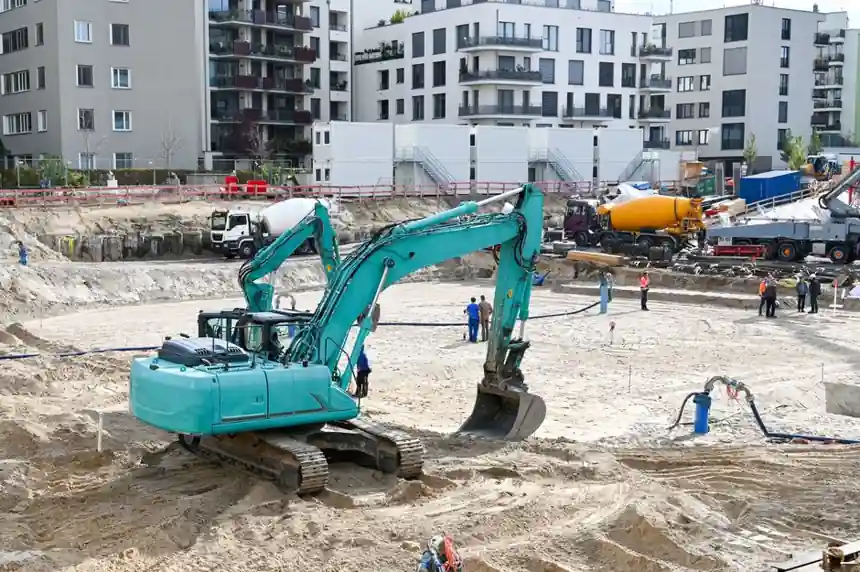
Concrete mixer trucks for urban infrastructure span 3 m³ to 12 m³ drum capacities, with 4x2 chassis built for narrow streets and short-haul pours while 6x4 chassis handle 8-12 m³ volumes for continuous ready-mix supply [S3][S4].
Drum concrete mixers hold 48% of the global product share in 2026, and the broader market is valued at US$ 6.36 B for 2026 with a 2.6% CAGR toward US$ 8.22 B by 2036, anchored by infrastructure spend on roads, bridges and public facilities [S5].
Drum Capacity and Chassis Configuration Match to Street Class
Drum volume, wheelbase, and axle count form the first decision triangle: a 3-6 m³ drum on a 4x2 chassis with a 3100-3900 mm wheelbase suits narrow urban roads, small sites, and short-distance delivery, while an 8-12 m³ drum on a 6x4 chassis with a 3575+1350 to 4025+1350 mm wheelbase targets high-volume pours and ready-mix plants [S3].
Compact urban units feed concrete at ≥2 m³/min and unload at ≥1.5 m³/min with a ≤0.8% residue rate; the larger 6x4 segment raises feed rate to ≥3.5 m³/min, unload to ≥2.5 m³/min, and drops residue to ≤0.5% [S3]. For procurement against zero-emission urban zones, axle load and weight distribution must be checked before each route, because overloading triggers fines and accelerates wear on bearings and wear plates inside the drum [S1].
Drum, Bearings, and Wear Plates: The Inspection Hierarchy
Inside every mixer drum, wear plates thin with cycles, and irregular rotation, knocking sounds, or visible play in the drum all point to bearing or drive-system wear that must be flagged during used-unit inspection [S1].
The drum itself runs at 1-2 rpm during transit to keep the mix workable without segregation, and capacities from 4 m³ to 12 m³ are covered by the transit-mixer category that dominates urban delivery [S4]. On the urban-friendly CMT3-CMT6 line, hydraulic systems draw from China-brand, PMH, or ARK component pools, and mixing tank volume scales from 5.05 m³ (CMT3) to 8.75 m³ (CMT6) within a 4x2 envelope [S3]. The concrete mixer truck product class covers both the small urban chassis and the heavy 6x4 platforms, and the rotating-drum transit-mixer architecture is shared across that range [S3][S4].
Engine, Emission Class, and Drivetrain: What Specs Actually Move

Urban 3-6 m³ trucks use 116-180 hp Euro-IV four-cylinder engines, manual transmissions, recirculating ball steering, air-pressure braking, and top out at 80-85 km/h; 8-12 m³ 6x4 units step up to 336-350 hp Stage-VI six-cylinder water-cooled diesels with dual-circuit air brakes, imported ZF8098 hydraulic steering, and 78-80 km/h maximums [S3].
New urban trucks offer measurably lower fuel burn and easier compliance with zero-emission zones, while a used 10x4 unit typically costs less and has already absorbed the steepest depreciation, provided the drum, bearings, and wear plates pass inspection [S1]. When a job also needs vertical reach, the truck-mounted concrete pump adds a boom to the same chassis; the truck-mounted concrete pump class covers that combined configuration for sites where the mixer alone cannot place the mix [S1][S2].
Mixer vs Dump Truck: Don't Confuse the Two
Concrete mixer trucks use a rotating drum to keep concrete workable during transport; dump trucks haul loose material like dirt, gravel, or demolition debris and tip it without any mixing function, so chassis, hydraulics, and body liners are specified to entirely different duty cycles [S6].
The same axle rule that applies to a 8x4 or 10x4 heavy concrete hauler in markets such as the Netherlands and Belgium applies to a 6x4 urban unit: always verify per-axle load against the local gross-vehicle limit before dispatch, because fines and accelerated bearing wear are the two immediate consequences of overloading [S1]. Brand choice also factors into lifecycle cost: a MAN concrete mixer is generally noted for lower maintenance overhead, while a Mercedes unit tends to lead on driveline refinement, and both retain resale liquidity in the used market [S1].
Concrete Pump Truck and Trailer Options: When the Drum Is Not Enough
When the pour point sits beyond the boom reach of a transit mixer, a concrete pump truck takes over placement: stationary, line, and boom pump configurations move concrete from the truck to the form, with high-rise pours typically requiring a boom pump and house-sized pours served by a mini line pump [S4].
For remote sites, rural road packages, or any project without a ready-mix plant nearby, a self-loading concrete mixer (SLCM) folds loading, mixing, and transport into one drum machine, with published drum sizes from 2 m³ to 4.8 m³ and a single brand offering 5.4 m³ on its largest model, which removes the transit-mixer leg from the logistics chain [S4]. Inside the truck, the hydraulic pump and motor pairing is the component that drives the drum, and on 8-12 m³ 6x4 units the supply typically comes from PMH P90 or ARK pumps coupled to PMH M90 or ARK motors with PMB6.5sp or PMB7.1sp reducers, all Italian-sourced for that segment [S3].
Selection Criteria by Use Case: Three Concrete Scenarios
For high-volume batching and long-distance haul, 8-12 m³ 6x4 chassis reduce trip count and lower unit cost per cubic metre, suiting infrastructure, commercial builds, and ready-mix plants, while 3-6 m³ 4x2 chassis cover narrow urban roads and short-haul work with lower fuel burn and easier maintenance [S3].
Where heavy infrastructure dominates, the concrete mixer truck market is fundamentally tied to construction activity and interest-rate sensitivity, and the residential construction segment alone accounts for 52% of application share in 2026 within the broader concrete-mixer market [S5]. Drum transit mixers alone hold 48% product share in 2026, and geographic growth is led by the USA at 2.9% and Mexico at 2.6% CAGR, with Germany and France contributing steady European expansion [S5]. For port, terminal, or mining-dust exposure, a separate spec map applies, because concrete-mixer drums can fail under municipal solid waste or quarry dust duty, and that duty separation is covered in the landfill-truck failure analysis and the quarry 2-8 m³ mining-safety spec map.
New vs Used Trade-Off and Total Cost of Ownership

Daily-run urban fleets benefit from new units because downtime, warranty coverage, and lower first-year maintenance deliver predictable TCO; less frequent or supplementary fleet additions are typically better served by a used 6x4, 8x4, or 10x4 unit, with the used market also offering mixer-with-pump combinations for added site flexibility [S1].
Axle configuration is a non-negotiable gate: 8x4 and 10x4 are the heavy-transport default in the Netherlands and Belgium, 6x4 is the urban mainstream, and lighter 4x2 chassis only fit the 3-6 m³ compact class [S1][S3]. For a port or terminal application where the truck also handles bulk aggregate movement, the port-and-terminal concrete mixer truck spec map lays out the drum, chassis, and emission-class logic specific to that duty, which differs from urban infrastructure in tire spec, brake duty, and corrosion exposure.
Trackable signal one: monitor Stage-VI / Euro-VI diesel and battery-electric mixer launches from SANY, Schwing Stetter, Liebherr, CIFA, Volvo CE, and Zoomlion through Q4 2026, since the named OEMs are the active suppliers into both urban and infrastructure segments per the 2026 market view [S5].