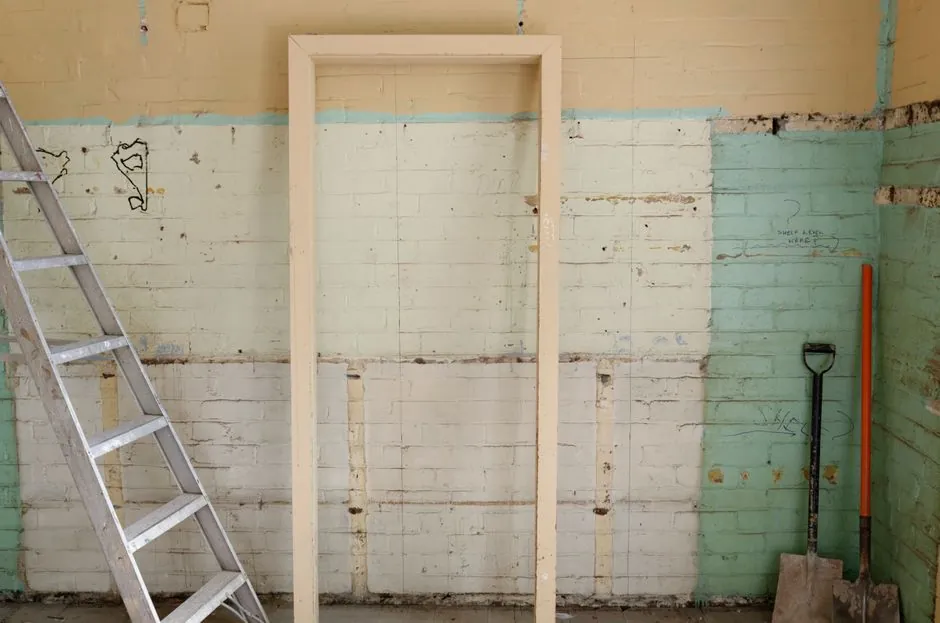
A demolition site punishes tools with dust, water splash, vibration, and rapid layout changes; a laser level spec'd for that environment needs a rotary-class receiver range of 1,000+ ft and an IP54 or higher sealing rating, paired with a self-leveling mechanism that survives tripod knock-over [S2].
Green-beam rotary units offer measurably better daytime visibility, but the trade-off is real: a paired demolition hammer or breaker work zone generates airborne particulates that scatter any beam, so the receiver (rod-eye / detector) is the actual ranging tool, not the visible dot [S6].
Why a Rotary Laser Beats a Line Laser on a Demolition Site
Rotary lasers project a full 360-degree reference plane and self-level within typical ±5° windows, which is what a slab-stripping or grade-check crew needs when no two reference points on the slab are intact [S2]. The Milwaukee 3704-21T dual-slope rotary kit is rated 1,000+ ft with a receiver in red beam, the Milwaukee 3702-21 sits in the same 1,000+ ft class for large indoor and outdoor work, and the Makita SKR001Z pushes that envelope to 2,600 ft with a receiver in green beam [S2].
Line lasers top out near 100 ft visible (165 ft with a DeWalt detector) and lack the slope and grade-setting math demolition and site-prep crews use; the DeWalt DCLE34020G and DCLE34030G both run 1/8 in @ 30 ft accuracy at IP54, which is the right tool for a finished interior, not a broken slab [S4]. A line laser is useful for setting a single wall opening or door height, but a rotary with a detector is the only sensible pick once the work area exceeds roughly 30 ft in any direction.
Beam Color: Green vs Red on Dusty, Sunlit Sites
Green beams are typically 2-4x brighter to the human eye than red at the same output power, which is the main reason contractors reach for them outdoors; DeWalt's green rotary DW079LG and DW080LGS both spec 250 ft visible and 2,000 ft with detector at 1/16 in @ 100 ft accuracy, while the older red DW074KD stops at 1,000 ft with detector at a looser 1/4 in @ 100 ft [S4]. Klein's 2026 World of Concrete Industry Choice Award winner, the 93RLS, is also a green rotary, with a published range of up to 1,150 ft when used with a receiver [S3].
Red is not obsolete. Red rotary units cost less, run longer per battery charge, and tolerate cold-weather operation slightly better because green diode efficiency drops more sharply at low temperature [S6]. For an interior strip-out with low ambient light, a red beam is fine; for outdoor slab demolition under direct sun, green plus a detector is the working combination.
Accuracy, IP Rating, and Impact Survival
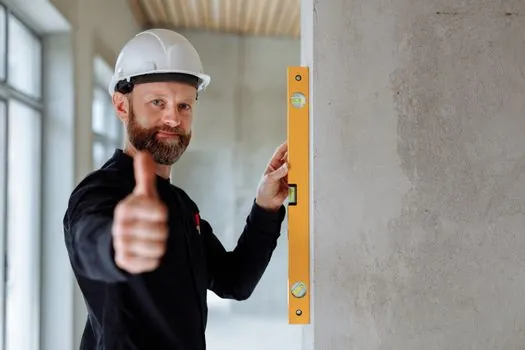
Concrete flatwork is typically held to 1/8 in over 10 ft, and that is the practical floor for any rotary specified for site prep or slab demo reference [S5]. DeWalt's green rotary DW079LG / DW080LGS spec 1/16 in @ 100 ft (about 2 mm at 30 m) and carry an IP67 rating, which is fully dust-tight and protected against temporary immersion; that is the spec to anchor demolition-side procurement on [S4].
Mid-tier rotaries like the Milwaukee 3702-21 and 3704-21T are typically IP54 to IP65, splash- and dust-resistant but not sealed for wash-down, which is acceptable for most demo dust but not for concrete-cutting slurry zones. Demolition crews running a track saw, breaker, or aerial work platform next to the laser should bias toward IP65+ housings because airborne slurry behaves like rain at distance.
Power Platform, Battery, and Mounting Choices
DeWalt's rotary and line lasers run on 20V MAX and 12V MAX battery packs shared with the rest of the brand's power tool line, and DeWalt backs the laser line with a 3-year limited warranty, 1-year free service, and 90-day money-back guarantee [S4]. Milwaukee's line and rotary lasers sit on M12 and M18 platforms, so a demolition contractor already standardized on one of these two ecosystems carries no charger or spare-battery burden [S1].
Mounting matters as much as beam color on uneven demo slabs. Self-leveling rotaries compensate for tripod tilt automatically, but the housing still needs a 5/8-11 tripod thread, a magnetic wall bracket, or a heavy-grade elevating tripod head; the Spectra Precision LL300S-47 in the surveying class is one of the common choices for civil and large-site work at 2,000 ft receiver range, and most demolition contractors will spec a similar tripod with a ground-anchor or wheel-kit for rebar-tied slab work [S2].
Selection Matrix for Common Demolition Tasks
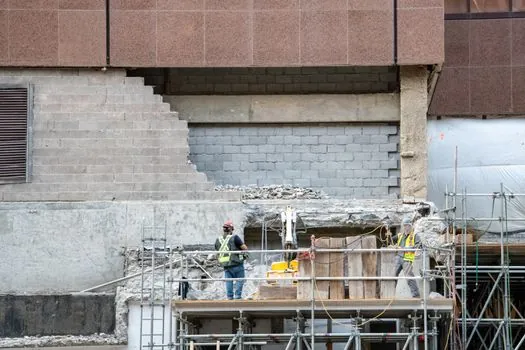
For interior wall and ceiling strip-out under 50 ft, a self-leveling cross-line or 3-plane laser such as the Klein 93PLL (green, 91 ft, ±4.5 mm per 10 m, IP54) is the lowest-cost correct tool; for slab demo, footing layout, and exterior grade check, step up to a rotary with receiver at 1,000+ ft, IP65 or higher, and dual-slope capability [S2]. Crews running a laser marker or layout station as well as a leveling tool should consolidate brands to keep the battery and accessory inventory down.
For heavy civil demo, a long-range green rotary (Makita SKR001Z at 2,600 ft with receiver, or Spectra LL300S-47 at 2,000 ft with receiver) is the right tier; the higher up-front cost is recovered on jobs where the receiver is parked 300+ ft from the emitter for half the shift. A useful companion on any demo spec sheet is a laser profiler for floor-flatness verification before and after the pour-back, since the rotary alone only sets reference, not surface profile.
Limits, Failure Modes, and What a Laser Will Not Do
Laser levels do not measure floor flatness; they only set a reference plane, and a laser profiler or F-meter is the separate instrument for F-number compliance on the finished slab [S5]. A rotary also will not compensate for a tripod on a vibrating deck: a breaker running 3 m away will jitter the receiver reading, and the practical fix is to stop the breaker, take the shot, then resume, or move the laser to a ground-anchored isolated pad.
Beam visibility through dust and slurry falls off non-linearly as particulate density rises; a receiver is the only honest ranging tool once airborne dust exceeds light haze, and that is normal on active demo. Cold-weather operation below roughly 14 °F (-10 °C) cuts green-diode output more than red, and battery capacity drops in parallel, so winter demo crews should spec red rotary plus receiver and carry twice the spare batteries [S6].
Trackable Signals and Procurement Notes

The Klein 93RLS green rotary, the 2026 World of Concrete Industry Choice Award winner with up to 1,150 ft receiver range, is a leading data point for the current green-rotary tier; compare its IP rating and slope capability against the DeWalt DW079LG / DW080LGS at 2,000 ft receiver and IP67 before locking a fleet spec [S3]. For a demolition fleet standardized on Milwaukee M18, the 3704-21T dual-slope kit is the closest match in receiver range and battery ecosystem; for an aerial work truck crew that needs long-range exterior grade, the Makita SKR001Z at 2,600 ft with receiver is the high-end anchor [S2]. Procurement should require an IP rating written on the spec sheet (not just "splash resistant"), a published accuracy in mm at a stated distance, and a receiver model number that is in current production and stocked by the brand.
See also our earlier report, Polyurethane Elastomer Selection for Electronics: A 2026 Spec Map.