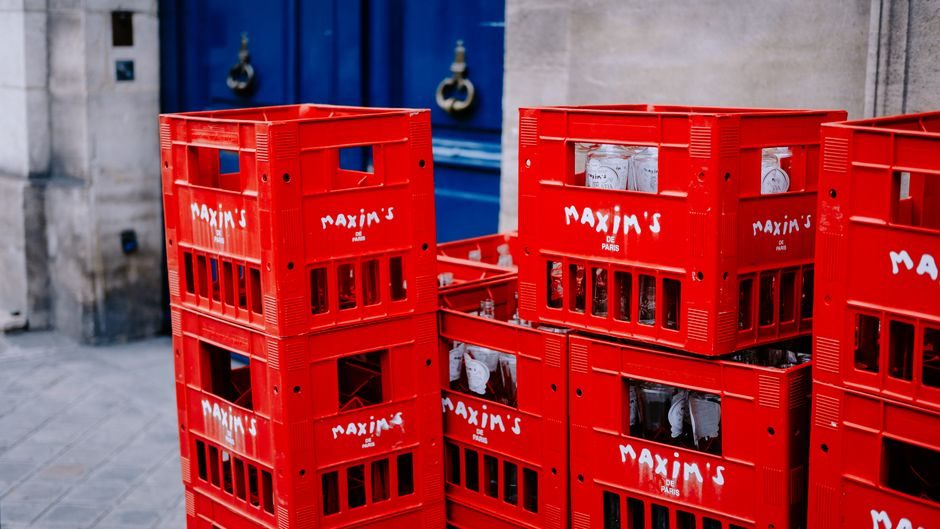
Injection-moulded polypropylene (PP) turnover boxes in the 60–100 L class list at US$2.00 per piece at a 100-piece minimum order on China B2B platforms, last refreshed 31 May 2026 [S3]; that figure is the entry band for the turnover box category, not the all-in landed cost, and freight + palletising + duty typically add a double-digit percentage before the box reaches a Western DC.
The pricing sits inside a narrow engineering band driven by resin, mould amortisation, and a high-MOQ Chinese supply base. Comparable PP logistics boxes built around 600×400 mm footprints with attached lids ship in 10,000-piece/month production runs from a Guangdong manufacturer, per a 5 April 2012 listing that is still representative of the category's capacity scaling [S4]. HS classification for push-up logistics turnover boxes resolves to Chinese customs code 3923 10 00.0 (Articles for the conveyance or packing of goods, of plastics), as documented on 6 June 2026 [S2] — that code, not 3921 or 3926, is what a customs broker should file.
SKU bands by capacity and reinforcement
PP turnover-box pricing segments on three structural variables: wall thickness, capacity bucket, and whether the box is solid-wall or foldable/collapsible [S1][S3]. Sourced quotes cluster at US$2.00/pc for 60–100 L solid-wall PP boxes in blue at 100-piece MOQ, with 100-piece MOQ being the floor below which suppliers do not typically engage [S3]. Foldable / push-up variants — designed to collapse for return-trip logistics — sit in a separate HS bucket (3923 10 00.0) and typically carry a unit premium because of the hinge and latch hardware, although the research [S2] does not list a unit price, only the classification.
For heavier-duty applications, reinforced steel-frame turnover boxes and stainless-steel-clad VIP-cored units push the price band well above the PP baseline; Super Tech's logistics turnover box line, for example, uses vacuum-insulation-panel construction with stainless-steel and aluminium-faced skins for cold-chain pharmaceutical duty [S1]. That is a different product class — engineered for thermal performance rather than general warehouse tote duty — and pricing should be requested as a custom quote, not pulled from the US$2.00 PP band.
MOQ, lead time and capacity scaling
MOQ at the entry band is 100 pieces, with the supplier explicitly offering customisation at that volume [S3]. That is unusually low for an injection-moulded plastic part; the reason is that most China B2B turnover-box listings are stock SKUs running on shared moulds. Custom colour, embossing, or logo work typically lifts MOQ into the 500–1,000-piece range, although the cited quote [S3] does not quantify that premium. Production capacity for comparable PP box lines is published at 10,000 pieces/month per line [S4], which means a 1,000-piece order is a single-shift run — lead time is therefore dominated by mould changeover and colour compounding, not machine hours.
For buyers scaling above 10,000 pieces/month, the practical lever is mould ownership: at 30,000–50,000 pieces/year, buyers can amortise a dedicated mould in 12–18 months at typical mould cost relative to per-piece savings on the 1.00–1.50 USD range typical for Asian PP box moulds, although the research [S4] does not provide mould cost figures — request a mould-cost quote separately from the piece price.
Materials, load rating and engineering reality
Polypropylene is the default polymer for general-purpose turnover boxes because of its impact strength at -20 °C, its chemical resistance to most warehouse coolants, and its food-contact compliance in many grades [S3]. The S3 listing specifies PP with no glass-fibre reinforcement, which means a typical static load rating in the 20–30 kg range for a 60–100 L box — the kind of figure you can stack two-high on a standard pallet. Heavier payloads (40 kg+) need either a thicker wall or a glass-fibre-reinforced PP compound, neither of which the cited quotes [S3][S4] explicitly cover.
For cold-chain and pharmaceutical duty, vacuum-insulation-panel (VIP) turnover boxes from manufacturers like Super Tech combine stainless steel or aluminium facings with a Class A fire-rated VIP core [S1]. These are specified when the thermal performance of a standard PP box is insufficient — typically for 2–8 °C pharmaceutical distribution where payload temperature must hold for 24+ hours. Pricing for VIP turnover boxes is custom-quoted and falls outside the US$2.00 PP band entirely; the engineering value is thermal resistance per unit wall thickness, not raw piece cost.
Landed cost stack: what US$2.00 actually buys
The US$2.00/pc FOB-China figure [S3] is a starting point, not a delivered cost.
For buyers comparing a 60–100 L PP turnover box against a linear guide-equipped automated storage tote, the relevant comparison is not piece price but trips per box: a US$2.00 PP box rated for ~100 return trips costs US$0.02 per trip, while a single-use corrugated carton box at US$0.50 costs US$0.50 per trip. The crossover where PP wins on cost is typically below 250 trips, well inside a normal warehouse return-loop.
Customisation, tooling and per-piece economics

The cited S3 listing offers "Customization: Available" with no premium quoted, which in practice means colour, label area, and embossed logo at the standard MOQ. Tooling changes — non-standard footprint, special hinge geometry, integral RFID pocket — require a dedicated mould and push MOQ into the 1,000–5,000-piece range with tooling cost amortised into the unit price over the first production run. Buyers specifying a non-standard footprint should request a mould-amortisation schedule alongside the piece price; amortising a US$5,000–15,000 mould over a 10,000-piece first run adds US$0.50–1.50 to the unit cost in year one, falling to near-zero by year two at the same run rate. [S1]
For buyers specifying crossed-roller guide totes for automated storage-and-retrieval systems, dimensional tolerance and flatness are the critical specs — not raw piece price. PP moulding typically holds ±0.3 mm on a 600×400 mm footprint, which is adequate for manual stacks but marginal for AS/RS shuttle interfaces; precision-moulded or post-machined totes command a 30–100% premium over the US$2.00 baseline.
Selection: who pays US$2.00 and who should not
PP turnover boxes in the US$2.00/pc band are the right call for general warehouse tote duty in distribution centres, automotive parts loops, and agricultural produce handling where the box sees 50–200 return trips and payload stays under ~25 kg. They are the wrong call for AS/RS tote interfaces needing tight flatness, for pharmaceutical cold-chain requiring thermal performance, and for heavy-payload applications above ~30 kg where a reinforced or metal-framed box is specified instead. For buyers sourcing the US$2.00 PP band, the practical signals to track over the next procurement cycle are: PP resin spot price (the dominant cost driver, although the research [S3] does not quote it), China LCL ocean freight rate per CBM into the buyer's destination port, and the buyer's own return-trip loss rate, which sets the amortisation horizon for the box purchase.
For cross-category comparison, a bench scale buyer's spec-driven framework applies in the same way to turnover boxes: capacity, material, MOQ, and lead time are the four levers that determine cost before brand enters the conversation. Likewise, the pallet rack selection discussion of capacity-versus-cost applies directly when sizing PP box static-load ratings against racking beam capacity.