A teardrop-style selective pallet rack upright with roll-formed columns, 1-1/2 in. step beams, and a 3 in. column pitch remains the most-shipped configuration from U.S. stockers, with new orders typically loaded on a truck within 48 hours of placement [S1].
The selection question is rarely "teardrop vs. structural" first — it is capacity, beam-to-column connection geometry, frame finish, and the applicable building/inspection code (RMI/ANSI MH16.1 in North America, EN 15635 in the EU) that decide the bill of materials [S1][S2].
Decision Criteria: Load, Aisle, Pallet Footprint, and Throughput
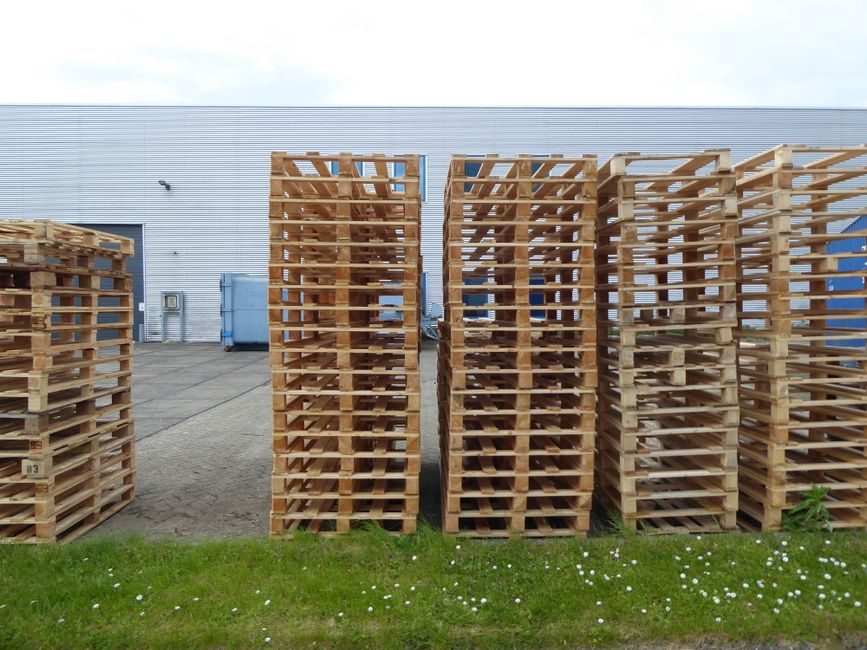
Pallet rack specification starts with four numbers: per-pallet load (typically 1,000–4,000 lb / 450–1,800 kg for general consumer goods, climbing past 6,000 lb for steel coils or drums), pallet footprint (40×48 in. GMA in the U.S., 800×1200 mm or 1000×1200 mm in Europe), ceiling clear height, and the forklift aisle width the system must accept. [S1]
Aisle width drives the rack class: counterbalanced or reach trucks want ~12 ft aisles, while turret trucks and stand-up forklifts can drop selective racks to ~8–9 ft; for sub-6 ft aisles the design migrates to double-deep, push-back, or drive-in/pallet-flow storage rack systems [S2]. Stocking the 800×1200 mm EUR-pallet footprint against the 1000×1200 mm footprint changes beam length, deck width, and frame depth together — not separately.
Teardrop vs. Bolted vs. Welded: Connection Geometry Rules the Floor
The teardrop connection — a teardrop-shaped slot punched in the column face and a matching stud welded to the beam end-fittings — dominates new North American installs because the beam hooks in by gravity and locks with a safety pin, so reconfiguration does not require special tools [S1].
Comparison on the four criteria that matter to a specifier:
• Teardrop selective: fastest reconfiguration, broadest used-market compatibility, beam capacity 3,000–6,000 lb typical; the right pick when SKU churn or seasonal re-slotting is expected [S1].
• Bolted (slot-and-bolt) selective: heavier gauge columns and beams, common in seismic-zone or heavy-pallet installs, but re-shelving requires a wrench and matched hole patterns.
• Structural rack: hot-rolled H-section columns and beams, used for impact-prone docks, outdoor yards, and very high capacities; not selective in the same way — beam spacing is set, not adjustable [S2].
• Drive-in / pallet flow: deep-lane storage for homogeneous SKU, sacrificing 50% pallet accessibility for 60–75% better cube utilization versus selective [S2].
Capacity, Deflection, and Beam-to-Upright Load Tables
Specifying capacity without reading the load table is the single most common spec error. A pair of roll-formed step beams rated at 4,000 lb per pair at a 96 in. span drops to roughly 2,800 lb at 108 in. and 1,800 lb at 144 in. — beam capacity is span-driven, not just section-driven [S1].
Upright frame capacity is governed by the weakest of three numbers: column section modulus, base-plate anchorage (typically 1/2 in. × 4 in. expansion anchors into 3,000 psi concrete with a minimum 4 in. embedment), and the unbraced length of the column. The same 42 in. × 96 in. frame in 14-gauge steel and in 13-gauge steel differs by roughly 25–35% in axial capacity — gauge and steel grade (A36 vs. A572 Gr.50) belong on the spec sheet, not as an afterthought [S1][S2].
Standards, Inspections, and the RMI / EN 15635 Workflow
Two codes shape day-to-day decisions. In the U.S., RMI/ANSI MH16.1 sets the design loads, deflection limits (L/180 vertical for beams, H/240 horizontal for frames), and base-plate geometry for steel pallet rack; a separate ANSI/RIA MH16.2 covers industrial work-platforms. In Europe, EN 15635 dictates the inspection regime — every 12 months at minimum, by a "specially trained inspector," with damage classified as Green (no action), Amber (monitor, load-rating review), and Red (immediate off-load) [S2].
Seismic design is the hidden cost line: in California (CBC Category D–F), Washington, and the Pacific Northwest, a base-plate uplift test, a horizontal-force calculation, and often cross-aisle bracing or heavier frames add 8–18% to the rack price versus a non-seismic job of the same capacity [S1][S3].
New vs. Used: Lead Time, Finish, and Honest Re-Certification

New teardrop uprights ship in 48 hours from U.S. stockers carrying the standard teardrop punch pattern, with 1-1/2 in. step beams, wire decks, and row spacers typically included in the same load [S1]. Used systems move through distributors that have been stocking since the mid-1980s in the U.S.
Used buyers should demand three documents: the original manufacturer's load table for the specific frame model, a recent third-party inspection report (not the dealer's own), and a re-galvanizing or paint record if the rack has been outdoors — column damage from forklift impact is invisible in photographs and is the most common cause of an Amber or Red classification on a used bay [S3][S4].
Who Pallet Rack Is For — and Who It Is Not For
Pallet rack is the right answer for operations storing 50+ SKUs on standard GMA or EUR pallets, served by forklift or reach truck, with moderate to high throughput and a clear height of 16–40 ft. It is the wrong answer for: bulk commodities with one SKU per truck (drive-in or block stacking is cheaper), very long loads that exceed beam length (cantilever is the spec), freezer-only operations with extreme temperature swings unless the rack is hot-dip galvanized, and any application where the operator must walk between the load and the wall (shelving, not rack) [S2].
If the workflow is a single-SKU lane with no pick-face, a pallet stacker or floor block-stack often wins on cost-per-pallet-position. Where SKU variety is high and throughput moderate, classic selective is hard to beat on total-cost-of-ownership over a 15-year horizon [S1][S2].
Failure Modes and Inspection Triggers

Three failure patterns drive most rack collapses: column damage from forklift impact (the "Z-bend" or column bow that takes the frame out of square), missing or improperly installed safety pins on teardrop beams, and overloaded upper beams that exceed the original load table after a tenant adds mezzanine-supported conveyors above the rack. All three are detectable in a documented walk-through; the EN 15635 Green/Amber/Red classification maps directly to repair-vs.-off-load decisions [S2].
Two trackable signals to watch: (1) the broader U.S. rack market is in a 48-hour-shipment window on the teardrop pattern as of 2026-07, with new and used stock both moving fast [S1][S3][S4]; (2) European operators are pushing the inspection-and-recertification workflow (EN 15635) onto used-rack imports, so a used-rack shipment without a current inspection report will fail the buyer's first compliance audit [S2].
For related coverage, see Vibrating Conveyor Price & Cost Guide: 2026 Bands, Levers and Sourcing.