Under ACI 318-19 §25.5.7.1, a mechanical or welded splice in tension or compression must develop at least 1.25 fy of the bar, and that threshold is the entry ticket for the Type 1 classification [S6].
Type 2 retains the 1.25 fy floor and stacks a second requirement: develop 100% of the specified ultimate tensile strength (fu) of the bar being spliced, with Type 2HS subclasses adding higher-cycle seismic strain performance [S3][S4].
Strength Definition, Side by Side
Type 1 coupler = 1.25 fy minimum in tension/compression, where fy is the specified yield of the rebar (typically 60 ksi / 420 MPa for Grade 60 / B500B stock used in segmental pour cages) [S1][S3].
Type 2 coupler = 1.25 fy AND 1.00 fu, meaning the same joint must also reach the bar's full ultimate tensile capacity before failure [S4][S7].
The numerical shortcut: for Grade 60 / B500B with fy = 420 MPa and fu ≈ 620 MPa, a Type 1 splice targets ≥ 525 MPa at the joint, while a Type 2 splice targets the same 525 MPa floor plus a verified 620 MPa ultimate, two distinct pass criteria, not a single number [S1][S6].
Code Path: ACI 318-19 §25.5.7 and Where Each Type Is Forced
ACI 318-19 §25.5.7.1 sets the Type 1 floor at 1.25 fy, and §25.5.7.2 then demands Type 2 (1.25 fy + 1.00 fu) for mechanical splices in plastic hinge zones of special moment frames and in columns where the design relies on yielding at the splice [S6].
For ordinary and intermediate moment frames (OMRF / IMRF) on Grade 60 stock, Type 1 couplers are commonly accepted for splicing in non-yielding regions, and several regional references (Bangladesh BNBC 2020 mapping, BNBC engineering manual) explicitly cap Type 1 use at Grade 60 in OMRF/IMRF without plastic hinge demand [S5].
The same source clarifies the physical failure mode that drives the spec: when threads are cut into the bar end, local cross-section is reduced, so a Type 1 tensile test typically fails at the threaded zone or coupler end, with measured ultimate below the parent bar's fu. Type 2 is the classification that requires the joint to actually pull the parent bar's fu before failing [S5].
Coupler Construction That Hits Each Class

Set-screw couplers with six to eight lock-shear bolts and two internal serrated strips commonly clear the 1.25 fy Type 1 bar at embedments as short as 2 bar diameters per side, with bolt heads shearing off to embed the strips into both rebar and sleeve wall [S1].
For Type 2, two construction paths dominate: longer sleeves with additional shear bolts (e.g. the "L-series" weldable set-screw anchor with one or two extra set screws), or full-length threading of the bar into the coupler. Both routes are quoted at 160% of fy as a working pull-out safety margin, with the threaded variants matching the Type 2 fu requirement at the joint [S2].
Thread geometry matters: a straight UNC thread is dimensionally portable across vendors but slow to install (multiple revolutions to bottom out), while a tapered thread installs in a few turns but uses a proprietary angle, so the coupler and threaded bar must come from the same supplier to keep Type 2 qualification valid [S2].
Decision Matrix: When Each Class Pays for Itself
Use Type 1 (1.25 fy) when: bars are Grade 60 / B500B, the member is OMRF or IMRF, the splice sits outside the plastic hinge zone, and the joint sees service compression or low-cycle tension. Cost premium over a lap splice is usually recovered on bars #8 and larger because code-mandated lap lengths for epoxy-coated bars run up to 50% longer than uncoated laps [S1].
Specify Type 2 (1.25 fy + 1.00 fu) when: the splice is in a special moment frame plastic hinge, a column splice sized to yield, a tension tie or chord member, or any location the EOR flags as "must yield away from the joint". Type 2HS sub-class adds high-cycle seismic strain capacity, relevant for nuclear-safety related and tall-core-wall projects [S3][S4].
Material-cost crossover: on plain Grade 60, the unit price gap between a Type 1 set-screw coupler and a Type 2 threaded coupler is small relative to the lap-splice steel it eliminates, but on epoxy-coated or Grade 80 / B500C stock, the lap length penalty grows and the Type 2 unit price gap shrinks, tilting selection toward the higher class on tonnage alone [S1][S5].
Qualification Testing and On-Site Reality
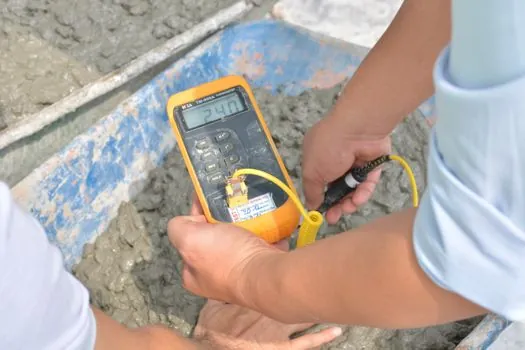
Qualification is sample-based: a production lot must include a calibrated tension test that proves the joint reaches the required 1.25 fy (Type 1) and, for Type 2, also reaches 1.00 fu without bar-thread strip-out or coupler burst [S1][S4].
For installation, an impact wrench or ratchet torques the set-screw bolts until the heads shear off, an unambiguous visual signal that the correct installation energy was delivered, which is why set-screw couplers dominate the Type 1 segment and also serve as a Type 2 option when extra bolts are added [S1][S2].
For threading-installation routes, torque verification is harder to eyeball: crews depend on the bar bottoming out inside the coupler, with tapered-thread systems reaching bottom in a few turns and straight UNC systems requiring multiple revolutions, a known source of field under-installation if supervision is weak [S2].
Failure Modes and Spec Pitfalls
Type 1 failure pattern: tensile rupture at the threaded root of the bar, with the coupler still intact, which is acceptable for the class but disqualifies the same fitting for Type 2 service [S5].
Type 2 failure pattern: ductile necking in the parent bar away from the coupler, with the joint still holding 1.00 fu, this is the visual confirmation inspectors look for on the test report [S4][S7].
Common spec errors: requesting "Type 2" while accepting any threaded coupler regardless of lot test data; mixing coupler and rebar from different tapered-thread suppliers (different thread geometry breaks the qualification); and using Type 1 in a plastic hinge zone on a special moment frame, where ACI 318-19 §18 codes (seismic detailing) demand Type 2 [S2][S6].
Adjacent Tooling and Where It Crosses Over

Field installation of set-screw couplers depends on the same impact wrench class used for structural bolting, and the torque-to-weight trade-off in cordless vs air vs hydraulic impact wrenches shows up directly in how fast a coupler crew can torque eight shear bolts per joint without overheating the tool. [S1]
For fabricators that pre-thread dowel bars in a rebar yard, a two-speed gearbox percussion drill in low gear is the practical choice for cutting straight UNC threads on #5 to #11 bar without work-hardening the cut.
The mechanical-splice decision also feeds back into basic rebar grade selection and the more specialised rebar coupler hardware catalog, since the 1.25 fy / 1.00 fu thresholds are ratios against the parent bar's fy and fu, not absolute stresses.
For utilities that pair rebar couplers with grouted splice sleeves inside precast columns, the strain-rate and fatigue performance of the embedded joint starts to resemble an electronic test and measurement problem, in that qualification is a measured signal, not a calculated one, and the data sheet is the deliverable.
Track these signals going forward: harmonisation of BNBC 2020, ACI 318-19 and IS 16172 on Type 2HS strain-class qualification, and any project-specific EOR bulletins tightening Type 2 use beyond §18 seismic detailing. Both are concrete inputs for the next coupler procurement round.