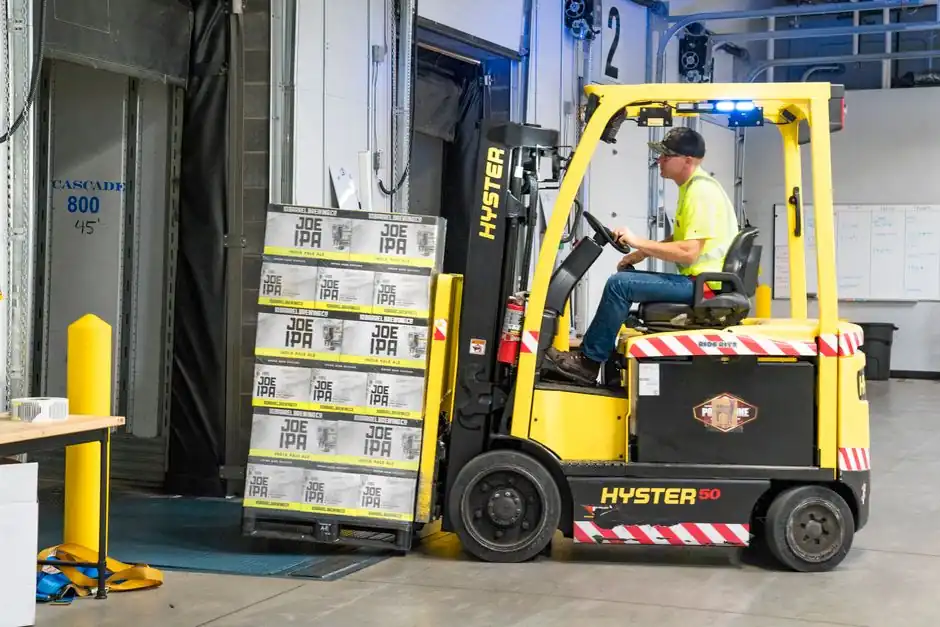
An underride AGV drives beneath a payload and raises it on a built-in lifting mechanism, typically a scissor or screw jack, while a conveyor-top AGV rides the load on an integrated belt, roller, or chain conveyor mounted to the deck of the vehicle itself [S1][S2]. Both fall under the "AGV" umbrella defined by ANSI/RIA R15.08-1-2020 (R15.08) as vehicles that follow predefined guide paths and stop-and-wait on blockage, as opposed to AMRs that set their own routes [S1].
Underride units, often called AGCs or "mouse" AGVs, dominate line-side cart trains in automotive plants; conveyor-top variants cover unit-load and pallet transfer in production and warehousing. Linde's P-MATIC tow tractor at 5,000 kg capacity shows the upper end of the same AGV family, while the platform-style automated trucks described in its August 2026 lineup illustrate how the underride and conveyor-top categories diverge at the load-handling interface [S3].
What "underride" and "conveyor-top" actually mean on the shop floor
Underride AGVs connect to the load from below, sliding under a cart, then lifting it on a vertical lift module so the cart's casters clear the floor. The connecting element can be a tow pin, a hook, a roller-dock, or a scissor lift plate, depending on the cart design [S1][S2]. Kivnon of Spain is cited as a producer of underride or "mouse" AGVs used in automotive manufacturing, where the vehicle and the cart it carries form a single transport unit [S1].
Conveyor-top AGVs sit the load on the vehicle, not under it. The deck is fitted with a powered belt, a roller bank, or a chain conveyor matched to a fixed transfer station. S1 and S2 both describe this as the "unit load" or "platform" AGV family, where the difference between a top-mounted conveyor and a flat deck is essentially a question of how the load crosses from the vehicle to the surrounding conveyor or workstation [S1][S2]. Linde's platform-truck range is described as able to "lift and set down load carriers directly from a transfer station or together with trolleys that can be driven under" [S3], which is exactly the function the conveyor-top AGV replicates for palletless flows.
Where the two types are specified, and where they are not
Underride lift AGVs are the default for cart-train material supply in automotive final assembly, sub-assembly, and engine plants, and they scale to large fleets because each cart is owned by the line, not the vehicle [S1][S2]. They are also the lowest entry price in the AGV range, cited at roughly $16,000-20,000 for a 1-tonne magnetic-navigation unit, with a comparable AMR running closer to $28,000 with natural navigation [S2].
Conveyor-top AGVs are specified where the load is a discrete unit (pallet, tote, carton, tyre, or coil) and where the surrounding intralogistics already use powered conveyors or robotic palletisers. They show up in end-of-line palletising, cross-docking, and warehouse replenishment loops [S1][S4]. They are not the right pick when the line is built around returnable carts on casters, because adding a top-mounted conveyor forces the fleet to invest in a parallel conveyor infrastructure that an underride unit simply does not need.
Decision criteria: load, lift, footprint, infrastructure, cost
Load interface is the first discriminator. Underride units need a compatible cart with a known footprint, caster height, and pickup point; conveyor-top units need a pallet or tote that matches the on-board conveyor width and roller pitch [S1][S2]. The bigger the variety of SKUs that hit the line, the harder the underride constraint becomes, and the more attractive a top-mounted belt or roller deck gets.
Lift height and stroke come next. Underride AGVs raise the load only enough to clear the casters, typically a few centimetres, while conveyor-top AGVs may need to match an existing transfer-station height, often 400-600 mm off the floor, to dock level with a fixed roller conveyor [S3]. Footprint and turning radius diverge sharply: underride carts are low and short, with a small footprint that suits dense automotive aisles, whereas conveyor-top AGVs are longer to fit the belt and drive, and need more aisle width to reverse into a transfer station [S6].
Infrastructure is the third axis. Track-guided navigation (magnetic tape, magnetic spots, QR codes, laser triangulation) is the classic AGV mode and is cited as the most affordable path for underride carts [S2][S3]. Natural-feature navigation removes the floor markers but raises the unit price, which is why it shows up more on higher-payload conveyor-top units in mixed-traffic warehouses [S3].
Cost position is the fourth. The same AGC vendor data point (about $16k-20k for a 1-tonne underride with magnetic navigation) and the AMR benchmark (about $28k) bracket the underride unit below most conveyor-top platforms, because the latter add a powered conveyor, a longer chassis, and a more capable safety scanner stack [S2]. S4 (KNAPP, September 2026) frames the trade-off in operational terms: AGVs pay back where transport volumes are high, shifts are multiple, and the labour pool is tight, regardless of which load-handling subtype is chosen [S4].
Comparison at a glance
On load capacity, conveyor-top unit-load AGVs are documented in the multi-tonne range (DTA of Spain is cited for 25-tonne steel-coil unit-load AGVs), while underride AGCs cluster around 1-2 tonnes per cart, with the line absorbing the cumulative tonnage through train length [S1][S2]. On throughput, an underride tugger pulling a train of carts will out-deliver a single conveyor-top unit per vehicle, but each conveyor-top unit does the transfer itself with no second handling step, which can simplify the station layout.
On integration effort, underride AGVs integrate with the cart fleet and the floor markers and need little upstream fixed infrastructure, while conveyor-top AGVs integrate with a fixed conveyor or workstation and need the height, speed, and photo-eye logic of that conveyor matched on the vehicle [S3][S9]. On floor marking and routing, both can use magnetic tape or laser navigation, but natural-feature navigation (SLAM-style, as Linde describes for its MATIC trucks) is more common on the higher-payload conveyor-top side, because the safety and route-revision benefit scales with payload value [S3].
For battery and energy planning, the choice of subtype also feeds into opportunity charging vs battery-swap decisions, covered in a related AGV fleet spec piece; the shorter underride cycle tends to favour opportunity charging at line-side docks, while longer conveyor-top pallet loops often run battery swap at a central station. For safety certification where combustible atmospheres exist, the AGV itself is a powered industrial truck and may need its own hazardous-area assessment, on top of any ATEX/IECEx equipment spec for the surrounding process, a topic treated in the related ATEX vs IECEx spec write-up.
Standards, navigation, and what to put on the datasheet
Safety for industrial mobile robots in the U.S. is anchored on ANSI/RIA R15.08-1-2020 (R15.08), which sets the AGV/AMR distinction used across the industry [S1]. S4 (KNAPP) breaks the navigation stack into track-guided on one end and SLAM-based on the other, with magnetic tape, magnetic spots, QR codes, and laser triangulation as the classic AGV modes, and natural-feature navigation as the flexible alternative that does not need physical guide elements [S3][S4]. Linde's August 2026 documentation describes natural-feature navigation in essentially those terms for its MATIC range [S3].
On the datasheet, an underride unit should be specified by cart footprint, lift stroke, pickup height range, tow capacity, navigation mode, and safety scanner field set. A conveyor-top unit should be specified by payload, conveyor type and width, transfer height, drive direction (uni- or bi-directional), navigation mode, and the I/O map for handshake with the fixed transfer station [S1][S3]. The conveyor vs AGV decision more broadly is laid out in S9, which frames the comparison as fixed-path stationary conveyor (no flexibility, lowest unit cost at high volume) versus mobile AGV/AMR (flexible routing, higher unit cost, no fixed path), and that same logic applies inside the AGV category between underride and conveyor-top subtypes [S9].
Failure modes and constraints to flag in writing
Underride AGVs fail when the cart fleet drifts out of spec: a caster swap, a new cart supplier, or a tote-on-cart retrofit can defeat the pickup geometry. They also constrain payload weight to what the cart frame and the floor can take, not what the AGV can lift, because the load is on the casters once picked up [S1][S2].
Conveyor-top AGVs fail when the on-board conveyor drifts out of sync with the fixed transfer conveyor: belt speed mismatch, photo-eye timing errors, or a height mismatch at the dock. They also consume more aisle width and turning radius than an underride cart, which can force a layout redesign in retrofits [S3][S6][S9]. Track-guided underride layouts, finally, are hard to re-route once the magnetic tape is in the floor, a constraint S3 (Linde) flags as a planning-time commitment rather than a runtime one [S3].
Track two signals over the next planning cycle: the proportion of new AGV asks that come with natural-feature navigation versus magnetic-tape, and the share of conveyor-top asks that include a battery-swap or opportunity-charging spec on the same RFQ; both will tell a specifier whether the line is moving toward flexible SLAM fleets or staying on fixed-path track-guided carts.
The underlying component specifications are covered under vertical lift module, agv robot, and concrete vehicle.
Background reading: AGV charging: opportunity charging vs battery swap stations, a 2026 spec-driven comparison.