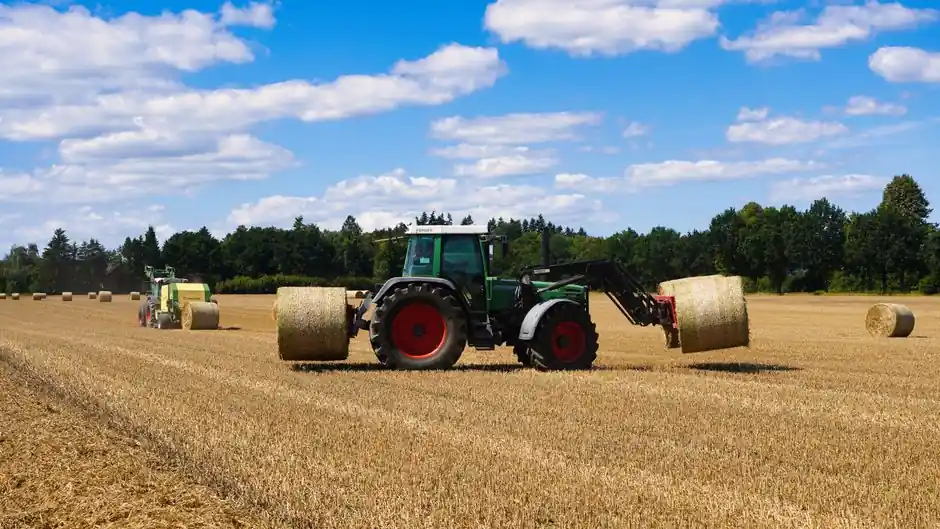
A cross-type universal joint transfers rotational torque between two non-collinear shafts and is the dominant coupling in tractor power take-off (PTO) drivelines, where the tractor stub shaft and the implement input shaft sit at continuously changing angles during turns and over uneven ground [S1][S5].
Selection in agricultural applications is governed primarily by the PTO series (1-8) and the ASAE/ISO PTO speed category (540 rpm, 1000 rpm, 540E), with kit pricing on the U.S. replacement market running from roughly $11.99 for a Series 1 cross kit to $44.99 for a Series 7 cross kit, and premium wide-angle or CV assemblies priced higher [S4]. For a deeper look at the mechanical category, see the universal joint reference page.
PTO Series, Bore, and Torque Mapping
Agricultural universal joints are sold as cross-and-bearing kits matched to a numeric PTO series that scales with torque capacity, not with shaft diameter alone; the same Series 4 cross can sit behind a 35 mm or a 44 mm bore depending on the yoke, so the series number is the procurement shorthand rather than a direct dimensional callout [S4]. Standard kits cover Series 1 through Series 8, with Walterscheid code patterns (W2200, WI, 2400/2480, 2500/2580) used to designate European-spec equivalents that interchange with ASAE series in most tractor and implement pairings [S4].
For non-PTO industrial and conveyor couplings, keyway or plain bores typically span 3/16" to 2" (5-35 mm), and custom machinable bores are available when the shaft finish or taper does not match a catalog size [S9]. The common Delyle 441M tractor replacement cross uses a heavy-duty forged alloy-steel spider and replaces the OEM ref. R64694 on John Deere drivelines, illustrating the series-and-cross-OEM pattern that buyers cross-reference when matching a replacement [S3].
Phasing, Angle, and the Case for CV Heads
Single U-joints introduce cyclic velocity variation through each rotation, so agricultural driveshafts are assembled with two cross-type joints in phase (yoke ears on the same plane) to cancel the secondary effect; a wrong-phase installation produces a strong once-per-rev vibration that destroys bearings and operator comfort within hours [S8][S5]. Wide-angle U-joints and constant-velocity (CV) heads are added at one or both ends when the articulation between tractor and implement exceeds the operating-angle envelope of a standard cross, which is typically cited at single-joint angles up to 25-30 degrees for acceptable velocity fluctuation [S5].
Pat's Driveline and Walterscheid both market CV heads and quick-disconnect yokes as separate agricultural sub-lines alongside the cross kits, recognising that the CV head is a different part from the U-joint itself and is only required when the duty cycle includes sharp turns at full power [S2]. For light-duty mowers and 3-point equipment that run below 25 degrees, a phased pair of standard cross joints remains the cost-effective baseline.
Material, Sealing, and Serviceability
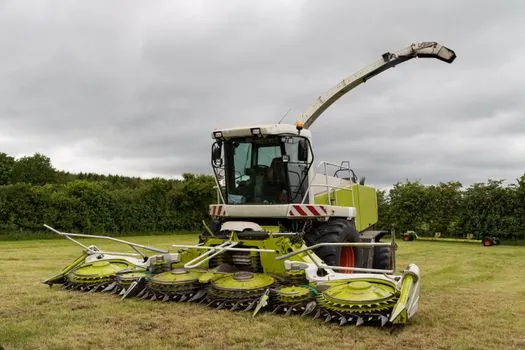
Forged alloy-steel spiders with induction-hardened trunnions are the default for agricultural cross-and-bearing kits, with needle-roller bearings running in grease-lubricated cups sealed by dust caps and re-greased through a nipple on most modern designs [S3][S6]. Field-serviceable cross kits include snap rings and grease fittings, allowing the joint to be repacked at service intervals without removing the driveshaft; a sealed-for-life alternative exists but trades serviceability for contamination resistance in heavy dust or slurry conditions [S6].
Implement-side joints on balers, mowers, and harvesters see the worst contamination load, so rebuild kits in the $11.99-$44.99 range are typically specified as wear items rather than replaced assemblies, keeping the driveshaft tubing and yokes in service across multiple cross rebuilds [S4][S3]. Pat's Driveline stocks Spicer, Rockford, Weasler, Bondioli & Pavesi, Walterscheid, Neapco, Agmaster, and Quality Gear as the cross-brand baselines that most U.S. and Canadian dealers will cross-reference when a part is not branded [S2].
Selection Criteria Compared Across Options
The decision matrix for an agricultural U-joint is narrower than for a general industrial coupling, but four criteria separate the candidates: (1) series/torque match, (2) operating-angle envelope, (3) sealing and serviceability, (4) brand and replacement-part availability. A standard cross kit (Series 1-4) suits 540 rpm Category 1 implements under 25 degrees and is the lowest-cost path; a wide-angle cross extends the angle envelope to roughly 30-35 degrees at the cost of higher cyclic loading; a CV head eliminates velocity variation entirely but adds cost, length, and a second grease point. [S5]
Buyers balancing OEM fit against aftermarket cost typically start with the OEM cross reference (e.g. R64694, 180.014.130, 1004020, 274235), confirm the series (441M / Series 4 in the Delyle example), and then choose between a branded kit (Spicer, Weasler, Walterscheid) and an unbranded forged-steel replacement, with the unbranded option typically priced 20-40% below the OEM part on U.S. e-commerce listings [S3][S4].
Where Standard Cross Joints Are Not the Answer
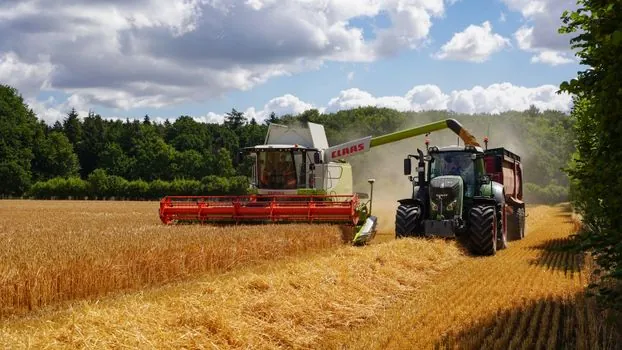
Cross-type universal joints are a poor fit for applications requiring constant output velocity at large angles, for sealed high-speed industrial couplings, and for any installation where the joint is not field-serviceable, since the cross is the planned wear item in any agricultural driveshaft [S1][S5]. For conveyor drives where thermal growth or structural settlement creates a fixed offset, a U-joint accommodates misalignment but a flexible coupling is often specified instead when torsional damping is also required [S9].
Selection also fails when a buyer specifies by shaft diameter rather than series, since two same-bore joints on the same shaft can be different series and therefore different torque ratings; matching by series number and OEM cross reference is the only reliable procurement method for replacement parts [S4][S3]. This same logic drives the cross-reference approach used in adjacent driveline categories, and a similar series-and-application matching is used for construction machinery and equipment PTO and driveline spares.
Sourcing, Standards, and Trackable Signals
Two procurement channels dominate: OEM dealer networks (John Deere, Case IH, AGCO, CNH) for in-warranty builds, and aftermarket cross-reference against ISO 5675 (PTO master shield and driveline spec) plus ASAE S318 (safety chain and shield practice) for replacement parts, with the OEM cross reference (R64694, 1004020, 180.014.130) used as the universal key [S2][S3]. Pat's Driveline is one of the larger North American aftermarket assemblers, holding cross kits for the Spicer, Weasler, Walterscheid, and Bondioli & Pavesi patterns under a single ISO 9001:2015 quality system [S2].
Trackable signals to watch for over the next 6-12 months: (1) Walterscheid and Bondioli & Pavesi extending their W2500/W2580 series cross kits into higher-torque EV-auxiliary PTO applications, and (2) U.S. aftermarket listings of Series 6 and Series 7 CV-head rebuild kits as more 1000 rpm large-acreage implements reach mid-life overhaul. Replacement cross-and-bearing kit pricing on the U.S. retail channel (Series 1 at $11.99, Series 4 at $24.99, Series 7 at $44.99 as of Q3 2025) is the most stable benchmark for sourcing-budget tracking [S4]. Buyers who need a broader view of drivetrain component selection can compare the same series-and-application logic against the industrial valve spec-by-series approach used in adjacent fluid-power components.
Background reading: Natural gas pipe sizing: longest-run method, table selection, and code map.
