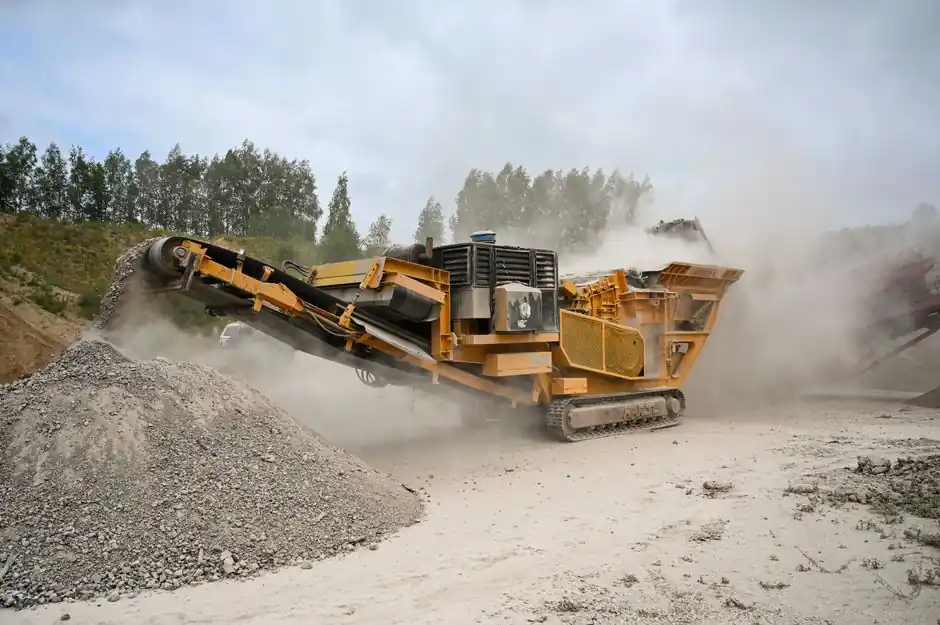
Universal joint selection in mining equipment reduces to a calculation between three engineering variables: transmitted torque, operating angle, and rotational speed (rpm) of the application [S3]. Underground and surface mining fleets use these couplings in conveyors, crushers, drilling systems, and slurry pumps, where dust, abrasive fines, and shock loads accelerate bearing wear [S4].
Single-joint (Cardan) designs tolerate angular misalignments up to 45° but produce non-uniform output velocity, the driven shaft speeds up and slows down twice per revolution [S3][S5]. Double-joint and constant-velocity (CV) configurations pair two single joints to cancel that fluctuation, accepting up to 90° total articulation (45° per joint) or parallel misalignment between the driving and driven shafts [S3]. For a deeper look at how the same torque/angle trade-off plays out in agricultural PTO drivelines, see this universal joint selection guide for agricultural PTO drivelines.
Operating Envelope: Torque, Angle, and RPM Boundaries
Durability of a mining-duty universal joint is largely determined by the transmitted torque, the angle of operation, and the rotational speed (rpm) of the driveshaft [S3]. Single joints are mechanically simple, with one yoke pair connected by a central cross, and are best specified when shaft offset is purely angular with no parallel displacement and rotational speed is low to moderate [S4].
When operating angle or speed rises, the speed fluctuation of a single joint can excite mechanical resonance in the conveyor structure or the crusher shaft. Double-joint assemblies counter the angular distortion of the first joint with the second, producing uniform output velocity even at higher shaft angles and enabling parallel-misalignment compensation [S4]. For comparison, a similar torque-vs-misalignment decision logic applies to gear couplings in farm machinery, covered in the gear coupling selection map for agricultural drivelines.
Bearing Type and Material Selection for Abrasive, High-Load Service
Friction-bearing universal joints rely on sliding contact at the central cross, generating more heat and wear at higher rpm; needle-bearing joints replace the sliding interface with rolling elements, allowing use on high-speed axes where friction-bearing designs would overheat [S3][S4]. Standard mining-grade joints are precision-machined from heat-treated alloy steel, with stainless-steel variants available for corrosive service such as slurry lines or chemical wash-down [S4].
Bore sizes for stocked industrial joints commonly span 3/16" to 2" (5 mm to 35 mm), with machinable bores available for custom applications, and inch-to-metric conversion couplings or step bores produced by special order [S4]. Wing-style U-joints, where the bearing is bolted directly to the yoke instead of being retained by snap rings, are the heavy-duty pattern used in mining and industrial equipment because the bolted connection carries higher torque and resists the sudden torque reversals common in crusher and conveyor drives [S5]. The broader engineering definition of the device, as a mechanical coupling kinematically equivalent to a pair of revolute joints whose axes intersect, is catalogued in the universal joint reference entry.
Environmental Stressors: Dust, Heat, Washdown, and Reversals
Operating environment is as decisive as the mechanical ratings. Dust and abrasives accelerate bearing wear, while exposure to heat, chemicals, or wash-down fluids can corrode the joint and break down the lubricant film, with both paths leading to premature failure [S3]. In heavy-loaded conveyors used in mining, steel processing, and continuous material handling, the joint must absorb constant rotation and sudden torque reversals without fracture or material deformation, which is why alloy-steel heat-treated bodies are specified over low-cost alternatives [S4].
Sealed boot covers, manufactured as lubricant-retaining sleeves, extend service life in dust-laden mines by blocking fines from the bearing faces, and the lubricant grade (open-gear grease, high-temperature grease, food-grade, marine, aerospace-grade) must be matched to the operating environment [S3][S4]. If pre-lubrication cannot be guaranteed, the joint can be supplied with a lubricant-retaining boot at the specification stage rather than retrofitted in the field.
Configuration Decision Map: Single, Double, Drive Shaft, or CV
The first decision is the type and extent of misalignment between the driving and driven shafts: angular (shafts set at an angle), axial (horizontal separation), or parallel (shaft axes offset but parallel) [S3]. On that basis, four configurations dominate mining spec sheets.
Single joint: angular misalignment only, up to 45°, mechanically simple, compact, but non-uniform output velocity rules it out for precision or high-rpm conveyors [S3][S4]. Double joint: two single joints coupled, up to 90° total (45° per joint) or parallel misalignment, with uniform output velocity, the preferred configuration where shaft offset is larger or speeds are higher [S3][S4]. Drive shaft: essentially an elongated double joint with a telescoping middle section, used where axial misalignment is significant or the assembly must be replaced as a single unit [S3]. Constant-velocity (CV) double joint: used in off-highway drivetrains, combines two cardan joints with a centering yoke to cancel speed variations at steep angles and reduce driveline vibration in articulated haul equipment [S5].
Inspection Signals and Failure Modes Specific to Mining Service

A distinct clunking or ringing noise when shifting into drive or reverse is the first audible sign of a worn U-joint, the noise being generated by excessive play in the bearing cups [S5]. Continued operation under that condition can lead to the joint seizing or breaking apart completely, and if the joint fails while the machine is moving, the flailing driveshaft can damage the transmission, exhaust, and surrounding structure [S5].
Wing-style joints, while rated for higher torque, are inspected on the bolt torque at the wing bearing interface, because loosening at that interface produces the same speed-fluctuation symptoms as a worn needle bearing [S5]. For haul-truck and loader powertrains operating in the same dust and shock environment, driveline maintenance parallels the broader mining dump truck powertrain spec window, where driveline U-joint life is one of the dominant scheduled-maintenance intervals.
Sourcing, Standards, and Specification Discipline
Universal joint selection should start with a written assessment of the operating conditions, with all relevant factors (torque, angle, rpm, environment, lubrication access, expected duty cycle) communicated to the supplier before a part number is issued, because most mining installations require some degree of customization [S2][S3]. Standard inch-and-metric bores in stocked ranges (3/16" to 2", 5 mm to 35 mm) cover the majority of conveyor and crusher shafts, but machinable bores, custom keyways, and inch-to-metric conversion couplings are sourced on special order [S4].
Off-highway driveline joints, particularly those used in articulated haul trucks and loaders, are specified as part of the vehicle's powertrain, with double-joint/CV designs selected where high articulation or higher road speeds are required, and wing-style joints selected for the highest-torque, shock-loaded positions [S5]. The off-highway drivetrain guide from Bull Powertrain is a useful field reference for inspection intervals and lubrication discipline, and a wider treatment of universal-joint engineering, including kinematic definitions and typical torque-density figures, sits in the universal joint encyclopedia entry. For procurement teams standardizing on a single-source spec, the deciding variables remain unchanged: torque rating per joint, maximum operating angle, rpm at that angle, bearing type, and sealing arrangement matched to the mine's dust, heat, and washdown profile.
The underlying component specifications are covered under expansion joint.