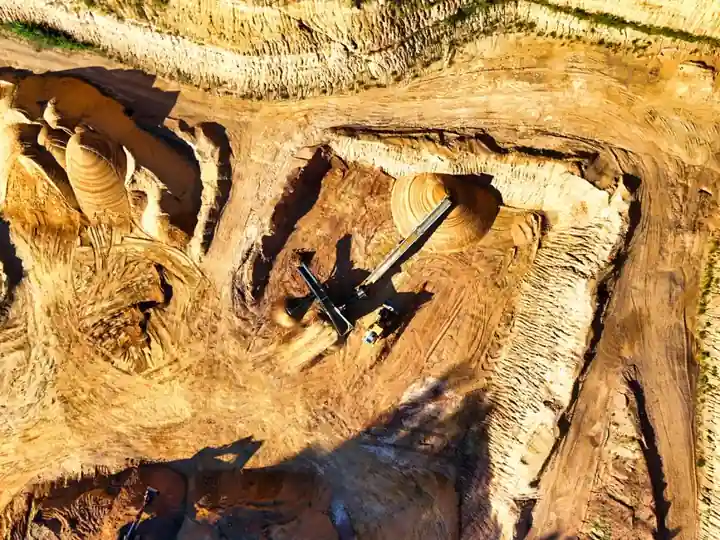
Domestic uranium mining now supplies around 3% of the United States' needs, and in 2024 the United States had 2.5% of global uranium resources and provided 0.4% of global production [S2].
The global uranium market serves 420 operational reactors with 68,920 tonnes of reactor feedstock, while Orano's Philippe Coste uranium conversion plant in France manufactured more than 12,000 metric tons of UF6 in 2025 [S5].
Conversion sits between uranium mining and enrichment
Uranium conversion transforms mined uranium into the chemical feed required for enrichment, most commonly uranium hexafluoride, UF6. The commercial fuel-cycle sequence has four distinct stages: mining and refining, conversion into a gaseous feedstock, enrichment of U-235, and fabrication of pellets and fuel rods [S3][S4].
The stage boundaries matter because mined uranium is not a direct feed to a conventional light-water reactor. Conversion provides the UF6 feed to enrichment plants, while fuel fabrication converts the enriched material into reactor-ready assemblies. A country can therefore hold uranium resources without possessing either commercial conversion or enrichment capacity [S1][S4].
US uranium mining peaked in 1980, and domestic mining supplied around 3% of US requirements in 2024. The United States held 2.5% of global uranium resources and produced 0.4% of global output that year [S2]. The separation between resource ownership, mining output, conversion capability and enrichment capacity makes fuel supply an infrastructure question, not merely a geological one.
UF6 conversion capacity is concentrated and thin
USGS Fact Sheet 2025-3057 is titled “Uranium—Deposits, production and resources, market dynamics, and supply chain risks” [S1]. This leaves a limited conversion layer between uranium concentrate and the much larger enrichment industry.
Orano's Philippe Coste plant in France produced more than 12,000 metric tons of UF6 in 2025, while ConverDyn restarted operations at the Metropolis Works conversion facility in Illinois [S5]. A planned US refining and conversion plant by United States Uranium Refining and Conversion Corp was designed for about 10,000 metric tons of uranium per year in UF6 [S5].
The spread is material for utilities and developers because conversion is usually contracted separately from the uranium itself, and a long conversion queue can restrict the practical availability of enrichment services even when ore and concentrate are available.
Enrichment concentration creates geopolitical exposure
USGS Fact Sheet 2025-3057 is titled “Uranium—Deposits, production and resources, market dynamics, and supply chain risks” [S1]. Legacy US gaseous-diffusion plants became uneconomic relative to overseas centrifuges, and Russian enrichment services have continued to supply the US market, including significant volumes after the Megatons to Megawatts program ended [S2].
Enrichment expansion is not limited to conventional low-enriched uranium. Orano obtained the authorizations needed to produce uranium enriched to 6% during 2026, while the United States is developing HALEU capacity for advanced reactors [S7]. Higher enrichment does not replace the entire front end: the plant still requires uranium feedstock, chemical conversion, enrichment services and fabrication capacity at commercially usable scale.
LEU, HALEU and advanced fuel compete for the same chain
Low-enriched uranium supplies the operating commercial fleet, while high-assay low-enriched uranium, commonly at an enrichment level of up to 20%, supports advanced reactor concepts and other specialized applications [S2]. The policy challenge is to expand HALEU without weakening LEU supply for existing reactors.
ASP Isotopes established Quantum Leap in 2026 to focus on uranium conversion and enrichment of uranium-235 for HALEU, LEU and LEU+ fuels [S6]. The project illustrates why conversion and enrichment cannot be evaluated as isolated commodities. A new enrichment line requires UF6 of the required chemical quality, delivered in the required quantity, before it can produce saleable LEU or HALEU.
Advanced reactors can also raise mining intensity per unit of thermal output. A Stanford University-led industry meeting identified uranium fuel as a blind spot for the U.S. nuclear power renaissance and warned that new fuel forms for advanced reactors could squeeze conventional fuel markets even more [S3]. Procurement plans based only on reactor count would therefore miss two variables: fuel assay and uranium consumption per unit of output.
Existing reactors and advanced designs need different fuel strategies
The fuel strategy for an operating light-water reactor differs from the strategy for a first-of-a-kind advanced reactor. Existing plants need proven LEU supply, compatible conversion services, enrichment contracts and qualified fuel fabrication. Advanced projects need reliable HALEU or LEU+ pathways, development-scale production before commercial rollout, and reactor designs whose fuel specifications are compatible with available enrichment output [S2][S6].
The comparison below separates the principal sourcing options by the constraints buyers actually face.
This distinction is especially relevant to small modular reactors and data-center power proposals. A reactor project without a qualified fuel-supply pathway is not commercially interchangeable with one holding long-term conversion and enrichment commitments. The fuel-cycle scope must therefore be included in reactor delivery schedules, not left as a late utility procurement.
Conversion is suitable for utilities with large, aggregated demand
Large utilities with multiple reactor reloads can aggregate annual conversion and enrichment demand, negotiate directly with suppliers and diversify across qualified facilities. Their scale improves commercial leverage, but it does not remove geopolitical or plant-level failure risk [S2][S5].
Small reactor developers and first-of-a-kind projects face a different position. Their smaller batches can be harder for large conversion and enrichment plants to schedule, while novel fuel specifications may require additional qualification. A developer with no domestic capacity is particularly exposed if conversion, enrichment and fuel fabrication all originate in one foreign jurisdiction.
For prospective U.S. enrichment developers, the funding route is more concrete than a general policy pledge. The January 5, 2026 contracts covered conventional and next-generation reactor fuel, the July 2026 financing framework exposed approximately US$17.5 billion in potential project capital, and named priority sectors included enrichment, conversion, HALEU, mining and milling, fabrication and transportation [S3][S5].
Fuel-cycle constraints are the main failure modes
The first failure mode is a mismatch between stages. Adequate uranium mining does not guarantee UF6 conversion; adequate conversion does not guarantee enrichment; and adequate enrichment does not guarantee delivery of a reactor-qualified fuel assembly [S1][S3]. Each interface can delay a reactor even when the next stage has nominal capacity.
The second failure mode is concentration. Five operating conversion facilities and more than 99% of enrichment capacity outside the United States create exposure to local outages, export controls, geopolitical disputes and constrained logistics [S1]. The United States previously depended on Russian enrichment services and imported fuel-cycle inputs despite operating commercial, research and military facilities across multiple stages [S2].
The third failure mode is incompatible assay planning. LEU from an operating enrichment service may not satisfy HALEU requirements, and advanced fuel that has not reached qualified commercial production cannot be treated as an interchangeable substitute. The 6% enrichment capability expected from Orano during 2026 and the development of separate HALEU capacity illustrate distinct production targets rather than a single pooled inventory [S7].
The fourth failure mode is demand forecasting. Global reactors consumed 68,920 tonnes of uranium feedstock in 2025, and next-generation designs may require more mined uranium per ton of fuel [S3][S5]. Underestimation can tighten both conversion and mining markets, while overestimating advanced-reactor deployment can leave new facilities without enough contracted volume.
Use contracted milestones to judge supply readiness
Conversion and enrichment are ready for a buyer only when the pathway can be traced to qualified capacity, not when a project merely announces financing or development. For an existing reactor, verify the conversion plant, enrichment supplier, contract term, assay, delivery schedule and regulatory authorization. For an advanced reactor, also verify fuel qualification and the planned HALEU production route [S2][S5][S7].
Two trackable signals deserve attention through 2026 and 2027: whether Orano reaches authorized 6% enrichment production, and whether US conversion projects backed by the approximately US$17.5 billion financing framework progress from announcement to operating capacity [S5][S7]. Additional milestones include the three US enrichment contract programs awarded on January 5, 2026 and any commercial UF6 output from restarted or new conversion facilities [S3][S5].
The defensible 2026 procurement conclusion is narrow: preserve LEU supply for operating reactors while building separate, qualified pathways for HALEU and advanced fuels, and contract conversion and enrichment as critical infrastructure rather than interchangeable commodity purchases.