Food-grade V-belt selection in processing plants hinges on three converging constraints: FDA- and EU-compliant food-contact materials, a service factor of 1.2-1.6 applied to actual horsepower, and minimum pulley diameters that match the belt cross-section (A, B, C, 3V, 5V) [S1][S4][S5].
Unlike a general industrial drive, a food-line V-belt sits near open product, frequent wash-down, and bacterial-risk zones, so a correctly sized standard wrapped V-belt and a hygienic thermoplastic flat drive are not interchangeable categories. Engineers must combine the classic five-step V-belt selection method (drive requirements, service factor, belt section, design program, install/maintain) with food-safety requirements (anti-microbial cover, metal/X-ray detectability, allergen color coding) before specifying [S1][S4].
Food-Safety Constraints That Override a Standard V-Belt Pick
Food safety is the top priority when selecting any belt that runs on a food line, and that priority reshapes what counts as an acceptable V-belt drive [S1]. Anti-microbial belt compounds, non-fray covers, and metal- or X-ray-detectable formulations are now baseline requirements on lines where belt fragments could enter the product stream, since modern inspection systems must be able to catch the smallest fragment before it reaches the consumer [S1].
Allergen segregation is a second hard constraint. Blue and white color-coded belts are widely used so that a line switching from a peanut, soy, milk, or wheat run to an allergen-free run can physically swap the belt and guarantee no cross-contact, a practice that applies equally to V-belt drive covers and to flat conveyor surfaces [S1]. In high-corrosion wash-down environments, such as soda and syrup facilities, traditional acetal plastic chains can fail within weeks, and the same chemistry attack that destroys a chain will shorten the life of an incorrect V-belt cover compound [S1].
Five-Step V-Belt Sizing Method Adapted for Food Lines
The Bestorq V-belt quick selection method starts with four drive inputs: actual horsepower, operating speed in RPM, center distance, and pulley size limits, then applies a service factor to convert actual horsepower into design horsepower before picking a belt cross-section [S4]. Light-duty applications such as small fans or centrifugal pumps carry a service factor near 1.0, while mixers, printing machinery, and positive-displacement pumps sit at 1.1-1.4, and heavy-duty units like crushers, mills, and rubber calenders require 1.3-1.8; food-line conveyors, agitators, and bottle fillers fall in the middle band and typically warrant 1.2-1.4 [S4].
Once design horsepower and the faster-shaft speed are known, the engineer selects a cross-section (A, B, C, 3V, 5V) and confirms that the smaller pulley meets the manufacturer's published minimum diameter for that section, because dropping below the minimum significantly reduces belt life, a failure mode that is especially costly on a food line where a snapped belt can drop debris into product [S4]. Cogged (notched) V-belts are the usual food-line preference when the smaller pulley is constrained, since cogged belts run cooler and wrap smaller-diameter pulleys without the life penalty of a smooth cross-section [S4].
Wrapped Rubber, Polyurethane, or Thermoplastic: Choosing the V-Belt Cover
Material selection for a food-line V-belt is dictated by three variables: belt construction (wrapped rubber, polyurethane, or monolithic thermoplastic), chemical exposure from cleaning agents, and operating temperature, and the choice is rarely one-size-fits-all across a plant [S1][S3]. Conventional fabric-plied PU and PVC conveyor belts are widely viewed as unhygienic by organizations such as EHEDG, because the fabric layers trap bacteria and survive only short clean-in-place cycles [S3].
Monolithic thermoplastic (solid extrusion, no fabric plies) belts, by contrast, are promoted as the only true monolithic plastic product for food contact, lowering bacteria counts versus fabric-plied and modular belts, and they are the preferred choice where the belt itself contacts product or where wash-down is continuous [S3]. A common failure mode on food lines is chemical attack of the belt compound from cleaning operations, so cover material must be matched to the specific cleaning chemistry rather than chosen on tensile strength alone [S3]. A second common failure, documented on stainless steel boning and trimming conveyors, is non-food-grade black rubber V-guides shedding a black powder that eventually migrates to the product surface and forces repeated wash-downs, a reminder that V-belt accessories (guides, tensioners) must carry the same food-grade rating as the belt itself [S3].
Application-Specific V-Belt Picks Inside a Food Plant
Food sub-segments have sharply different V-belt and drive-belt requirements, and a single cross-section rarely covers an entire plant [S1]. Baking, cookie, and cracker lines demand belts that survive entering and exiting high-heat ovens while gently handling product, so PTFE- or silicone-coated covers and cogged high-temperature V-belts are the usual specification for the drive side, while the conveyor side may use a homogeneous positive-drive belt for dough handling and proofing [S1].
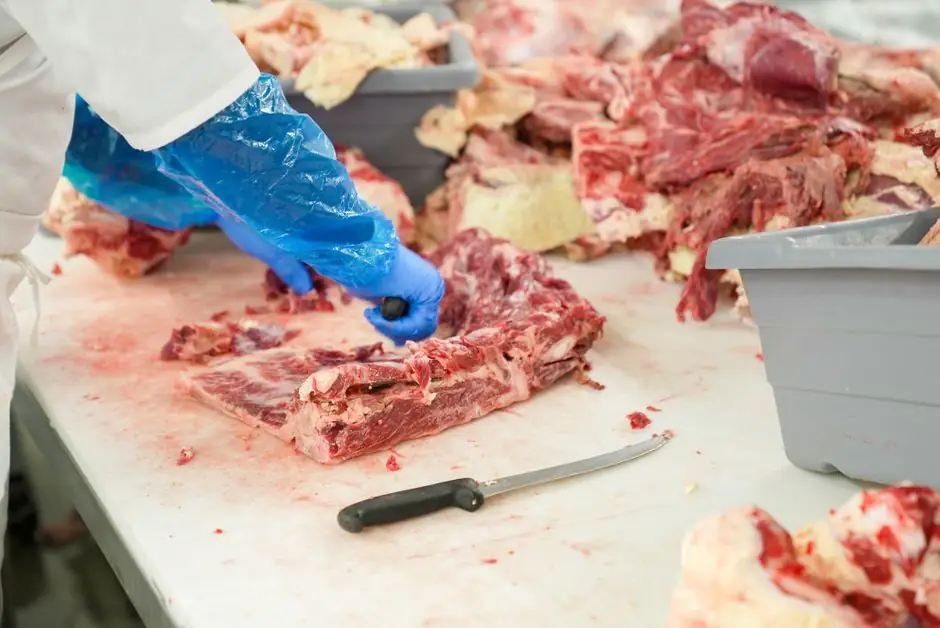
Meat, poultry, and sausage lines have a different priority order: hygienic monolithic thermoplastic on the product-contact run, FDA- and EU-compliant V-belts on the drive side, and metal/X-ray-detectable compounds to ensure any belt fragment is intercepted by the inspection system [S1][S3][S9]. Seafood, dairy, and ready-meal operations typically run high-moisture wash-down with acidic or chlorinated cleaners, so the V-belt cover must be rated for the specific cleaning chemistry, not just for incidental water splash [S1][S3].
Comparison: V-Belt Options for Food Processing Drives
The three practical V-belt choices on a food line (wrapped rubber, polyurethane, and monolithic thermoplastic/positive-drive) trade off against four decision criteria: hygienic rating, chemical resistance, temperature ceiling, and cost per drive [S1][S3][S4][S5]. Wrapped rubber V-belts are the lowest-cost, widest-temperature option with established service-factor data (1.0-1.8) and FDA/EU cover compounds available, but the fabric ply layers can trap bacteria and are not considered hygienic by EHEDG [S3][S4][S5]. Polyurethane V- and ribbed belts give smoother running and good chemical resistance at higher unit cost, with FDA/EU grades common, and are a good fit for enclosed gear-motor drives where dust and water splash are limited [S5]. Monolithic thermoplastic positive-drive belts win on hygienic rating and cleanability but sit at the top of the cost range and require matched sprocket geometry rather than standard V-groove pulleys [S3].
For most food-line V-belt drives, the practical specification is a wrapped rubber or polyurethane FDA/EU V-belt with a service factor of 1.2-1.6, a cogged cross-section (3V or 5V, or A/B/C) sized to the smaller pulley's published minimum, anti-microbial cover, and a metal- or X-ray-detectable compound, paired with stainless or food-grade belt tensioner hardware so the accessories carry the same compliance rating as the belt [S1][S4][S5]. A related deep dive on compliance-criteria selection for synchronous drives sits in this food-grade timing belt selection reference for lines where positive-drive eliminates slip on coated or sticky products.
Installation, Maintenance, and Failure Modes on Food Lines
Even a correctly selected V-belt will fail prematurely if install and maintenance discipline slips, and on a food line the failure mode is product contamination rather than a clean mechanical stop [S4]. Correct tension, accurate pulley alignment, and avoidance of over-contaminated or undersized pulleys are the three controls operators are expected to follow, with tension typically rechecked after the first 8-24 hours of run-in as the belt beds in [S4].
On wash-down lines, scheduled visual inspection of the cover compound for chemical attack, swelling, or cracking, plus verification that V-guides, tensioner pulleys, and idlers are themselves food-grade, is the difference between a 12-month belt life and a 3-month belt life [S3][S4]. Tracks worth watching in 2026 include wider adoption of metal- and X-ray-detectable V-belt compounds as inspection systems become standard on more lines, and continued displacement of fabric-plied PU/PVC belts by monolithic thermoplastic and high-grade polyurethane in EHEDG-aligned facilities [S1][S3].