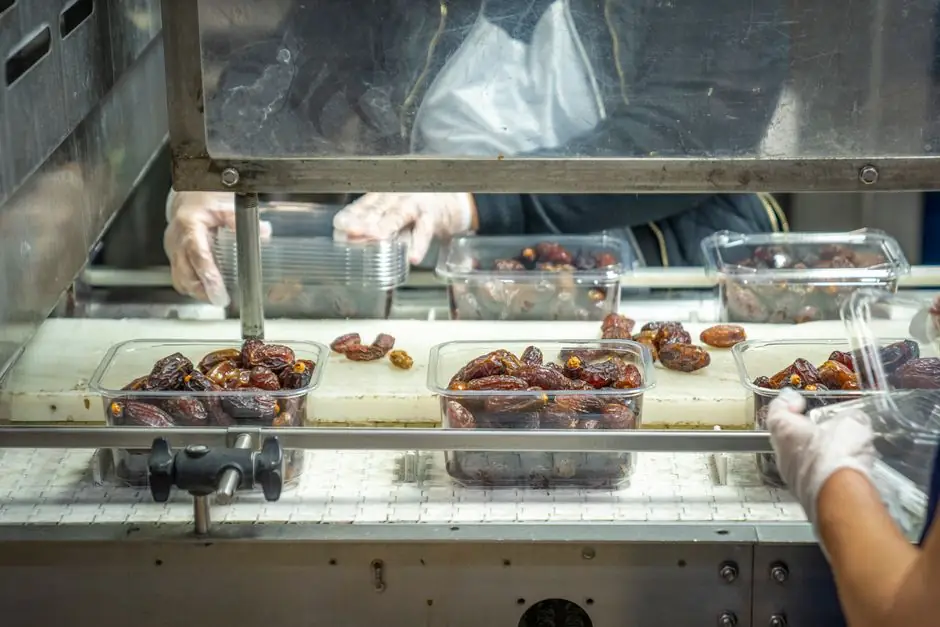
Standard neoprene timing belts are not food safe; any belt in the product zone of a USDA-inspected facility must be polyurethane construction compliant with FDA 21 CFR, with color options including blue, white, and metal-detectable variants [S2].
Food processing drives typically span seven application classes (bakery, confectionery, meat/poultry, dairy, beverage, produce, frozen), and each class maps to a specific pitch (T5, XL, 5M, 8M, L, H) and tensile cord (steel, fiberglass, Kevlar/Aramid) [S2][S5].
Why Neoprene Fails in a USDA Zone
Neoprene (chloroprene rubber) absorbs moisture, swells under washdown, and degrades when exposed to peracetic acid and chlorinated cleaners commonly used in CIP cycles, while its nylon-faced teeth can harbor bacteria in food-contact zones [S2]. The practical consequence is that HACCP, SQF, BRC, and FSSC 22000 audit programs commonly require every belt in the product zone to be food-grade material in a detectable, non-food color, even if direct contact does not occur [S2]. Polyurethane belts rated for food contact resist animal fats, vegetable oils, and mineral oils, and they are available in colors that support optical and metal-detection inspection [S2][S5].
This material shift is the single largest specification change when porting an industrial drive into a hygienic environment, and it ripples into the timing belt selection table used by maintenance and OEM engineering alike.
Profile and Cord Selection by Application
Food-grade urethane timing belts are offered in most standard metric and inch profiles, with the right profile governed by drive torque, speed, and the timing pulley geometry already on the machine [S2]. For bakery, confectionery, and food packaging, the common picks are 5M, XL, and L with steel cord where registration is critical (enrobers, form-fill-seal, indexing conveyors), or fiberglass cord on general-purpose high-speed beverage drives [S2].
Meat, poultry, seafood, and pet food lines use heavier 8M or H pitches with steel or Kevlar cords to absorb shock from aggressive CIP/COP sanitation and to survive animal-fat exposure, while dairy and cheese lines favor 5M or T5 with steel or fiberglass to handle hot water washdown and lactic acid [S2]. Frozen-food and IQF applications specify 5M or 8M urethane with Kevlar cords for flex life at temperatures down to -40°F [S2]. Pharmaceutical and nutraceutical GMP/cleanroom drives typically run T5, AT5, or 5M with steel cord for positioning, where particulate shedding must be eliminated [S2].
Construction Details That Drive Hygienic Performance
Fully encapsulated tension members are the key construction feature that makes a food-grade belt impervious to water and oil intrusion, and they also extend service life in regular washdown conditions [S5]. The AU1 blue polyurethane compound used in BRECOprotect® belts is FDA approved and the blue color is tuned for vision-inspection camera systems on automated lines [S5].
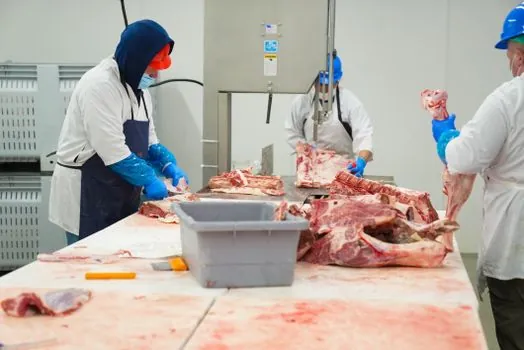
Advanced Meat Recovery (AMR) separator belts pair Aramid tension members with a high-performance FDA-approved coating and fully sealed edges, with available surface texture on one or both sides; standard sizes run 1300-3000 mm long and 150-300 mm wide [S5]. Form-Fill-Seal (FFS) belts are made truly endless with no seams, typically in T-series pitch with coatings such as yellow polyurethane, red rubber, or blue silicone, often machined with vacuum holes so the belt can grip and hold packaging during the fill cycle [S5].
Enclosed belt edges with no coiling noses prevent detergents and water from reaching tension members, and FDA-grade backings such as White Linaplus, PVC White FDA, Supergrip White FDA, PVC Blue FDA, White Herringbone, and White Nub allow standard timing-belt cores to be repurposed for food, film, and pharma contact surfaces [S4][S5]. White PVC, white Supergrip, herringbone profile, white studs, and sawtooth profiles are also flagged as particularly suitable for food-industry conveyors [S6].
Decision Comparison: Cord vs Profile vs Temperature
Steel cord gives the highest registration accuracy and the lowest stretch, but it is the least tolerant of repeated bending at very low temperatures; Kevlar/Aramid cord trades some stiffness for cold-flex life, which is why IQF and frozen-food lines specify it [S2]. Fiberglass cord is the standard pick for high-speed beverage bottling where corrosion from chlorinated wash water is a concern but registration tolerance is wider [S2].
Service-life references from general industrial timing-belt use land in the 15,000-30,000 hour range under proper tensioning, alignment, and load management, and that range is commonly cited as the inspection interval for predictive replacement in continuous-process plants [S3]. Misumi selection tables for food-adjacent equipment such as mixers, granulators, and centrifuges show service multipliers (1.2-1.9) that engineers apply to base ratings when shock, dust, or washdown is present [S9].
Compliance, Detection, and Audit Reality
Forbo Movement Systems' Food Line timing belts are explicitly compliant with FDA and EU/EC regulations, with easy-clean surfaces that resist cleaning-agent chemicals and temperature exposure, and with enclosed belt edges that block detergent ingress to tension members [S4]. A practical specification must state the FDA title (21 CFR) and the EU food-contact framework, the color (blue or white for vision systems, metal-detectable for stray-fragment control), and the intended profile so the belt tensioner and idler stack can be verified for the new belt width and pitch [S2][S4].
Specifying a higher service-factor multiplier than the OEM table lists is normal when a line sees daily CIP, because chemical attack and thermal cycling shorten elastomer life well before the catalog hour rating is reached; this is also why belt conveyor OEMs in food plants pre-size for a shorter replacement interval than in dry-goods plants.
Common Failure Modes and Selection Pitfalls
The three most common field failures on food lines are (1) tooth shear from under-spec cord on high-torque starts, (2) edge wicking and tension-member corrosion on belts that lack encapsulated edges, and (3) microbial growth in nylon-fabric-faced neoprene belts used in the product zone [S2][S5]. Each failure mode is addressed by a different lever: a heavier pitch (8M or H) and Kevlar/Aramid cord for shock, fully encapsulated tension members for washdown, and a switch from neoprene to smooth polyurethane for hygiene [S2][S5].
For drives that must also run a chain belt or flat-belt section on the same line, the timing-belt portion still needs the same FDA 21 CFR construction; a mixed-material line does not relax the compliance requirement for any segment that touches the product zone [S2].
Track these signals going forward: published 2026 OEM selection tables from Misumi, Contitech, and Forbo for food-rated T5/AT5 and 8M profiles, and any new FDA 21 CFR food-contact amendment that touches polyurethane or Aramid-cord tension members; both are realistic near-term triggers for a re-spec on an existing line.
Engineers sizing a new bakery, dairy, or IQF line in 2026 should default to 5M or 8M urethane with encapsulated steel or Kevlar cord, blue or metal-detectable color, and an FDA 21 CFR + EU/EC compliance statement on the datasheet, then verify pitch against the existing flat belt and chain belt sections to keep the spare-parts inventory rationalized. For a broader look at how meat, dairy, and bakery line build-outs are shaping the 2026 food processing equipment order book, see this order-book analysis.