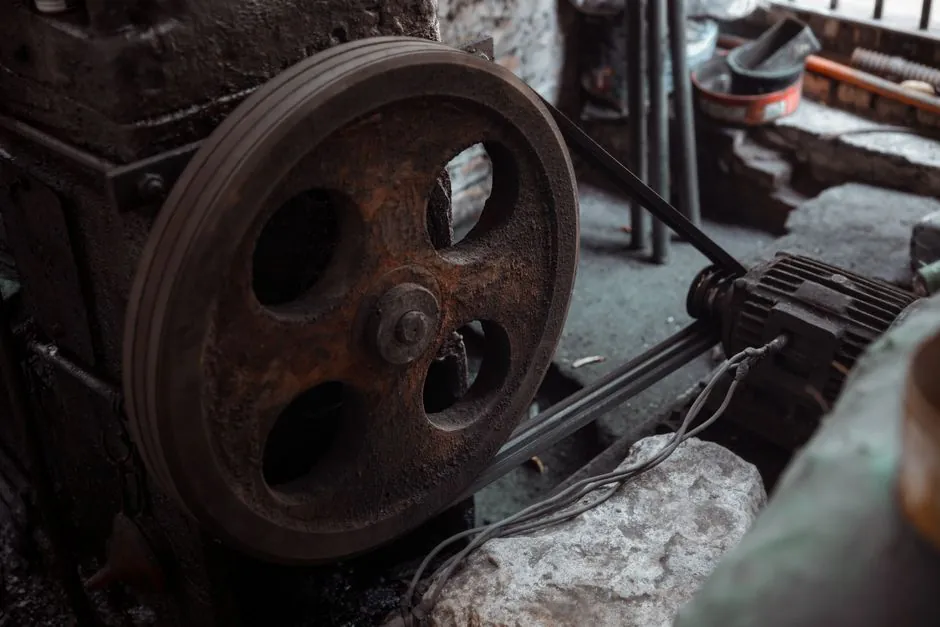
Steel-mill V-belt selection is governed by Design Horsepower, the product of motor nameplate HP and a service factor that, for crushers, mills, and hammer mills, ranges from 1.4 to 2.0 under normal-to-heavy shock duty [S1]. The same source recommends 1.4 to 1.6 for bucket elevators, piston pumps, and reciprocating compressors, ranges that map directly onto the pulverizer, blower, and roll-table drives common in integrated mills [S1]. Bestorq's published quick guide compresses that into a 1.3-1.8 window for "crushers, mills, rubber calenders," which catches most rolling-mill auxiliaries [S4].
Selection then collapses to five concrete decisions: belt cross section (A/B/C/D/E classical, or 3V/5V/8V narrow wedge), wrapped vs. cogged (raw-edge) construction, belt length, number of belts per drive, and sheave groove compatibility. The V-belt cross section is sized off Design HP per belt and the faster shaft RPM, with classical C-section typically carrying 15 to 100 HP and D-section 50 to 250 HP per drive [S1]. For new steel-mill builds, narrow wedge (5V, 8V) is the default because it delivers more power per belt and tolerates smaller sheaves, which is often the binding constraint in retrofit packages.
Service Factor Bands by Driven Equipment
Service factors for steel-mill driven equipment cluster in the 1.2-2.0 band, and a misread of 0.2 is enough to put a drive one cross-section too small [S1]. Belt conveyors, screw conveyors, and line shafts sit at 1.2-1.4 normal and 1.4-1.6 heavy, which covers most mill material-handling fans. Centrifugal pumps and centrifugal fans stay at 1.0-1.4, but reciprocating compressors and piston pumps jump to 1.4-1.8, reflecting their cyclic torque [S1]. A 10 HP motor on a reciprocating compressor therefore becomes 14 Design HP at 1.4, and 18 Design HP at 1.8, a 28% swing that pushes the cross-section up at least one step [S1].
For primary metalforming equipment, the multipliers get harsher: crushers, mills, and hammer mills run 1.4-1.6 normal and 1.6-2.0 heavy or shock [S1]. Bestorq publishes 1.3-1.8 for the same family of equipment, which lines up within rounding tolerance and is the figure most procurement engineers quote on a steel-mill RFQ [S4]. When the application is unclear, Bestorq's quick guide states plainly that the higher service factor should be used, because the cost difference between a correctly and incorrectly applied belt conveyor drive V-belt is trivial against the cost of a 30-minute hot-strip mill stoppage [S4].
Classical vs Narrow Wedge vs Cogged: Section Comparison
The three practical families for steel-mill service are classical wrapped (A/B/C/D/E), narrow wedge wrapped (3V/5V/8V), and cogged (raw-edge) variants (AX/BX/CX/3VX/5VX/8VX). Classical sections are the default for replacing belts on existing classical-groove sheaves because the groove angles match, and they cover Design HP per belt from under 1 HP (FHP, 3L/4L/5L) up to 500+ HP (E-section, multi-belt) [S1]. Narrow wedge sections deliver more HP per unit width, allow smaller sheaves, and are the recommended choice for new drive designs [S1].
Cogged (raw-edge) belts, with molded notches that increase flexibility and reduce bending stress, are well suited to drives with smaller-diameter sheaves and to high-temperature environments where wrapped belts would lose life [S2, S5]. They are the upgrade path when the existing sheave diameter is at or below the classical minimum, a common constraint on legacy mill auxiliaries retrofitted with new motors. The MISUMI Mech Lab blog lists classical profiles A through E plus metric (SPZ/SPA/SPB/SPC) families as the principal size systems in use today, with cogged variants offered in both [S3].
Decision rule: pick classical wrapped when sheaves are existing and groove-compatible, narrow wedge wrapped when the drive is new or the sheaves can be re-grooved, and cogged raw-edge when sheave diameter is the binding constraint or ambient temperature at the drive exceeds the wrapped-belt ceiling. For steel mills with belt tensioner-equipped take-up rails, cogged variants also run cooler because the notches increase surface area for heat rejection [S5].
Design HP and Cross-Section Mapping for Mill Auxiliaries

Cross-section selection in steel mills follows a fixed Design HP per belt vs. classical/narrow wedge/cogged table, with hard overlap zones that drive the number-of-belts decision [S1]. At 1-25 HP per belt, the choices are B-classical, 5V-narrow wedge, or BX/5VX cogged; at 15-100 HP, C-classical, 5V or 8V narrow, or CX/5VX/8VX cogged; at 50-250 HP, D-classical, 8V narrow, or 8VX cogged; at 100-500+ HP, E-classical, 8V multi-belt narrow, or 8VX multi-belt cogged [S1]. When Design HP per belt falls in the overlap (e.g., 15 HP touches both B and C), the smaller section with more belts is usually cheaper per belt; the larger section with fewer belts is simpler to tension and maintain [S1].
For a typical steel-mill 75 kW (about 100 HP) coiler or table-roll drive, the practical answer is a 5VX or C-section cogged matched set, with three to five belts per sheave set. This configuration is consistent with what chain belt alternatives are often weighed against on tonnage-sensitive lines, because the chain-belt path uses a single strand and shifts the failure mode from slippage to elongation.
Belt Length, Center Distance, and Sheave Diameter
Belt length is set by sheave diameters and center distance, and a caliper measurement of belt width plus an outside-circumference roll-out on a tape are the two field measurements that drive a replacement order [S3]. For a new drive, the length is solved from sheave pitch diameters and the center distance, then snapped to the nearest stock length; the catalog stock range typically runs from under 500 mm up to several meters depending on section [S3].
Sheave diameter is the silent killer: pulleys smaller than the section's recommended minimum significantly reduce belt life regardless of the belt's HP rating [S4]. The Gates heavy-duty design manual states that cogged (notched) belts are well suited to drives with smaller-diameter sheaves specifically because the notches lower the bending stress at the same pulley diameter [S2]. Steel-mill drives with restricted shaft spacing, common on skid-transfer and coil-handling auxiliaries, are the canonical case for moving from wrapped classical to cogged narrow wedge [S2, S4].
Construction and Material Choices for Mill Environments
Wrapped belts have an outer fabric jacket that protects the tensile cords from oil, dust, and abrasion, and are the workhorse on enclosed gearboxes and motor pads [S5]. Cogged (raw-edge) belts expose the rubber compound, so they tolerate higher operating temperatures and run quieter, but they need cleaner sheave grooves and are more sensitive to oil contamination [S5]. For drives close to rolling-mill lube systems, oil-resistant chloroprene or neoprene compounds are typically specified, with antistatic construction mandatory in any drive near a classified area.
Edge machining matters on heavy belts: machined edges track truer under shock load and reduce turnover on misaligned sheaves, a frequent failure mode on long flat belt and V-belt mill drives that have settled on their bases [S2]. When ambient temperature at the drive exceeds the wrapped-belt ceiling (often quoted in the 80-90 deg C sustained range for chloroprene), the raw-edge cogged construction is the right move, with the trade-off that inspection intervals shorten because rubber ageing is visible at the cord line [S5].
Installation, Tensioning, and Field Maintenance
Correct installation is not optional: even a perfectly selected V-belt will fail prematurely without correct tension, accurate sheave alignment, and clean grooves [S4]. Force-deflection or sonic tension gauges are the standard field check, and the target deflection is typically 1/64 of the center distance per inch of span at the rated belt tension. Laser alignment tools, increasingly common in mill maintenance shops, take parallel and angular misalignment out of the installation loop and cut turnover-related failures dramatically.
Contaminated or undersized sheaves are flagged in two independent guides as a leading cause of premature failure, ahead of under-spec service factor [S1, S4]. On V-process line auxiliaries and similar dust-heavy mill drives, sheave groove cleaning should be on the same maintenance ticket as belt replacement, not a separate work order. Where take-up rails allow it, a belt tensioner keeps the drive in its elastic window across belt stretch and thermal cycles, but it cannot compensate for a section that is one size too small for the Design HP.
Track two signals through 2026: raw-edge cogged V-belt adoption in greenfield steel-mill packages, and OEM-published updates to heavy-duty design manuals following the recent consolidation in industrial V-belt brands. Both will move the recommendation matrix on cogged vs. wrapped for high-ambient drives within the next selection cycle. For a deeper cross-check on related powertrain component selection, see this walkthrough of universal joints for packaging lines, which uses a comparable spec-first selection logic.