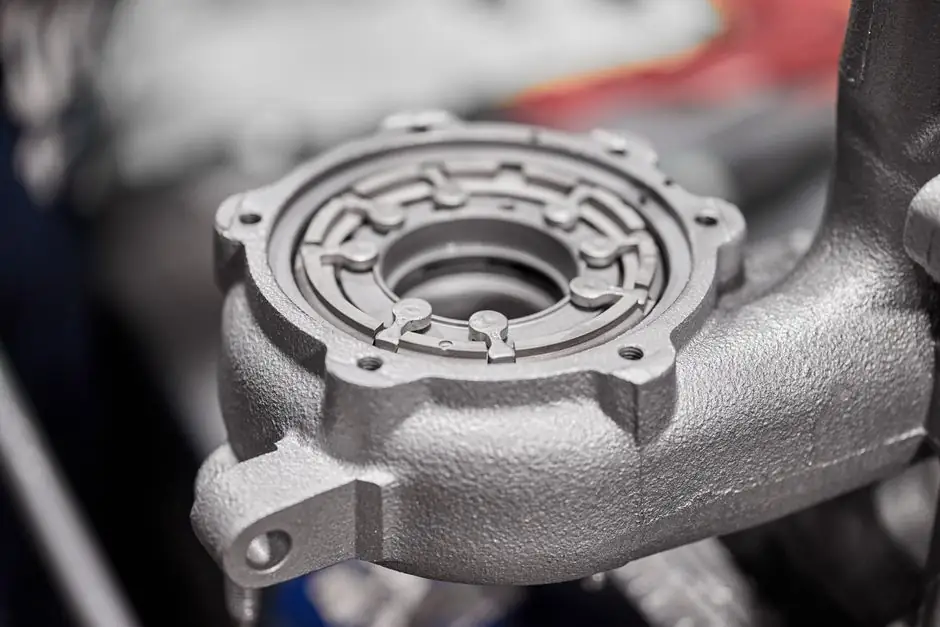
V-Process molding lines deliver binder-free sand castings with 50-100 kPa vacuum differential, 0.05-0.2 mm plastic film, and tolerances of ±0.2-0.5 mm per 25 mm, making them a fit for hardware foundries evaluating clean-room, low-emission casting cells [S2].
Originally developed in Japan in the early 1970s, the V-Process (vacuum sealed molding of unbonded sand) holds dry silica sand rigid through atmospheric pressure acting on a heat-formed plastic film over a metal pattern, then releases the vacuum after solidification so the sand collapses and is recovered for near-100% reuse [S1][S2].
Process Boundaries: Where V-Process Fits, Where It Does Not
V-Process sits between green sand and resin-bound systems: it uses dry unbonded silica sand compressed by vacuum rather than clay, water, or chemical binders, so foundries avoiding resin smoke, VOC abatement, or sand reclamation kilns are the primary adopters [S2]. Hardware categories that pair well with this profile include door and window castings, architectural ironmongery, plumbing fittings, and pump or valve bodies, all of which tolerate the achievable Ra 6.3-12.5 µm finish with light machining [S2].
The process is a poor match for runs under a few hundred pieces per pattern (the film and vacuum overhead does not amortize), for steel pours above roughly 1450 °C where film survival becomes marginal, and for foundries that need shell-type thin walls below 4 mm, since dry sand transmits impact less efficiently than resin-bonded systems. For a comparison of binder-bound alternatives on the same problem class, see resin sand line selection for telecom enclosure castings.
Selection Criteria: Vacuum Pump, Flask, Film, and Control Stack
Four hardware blocks decide whether a V-Process line is fit for purpose: vacuum pump capacity sized to the flask envelope at 50-100 kPa differential, an airtight molding flask with quick-seal gaskets, a thermoplastic film heating and draping station (0.05-0.2 mm EVA or similar), and a vacuum control unit with leakage monitoring [S2].
A practical pump sizing rule is to target a leak rate below 5 kPa/min on a fully assembled flask, since film pinholes and seal degradation show up first as a pressure-decay curve rather than as a visible defect. For medium hardware (flask 800-1200 mm), a 2-4 kW oil-sealed rotary vane pump is typical; for flask sizes above 1500 mm or for steel-density pours, plan for a 5-7.5 kW pump or a paralleled pair with non-return isolation. Foundries integrating V-Process into a broader molding line should also rate the vibration table for the loaded sand mass, not just the empty flask.
Comparison: V-Process vs Green Sand vs Resin Sand vs VARTM for Hardware
Against the three most common alternatives a hardware foundry weighs, V-Process scores on emissions and surface, but trades off on pattern lead time and wall thickness. Green sand is cheaper per flask and faster on small runs, but the moisture window limits dimensional control; resin sand gives the strongest thin walls yet carries binder cost and reclamation load; V-Process sits in the middle on cost and at the top on surface and emissions [S2].
VARTM (vacuum-assisted resin transfer molding) shares the vacuum-pressure physics but operates on fiber preforms and catalyzed resin, not on unbonded sand and molten metal, so it is not a substitute for sand casting hardware and only appears here as a reference for the vacuum-bag-handling knowhow that has migrated into modern V-Process film stations [S3]. For a broader automatic molding line view covering green and flask lines, the pattern-handling and flask-transfer subsystems are directly comparable; V-Process adds the vacuum manifold and film draping but reuses the same flask shuttle logic. A side-by-side on the four decision axes:
1. Surface finish: V-Process Ra 6.3-12.5 µm beats green sand (typically Ra 25-50 µm) and approaches resin sand, well above VARTM which targets composite laminate, not metal, surfaces [S2].
2. Tolerance: V-Process ±0.2-0.5 mm/25 mm is roughly 2-3× tighter than green sand, comparable to shell resin sand, and tighter than the fiber-volume tolerance VARTM can hold on thick laminates [S2][S3].
3. Emissions and reclamation: V-Process is binder-free with near-100% sand reuse, against the binder smoke and reclamation burn-out needed for resin sand, and the moisture-handling burden of green sand; VARTM emits residual VOCs from the resin system [S2][S3].
4. Capex and throughput: V-Process lines sit between green sand (lowest) and resin sand (highest), and the v-process line capex driver is the flask size and pump capacity, not the molding machine itself [S2].
Hardware and Film Specifications Worth Pinning in the RFQ
For hardware castings such as handles, hinges, brackets, and decorative ironmongery, pin the following in any supplier RFQ: flask internal dimensions with ±2 mm flatness, vacuum decay rate below 5 kPa/min on a sealed empty flask, film thickness 0.05-0.2 mm with a defined draw temperature window, vibration table frequency and amplitude, and a documented sand recovery loop showing the re-use ratio over at least 10 cycles [S2].
As-cast finish Ra 6.3-12.5 µm is achievable straight off the process, which lets hardware buyers skip shot-blasting on visible faces and reserve machining for bearing fits and threaded bores only. A useful tie-in for foundries already running other architectural hardware finishing cells is that the same surface envelope holds across hand-forged and cast components, simplifying the cosmetic QC plan.
Common Failure Modes and Sourcing Signals to Track
Three failure modes dominate V-Process commissioning and steady-state runs: vacuum leaks at flask seals (caught by the decay-rate test above), film thinning at deep pattern draws below 1.5 mm radius, and sand contamination from foreign debris that punctures the back film during pour [S2]. Each has a trackable signal: rising pump duty cycle, rising reject rate on deep-draw cores, and rising inclusion defects respectively.
Two further signals worth tracking through 2026 are the supply of 0.05-0.2 mm EVA-grade film in widths matching the largest flask, and the availability of replacement vacuum pump vanes on local service, since downtime on either is the single largest contributor to lost tonnage in V-Process cells. Foundries that benchmark against the v-belt drive service intervals on adjacent equipment tend to under-schedule vacuum pump service by 30-40% in the first year, a pattern that flattens once a leak-test cadence is enforced.