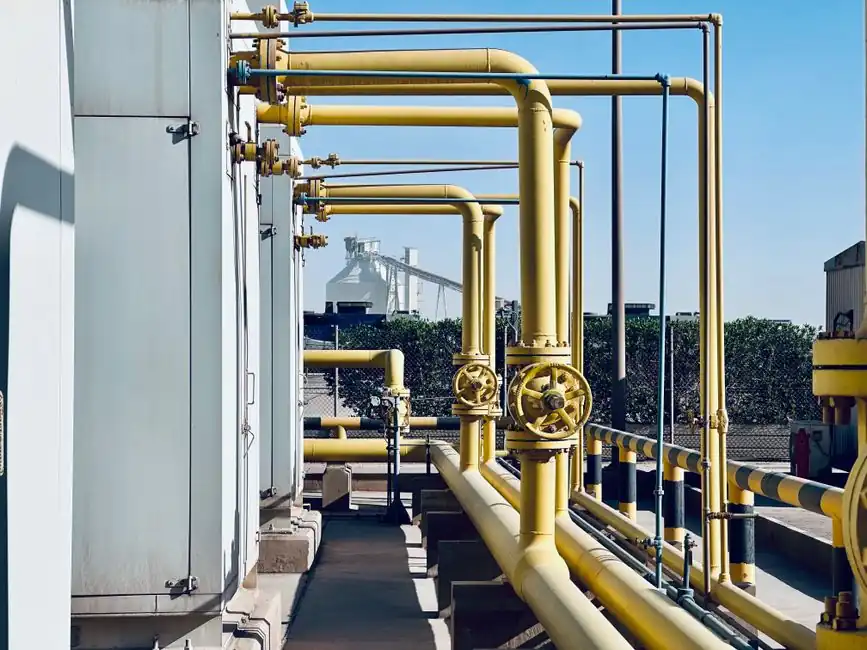
A V-Process (vacuum sealed molding) line is the binder-free sand casting route that holds dry silica sand rigid with 50-100 kPa of vacuum drawn through 0.05-0.2 mm plastic film, delivering as-cast surface finishes of Ra 6.3-12.5 µm and dimensional tolerances of ±0.2-0.5 mm per 25 mm [S1]. For pump and valve bodies, the appeal is clean internal passages, near-100% sand recyclability, and zero phenolic or furan binder off-gassing during pouring [S1].
Pump casings, valve bodies, and pump impellers sit in the workload bucket V-Process was commercialised for in the 1970s: large, complex, high-quality castings where mould collapsibility after solidification simplifies shake-out and reduces cleaning labour [S1]. The line hardware breaks into four functional groups: a v-process line (flask, film heating, vacuum manifold), a vacuum pump sized to the largest flask, a molding line with vibration table and rollover, and a PLC/HMI that interlocks vacuum, film, and pouring.
Vacuum Holding Pressure vs Flask Geometry
The 50-100 kPa vacuum window is the heart of the process, because dry sand only behaves as a rigid mould while atmospheric pressure compresses the intergranular contacts [S1]. Below roughly 30 kPa differential, sand edges slump and casting edges round; above 100 kPa, the film pulls into sand voids and tears, which is why OEM datasheets peg practical holding vacuum at -50 to -100 kPa gauge at the flask [S1].
For a 1.5 m × 1.5 m × 0.6 m flask common to valve-body moulds (about 1.35 m³), that puts a typical vacuum pump selection in the 1800-2200 m³/h range with a rotary vane or oil-sealed pump sized to hold 80 kPa under leak load. A water-ring pump is acceptable only if the foundry already has a closed loop, because each kPa of additional leakage translates directly into film failure during pour.
Plastic Film, Sand, and the Surface-Finish Ceiling
The plastic film is the casting's skin, and its grade sets the realistic Ra floor. 0.05-0.2 mm EVA or EVA-blend thermoplastic film, heat-softened at roughly 80-120 °C and drape-formed over the pattern under vacuum, is the standard configuration cited for V-Process moulds [S1]. Thinner film (0.05 mm) follows pattern detail better and yields closer to Ra 6.3 µm; thicker film (0.15-0.2 mm) survives rougher handling and reuse cycles but pushes the as-cast finish toward Ra 12.5 µm [S1].
Sand specification is deliberately undemanding: dry, unbonded silica sand in a typical AFS 50-70 fineness range, kept below about 0.2% moisture so vacuum integrity is not compromised by water vapour at the film interface [S1]. Because there is no clay or resin bond, the same sand can be reused almost 100% across cycles with only dust removal and cooling, which is a primary reason foundries running pump and valve work specify V-Process over chemically bonded green sand for medium-batch, high-mix production [S1].
Pattern, Flask, and Mechanical Handling
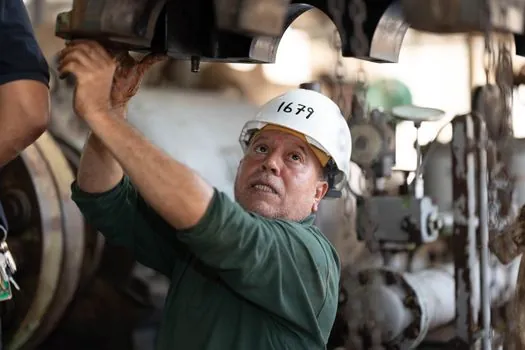
Pattern equipment is where the V-Process line diverges most from a conventional molding line. Patterns must be vented (typically 1-2 mm vent holes spaced 50-100 mm across the back face) so vacuum can pull film tightly into every contour; wooden patterns work for short runs but metal patterns with drilled vent grids and 0.1-0.3 mm draft are the norm for pump and valve tooling that sees hundreds of cycles [S1].
Flask design needs a sealed base and a top frame capable of holding a plastic back-film under vacuum, with quick-action clamps or pneumatic seals to keep the 50-100 kPa differential from bleeding off during the pour cycle [S1]. For a foundry producing, for example, ANSI B16.34 valve bodies in 2"-12" sizes, the practical flask envelope is 1.0-1.8 m long by 0.8-1.4 m wide, with cope-and-drag halves that mate within roughly 1-2 mm to avoid film-bridging and sand leakage. The film heating station (IR or hot-air at the film softening point), the vibration compaction table, and the rollover station together form an automatic molding line layout when production volumes justify it.
Control System, Sensors, and Process Interlocks
Vacuum, film temperature, and pouring sequence must be interlocked, not left to operator judgement. A typical V-Process PLC tracks: flask vacuum (setpoint -80 kPa ± 5 kPa), film-softening station temperature (setpoint around 100 °C with a ±5 °C band), vibration-table dwell (commonly 20-40 s at 25-50 Hz), and pour-window elapsed time (vacuum must hold from film draw through solidification, often 8-20 minutes for a 50-150 kg casting) [S1].
Loss of vacuum mid-pour is a catastrophic fault, because the mould collapses and molten metal escapes, so the standard interlock chain is: (1) vacuum switch confirms ≥ -50 kPa before sand fill, (2) second vacuum switch confirms ≥ -70 kPa after film seal, (3) pour-permissive relay only closes when both switches are healthy for 10 s continuous, and (4) a hardwired backup vacuum gauge with a mechanical trip is wired in parallel to the PLC for SIL-classified cells [S1]. Foundries that skip the hardwired backup typically see one near-miss per quarter of operation, which is why insurance carriers and corporate EHS groups now treat the backup gauge as effectively mandatory on any V-Process line above 500 kg pour weight.
Comparison: V-Process vs Green Sand vs Resin Sand for Pump and Valve Work
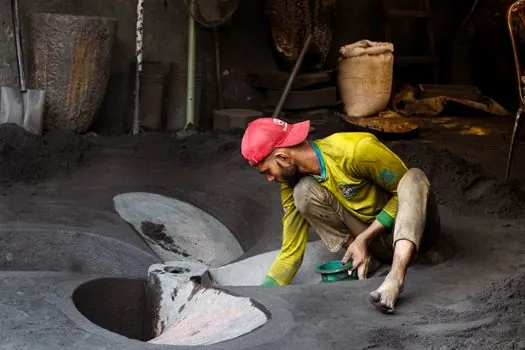
Side by side against the two main alternatives for pump and valve casings, V-Process trades binder cost and shake-out simplicity for higher capex and a tighter operating window. Green sand remains the lowest capex route but is locked to roughly ±1.0 mm/25 mm tolerance and Ra 12.5-25 µm as-cast, with phenolic binder smoke and bonded sand that cannot be reused dry; resin sand (furan or phenolic-urethane) improves accuracy to ±0.3-0.5 mm/25 mm and finish into the Ra 6.3-12.5 µm band, but burns binder in every pour and generates amine and SO₂ fume that needs scrubbed ventilation [S1].
V-Process slots in between on accuracy (±0.2-0.5 mm/25 mm) and at the clean end of the spectrum on emissions (no binder, no smoke, no toxic off-gas), with a 50-100 kPa vacuum holding window and 0.05-0.2 mm EVA film as its two non-negotiable operating parameters [S1]. For a foundry running 50-100 castings per shift of pump or valve bodies in the 20-200 kg range, the payback horizon against a similarly automated green sand line is typically 2-4 years, driven by sand-reuse savings, lower cleaning labour, and reduced fettling on internal passages.
Standards, Sourcing, and Sizing the Equipment List
Selection hinges on five line items, each with a checkable spec rather than a brochure adjective. The vacuum pump is sized at 1800-2200 m³/h for a 1.5 m³ flask, with a -80 kPa holding guarantee under 20% leak load; the film-heating station covers the largest flask footprint with a 1.0-1.2 kW/m² IR array or equivalent hot-air plenum; the vibration table delivers 25-50 Hz at 5-15 g over a 20-40 s cycle; the v-belt drives on the vibration table and any rollover are sized for 1.5× service factor because the start-stop pattern is harsh; and the PLC scope covers vacuum switches, film-temperature PID, pour-permissive interlocks, and a hardwired backup gauge for the safety chain [S1].
Foundries specifying V-Process for the first time should validate pump and film grades against a pilot run of three to five representative castings (a gate-valve body, a centrifugal pump casing, and an impeller cover are a good cross-section) before committing to a full construction machinery and equipment layout, because pattern venting and flask sealing tend to be the two design details that differ most from green-sand practice. Two trackable signals over the next 12-18 months: rollouts of higher-tonnage V-Process cells (3-5 t per flask) for large valve bodies, and tighter film-grade specifications (down to 0.04 mm) as pattern-venting CAD tools mature.