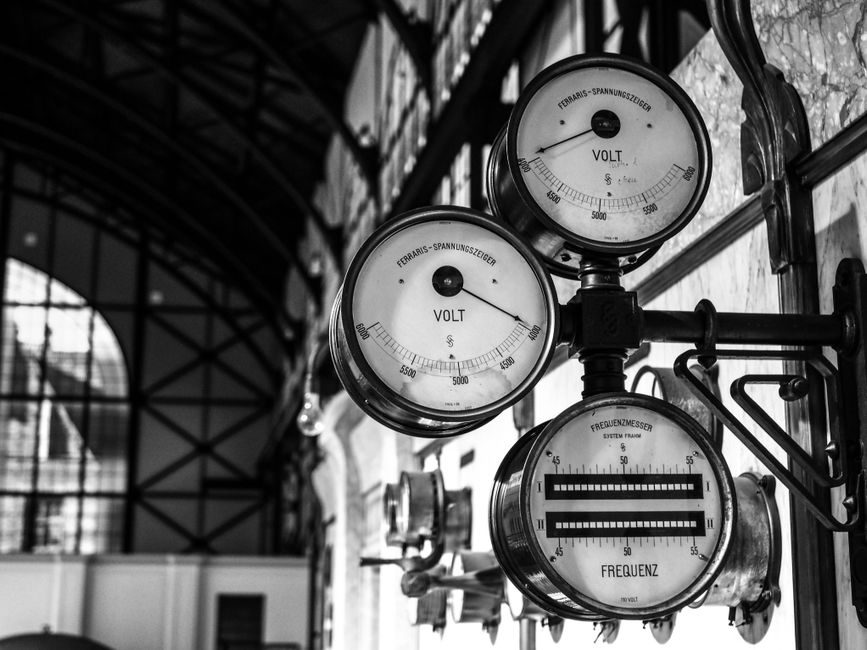
Industrial vacuum measurement in 2026 splits cleanly into four sensing families — Pirani, cold-cathode (inverted magnetron/Penning), capacitance diaphragm, and Bourdon tube — each covering a defined decade band of the vacuum spectrum, with hybrid FullRange® units bridging the atmospheric-to-UHV gap [S1][S2][S3][S4].
For a process engineer writing a 2026 spec, the buying decision is governed by four axes: full-scale pressure range, gas-type dependence, media compatibility (corrosive vapours, solvents, food-grade), and signal output (analog dial, 4–20 mA, digital RS-485/Profibus, Bluetooth telemetry). Range alone rules out most sensors — a Bourdon tube tester that maxes at negative-pressure canned-food sampling is the wrong instrument for a semiconductor load-lock, and a 10⁻⁹ mbar cold-cathode head is wasted on a HVAC evacuation line.
Pressure range: which sensor covers which decade band
Pirani thermal-conductivity gauges from Pfeiffer Vacuum's RPT 200 series span 1,200 mbar down to 1×10⁻⁴ mbar in a single digital instrument, covering rough, fine, and the upper edge of high vacuum in one head [S4]. Cold-cathode/Penning heads extend the lower end: the PTR 91 FullRange® unit pairs Pirani and cold-cathode in one housing for a 1,000 mbar to 5×10⁻⁹ mbar full-scale sweep [S1]. Capacitance diaphragm gauges such as the Azbil SPG sit in the 0.2 mbar to 1,000 mbar rough-to-fine band with sapphire diaphragms for chemical resistance [S2]. Bourdon tube instruments like the AMETEK Model 534 are destructive-sample negative-pressure testers for canned-food lines, not continuous process gauges [S3].
Sensing technology trade-offs: gas-type dependence and media compatibility
Pirani gauges use thermal conductivity of the gas, so readings shift with gas composition — a known pain point when evacuating refrigerant blends versus dry nitrogen on a heat-pump line, where Testo markets Bluetooth-enabled gauges specifically for HVAC/refrigeration evacuation [S8]. Cold-cathode (magnetron/Penning) sensors measure ion current and are gas-type sensitive in a different way — they tolerate corrosive residues better than hot filaments but fail in the presence of high vapour loads without protection. Capacitance diaphragm units use a sapphire or Inconel diaphragm whose deflection is capacitance-read out; they are inherently gas-type independent, which is why Azbil specifies the SPG as chemical-resistant for solvent and steriliser service [S2]. Bourdon tube mechanical gauges measure only relative pressure, are gas-type independent, and are limited to rough vacuum and canned-product leak testing [S3].
Output, display, and remote-monitoring requirements in 2026

Output choices have multiplied since 2024: analog dial only (Model 534 [S3]), analog + digital display (RPT 200 [S4]), digital/analog/head-mount blind variants (SPG [S2]), and Bluetooth-tethered evacuation gauges that stream to a smartphone or tablet during HVAC commissioning [S8]. Industrial PLC integration is now standard on Pirani and capacitance lines via 4–20 mA, RS-485, and Profibus, while cold-cathode combo heads typically expose setpoint relays for interlock with roughing pumps. For field evacuation where no PLC is present, a Bluetooth gauge cuts the leak-search loop dramatically on refrigeration and heat-pump work [S8].
Selection criteria: building a 2026 decision matrix
The four-axis comparison below is the working matrix for any 2026 vacuum-gauge RFQ. The right column gives the decision driver. [S1]
1. Pressure range — Bourdon < 0 mbar gauge only; capacitance diaphragm 0.2–1,000 mbar; Pirani 1×10⁻⁴–1,200 mbar; cold-cathode/Penning 1×10⁻⁹–1×10⁻³ mbar; FullRange® combo to span both Pirani and cold-cathode bands in one head [S1][S2][S3][S4].<br/>2. Gas-type dependence — Pirani and cold-cathode both read differently for N₂ vs Ar vs refrigerant blends; capacitance diaphragm and Bourdon are gas-type independent [S2][S3][S8].<br/>3. Media/corrosion resistance — sapphire-diaphragm capacitance and ceramic-protected cold-cathode survive solvents and acid vapours; standard Pirani filaments degrade in corrosive service; Bourdon stainless+rubber-gasket heads are food-canning specific [S1][S2][S3].<br/>4. Output/display — analog dial for local-only destructive tests; 4–20 mA / RS-485 / Profibus for PLC; Bluetooth for HVAC field evacuation; digital heads for cleanroom and load-lock UHV work [S2][S3][S4][S8].
Who this guide is for — and who it is not for

The industrial sections above are written for process engineers specifying gauges for semiconductor load-locks, freeze-dryers, vacuum furnaces, analytical instruments, HVAC/refrigeration evacuation, and canned-food vacuum testing [S1][S2][S3][S4][S8]. Readers shopping for residential stick, robot, or wine-sealant consumer vacuums should look elsewhere — the only industrial overlap with consumer product reviews is the HVAC evacuation niche, which is the segment where Bluetooth gauges first crossed over from lab use [S5][S6][S7][S10].
Limits, failure modes, and standard references
Each technology has a defined failure mode worth pre-empting in the spec. Pirani filaments burn out in oxygen-rich or oil-contaminated chambers and shift calibration with gas mix. Cold-cathode heads need a feed-through voltage tolerance check; a sudden pressure spike can sustain the discharge and degrade the cathode. Capacitence diaphragm gauges are mechanically delicate — a single over-pressure event to atmospheric in a UHV line can rupture the sapphire diaphragm, and the replacement cost is roughly 60–80% of a new head. Bourdon tube testers are destructive: the stainless needle physically punctures the can, so they belong on a QC bench, not in-line [S1][S2][S3][S8]. Busch's VACTEST line and similar OEM metrology equipment now bundle these failure modes with manufacturer-side diagnostics on the head electronics [S9].
Cross-references inside the metrology handbook
Vacuum-gauge work usually sits next to a pressure gauge on a process line and shares its hygienic, portable, and process segments — see the 2026 cost breakdown in Pressure gauge price and cost guide: 2026 process, hygienic and portable segments. When the application is a differential reading across a filter or heat exchanger, the spec path is closer to a Differential Pressure Transmitter Buying Guide: 2026 Spec Comparison or Pressure Gauge vs Differential Pressure Transmitter: 2026 Selection Criteria. For line-cleanliness work, a linear guide on the chamber door or a height gauge on a fixtured load lock can ride alongside the gauge head. Rough-vacuum verification on a heat-pump evacuation is also a natural place to add a force gauge proof-load check on the hose clamp fittings. [S2]
Trackable signals for the rest of 2026: (a) cold-cathode + Pirani FullRange® combo heads extending their low-end range below 1×10⁻⁹ mbar in semiconductor-fab load-locks; (b) Bluetooth-enabled evacuation gauges moving from HVAC/refrigeration into chemical-vapour-deposition roughing lines; (c) sapphire-diaphragm capacitance units replacing legacy stainless diaphragms in solvent and steriliser service where the chemical-resistance claim is auditable [S1][S2][S8].