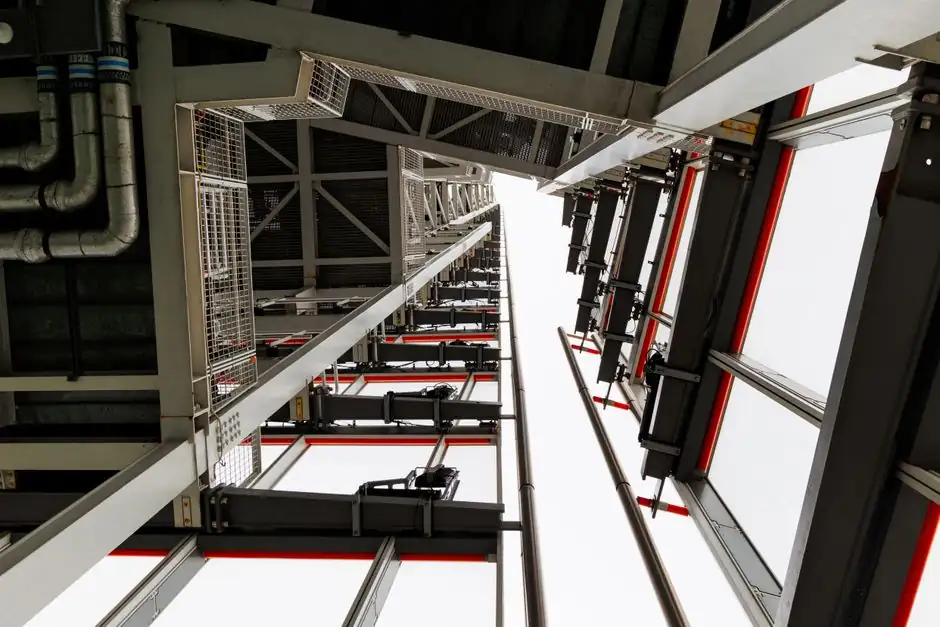
A Vertical Lift Module (VLM) uses an onboard height sensor that re-measures each tray's tallest load on every putaway, so the warehouse management system can re-rank SKU locations by turnover in real time [S2]. Inside two columns of trays flanking a central extractor, that ranking decides which item surfaces at the ergonomic access opening first when an order is released [S5].
The result is a shift from fixed to adaptive slotting: fast-moving stock is no longer chained to a single address, and golden-zone capacity is recovered automatically instead of by a periodic slotting review. Operators still see pick-to-light confirmation, but the underlying layout is fluid. White Systems and other integrators report 80–85% floor-space recovery when a VLM replaces static shelving, and the same control loop that wins back space also wins back picker travel [S5].
How dynamic slotting differs from fixed and random slotting
Fixed slotting keeps a SKU at one address forever, the default for high-turnover items whose pick frequency justifies a dedicated home; random slotting assigns whatever free address appears next, typically used for low-turnover items [S3]. Dynamic slotting breaks that lock-in: a height sensor re-measures stored item height on every putaway, the WMS updates an ABC turnover score, and the VLM's extractor sequence is re-ordered so the new fast-mover sits nearest the access opening on the next cycle [S2][S3].
Because the system knows the actual loaded height per tray, it can pack a 50 mm tall carton and a 350 mm tall carton into adjacent slots without wasting the air gap a fixed slot would reserve. For a process engineer this is the main difference: fixed slotting is a manual spreadsheet problem, dynamic slotting is a closed-loop control problem solved at the machine. The classic golden-zone rule, where the highest-velocity SKUs are kept in the easiest reach, is enforced by software instead of by a slotting analyst's quarterly review [S3].
Selection criteria: when dynamic slotting pays off
Dynamic slotting inside a vertical lift module pays off where three criteria line up: SKU count is high enough that fixed addresses become a constraint, order profiles are mixed so no single SKU dominates, and pick accuracy is being measured in error-rate per order rather than per shift. Kardex Remstar cites the cost of staying manual: 35% of warehouses run a fulfillment error rate of 1% or higher, a single order error can cut profitability by as much as 13%, and roughly 23% of orders are returned because customers receive the wrong item [S2].
VLMs are recommended for fast-moving SKUs in single-unit deployments in small warehouses, and they scale by adding units rather than by widening aisles [S1]. Where the workload is dominated by slow or medium movers, a VLM still works, but the height-sensor loop is less of a differentiator because the layout rarely needs to change; the system is then a dense storage device, not a slotting engine [S4]. For very small, consistent items in uniform cartons, a vertical carousel is often a better match, and a VLM is the right call only when mixed or irregular heights dominate the mix [S9].
Comparison: fixed, random, and dynamic slotting in a VLM
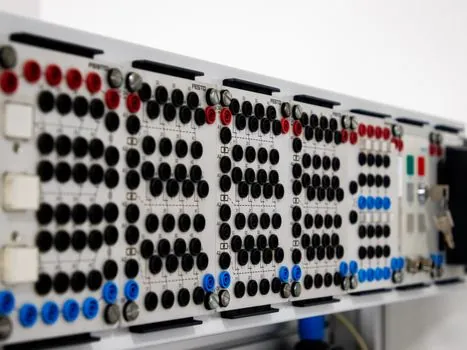
The three slotting modes line up clearly against four engineering criteria, drawn from the same VLM, MRO, and e-commerce deployments covered above [S2][S3][S4][S5].
Fixed slotting: best for predictable high-velocity SKUs, but it cannot recover floor space or re-prioritise when demand shifts; golden-zone churn is high because slow movers occupy prime addresses. Random slotting: best for slow movers with sporadic demand, but the picker walks further and the WMS cannot enforce a hierarchy, so ABC analysis has to be done by hand. Dynamic slotting inside a VLM: best for mixed or seasonal SKU profiles, the height-sensor loop re-measures on every putaway so tray capacity is fully used, and ABC ranking is updated automatically; the trade-off is that the WMS or VLM controller must be configured to trust the sensor data, and operators need pick-to-light or laser-pointer confirmation to keep error rates low [S2][S3].
Real use cases where the loop shows up
E-commerce fulfillment is the headline use case, and VLMs are repeatedly described as instrumental in this segment because they give fast access to a wide range of SKUs and cut picker travel [S4]. Spare parts storage and MRO cribs benefit the same way, with irregularly sized parts re-sorted by frequency each time they go back into the unit [S4]. Manufacturing line-side storage and work-cell storage are also VLM-strong, since components needed at the line can be re-slot-ed upward toward the access opening as build-rate shifts from one part number to another [S4].
Tool crib storage is the cleanest example of the loop: a mechanic returns a torque wrench and pulls a different tool, and the WMS logs both events. Within a handful of cycles, the VLM has learned that the torque wrench is now the hot SKU and presents it at the access opening the next time it is requested [S2][S4]. For kitting components and retail back-room replenishment, the same dynamic-slotting pattern keeps small, high-velocity parts at the easiest reach, so the back-room team does not have to re-shelve by hand after every promotion [S4].
Hardware that makes the loop reliable
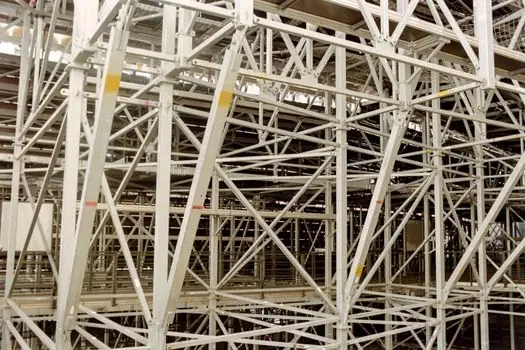
Dynamic slotting is only as good as the sensing and the operator interface around it. Kardex Remstar's Shuttle VLM pairs the height-sensor loop with a pick-to-light system, an LED Navigator that can be configured for different languages, and a laser pointer mounted on a track above the access opening that highlights the exact pick point inside a tray [S2]. The laser travels horizontally and swivels in depth, which is what makes small-parts picking inside a deep tray practical once the slotting engine has packed many SKUs into one tray [S2].
Integration is the second leg: the VLM must talk to the WMS, which is what feeds ABC ranking data and consumes every putaway and pick event. White Systems' MILO inventory management software sits in this layer for the Compact Lift, Compact Twin, Compact Double, Compact Heavy, and PowerColumn 3 VLM product lines [S5]. Pick accuracy under dynamic slotting is therefore not a free lunch; it depends on a closed WMS-to-VLM-to-pick-to-light chain, and a missing link anywhere in that chain takes the system back toward the manual error rate cited above [S2].
Limits, failure modes, and where the loop breaks
Dynamic slotting assumes the height sensor is calibrated and that tray contents are placed without overhanging the tray edge; a misread on a tall load either reserves too much air gap (lost density) or collides with the extractor on the next cycle. The loop also assumes a clean ABC signal from the WMS, so any SKU master-data error, like a stale velocity flag, will mis-rank the SKU and bury a real fast-mover behind a slow one [S2][S3].
For very small, uniform items the VLM is the wrong tool and a vertical carousel is the better match, because the access time per pick is lower on a carousel and the height-sensor gain is minimal when every tray is the same height [S9]. Likewise, a single SKU that dominates 40% of picks does not need dynamic slotting; it needs a dedicated forward-pick face, and forcing it through the VLM loop just adds extractor cycles. The integration layer that makes a VLM valuable is the same layer that makes it fragile, so the realistic engineering trade-off is throughput gain against WMS discipline [S1][S2].
Sourcing and standards notes
Public VLM technical literature is dominated by OEM application notes rather than ISO or EN storage-automation standards, and the citations above reflect that, with primary sources from Kardex Remstar (October 2025), Modula (February 2023), Storage Solutions (November 2023), White Systems, and Vertical Storage USA [S2][S3][S4][S5][S6]. Useful trackable signals for the next planning cycle are: any update to WMS-to-VLM API behaviour from the major VLM OEMs, the rollout status of MILO and equivalent inventory software layers [S5], and the appearance of multi-VLM orchestration features inside one WMS tenant, since the height-sensor loop is most powerful when several units are managed as one pool [S1][S5]. For adjacent automation context inside the same plant, the engineering trade-offs discussed in Forklift vs Tugger vs Unit Load AGV: Spec-First Selection Guide and the control wiring patterns in Sink vs Source Wiring for PNP and NPN Sensors on Remote I/O both line up next to a VLM cell in a typical distribution build.
The underlying component specifications are covered under dynamic compactor, and dynamic balancing machine.