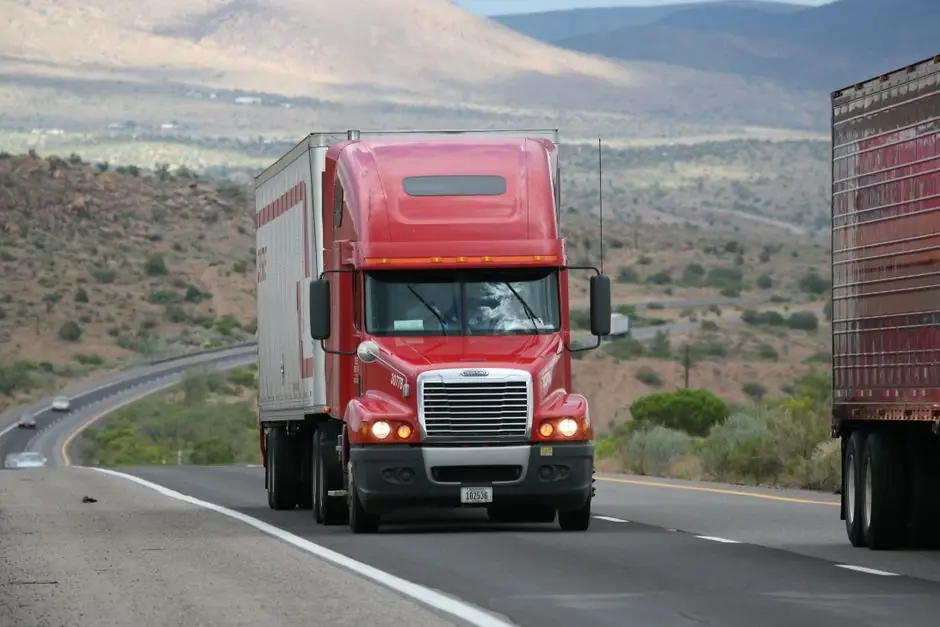
The Ast calculation in VDI 2198 is not a single number, it is a per-truck geometry problem: take the manufacturer's turning radius Wa, add the pallet length, then add a safety margin a of typically 100-200 mm per side [S1][S5].
Reach trucks, counterbalanced trucks and order pickers each get a different algebraic form of the same equation, which is why a datasheet's "minimum aisle" figure only applies to the exact truck class printed next to it [S1][S3].
VDI 2198 Ast formula: counterbalanced vs reach truck
VDI 2198 splits the Ast calculation by truck family because the load pivot point and the wheelbase geometry differ [S1]. For 3-wheel and 4-wheel counterbalanced trucks the working equation collapses to a simple linear sum, because the load centre sits ahead of the front wheels and the truck rotates around its own axle: Ast = Wa + x + l6 + a, where Wa is the truck's turning radius, x is the load-centre offset, l6 is the pallet (load) length, and a is the per-side safety margin [S1]. For reach trucks, the load is not ahead of the axle but carried between the drive wheels and a sliding mast carriage, so the truck must travel forward by a reach distance x before the forks clear the rack upright; the Ast term becomes a Pythagorean sum of the residual travel and half the truck width: Ast = Wa + sqrt((l6 - x)^2 + (b12/2)^2) + a, where b12 is the truck body width and the term under the root is the diagonal clearance the load needs to swing past the rack [S1]. The safety margin a in VDI 2198 is conventionally 100 mm per side for guided VNA trucks, 100-200 mm for reach trucks, and up to 200-300 mm per side for sit-down counterbalanced trucks; the standard does not pin a single value, so the spec sheet of the truck family is the binding source [S5]. The 12 in. (roughly 300 mm) "maneuvering cushion" used in US practitioner formulas is functionally the same as a + 2a in the VDI form, just with the safety margin lumped into one number [S2][S6][S7].
Reading a reach-truck datasheet: Wa, l6, x, b12, a
A reach-truck Ast value on a cut sheet is only as good as the five variables that produced it, so engineers should always pull Wa, l6, x, b12 and a directly from the OEM datasheet instead of trusting the headline aisle number [S1]. Wa is the published turning radius of the bare chassis with no load; typical single-reach trucks in the 1.4-1.8 t class sit near Wa = 1.65-1.85 m, which is why a headline "2.7 m aisle" usually means Wa roughly 1.7 m plus 1.0 m of load length and roughly 0.2-0.3 m of margin per side [S4]. l6 is the pallet length measured in the direction of travel, so a Euro pallet (1200 mm along the fork) and a GMA pallet (48 in. = 1219 mm) give near-identical l6 values, while a 1200x1000 "industrial" pallet run sideways effectively shortens l6 by 200 mm and tightens the Ast by the same amount [S5]. x is the reach offset, the distance the mast carriage travels beyond the front wheels to pick or deposit the pallet; for single-reach units x is typically 500-700 mm, and for double-reach (scissor) units it roughly doubles to 1000-1200 mm, which is the geometric reason double-reach trucks need 12-18 in. (300-450 mm) more aisle than single-reach [S3]. b12 is the chassis width across the drive tires, normally 0.95-1.10 m on a single-reach truck; the (b12/2)^2 term under the square root means a 100 mm wider truck only adds a few millimetres to Ast, so b12 is rarely the deciding dimension [S1]. The practitioner rule "right-angle stack + load length + 12 in." works for counterbalanced trucks, but under-estimates reach-truck aisles by 100-200 mm if the reach offset x is not folded in [S2][S6][S8].
Typical Ast by truck class: from counterbalanced to VNA

For counterbalanced trucks the Ast calculation produces the widest aisles in a building, and the industry rule of thumb matches the VDI 2198 form within 50-100 mm [S3][S4][S5]. A compact 3-wheel electric counterbalanced truck with Wa near 1.55 m, l6 = 1.2 m and a = 0.2 m per side gives Ast near 3.15 m (about 10 ft 4 in.), but the US practitioner floor adds a 12 in. (300 mm) lumped margin, so published "minimum aisle" numbers for the same truck land at 3.4-3.7 m (11-12 ft) [S3]. 4-wheel counterbalanced trucks add chassis length and a larger Wa, pushing Ast to 3.5-4.0 m (11 ft 6 in. to 13 ft), with 12 ft 6 in. (3.81 m) the common "we recommend" value and 14 ft (4.27 m) reserved for long loads [S3]. Single-reach trucks run Ast near 2.7-2.9 m (roughly 9 ft), and double-reach (scissor) trucks run Ast near 3.0-3.2 m (10-10 ft 6 in.), exactly the 12-18 in. delta that the longer reach offset produces in the VDI formula [S3]. Order pickers and turret trucks drop into VNA territory, with unguided order pickers at Ast near 1.93 m (6 ft 4 in.) for a 40 in. (1.02 m) chassis plus 18 in. (450 mm) clearance per side, and guided VNA trucks down to 1.32-1.83 m (4 ft 4 in. to 6 ft) [S3]. The order-picker chassis width alone (40 in. = 1016 mm) plus 2 x 18 in. side clearance reproduces Ast = 1.93 m to within 10 mm, which is a useful sanity check on the spec sheet [S3].
Load length, overhang and the 12 in. cushion
The "load length" term in Ast is not the nominal pallet dimension, it is the pallet plus any product overhang measured in the direction of travel, and the US practitioner formulas all carry this same caveat [S2][S7]. Apex MHC's worked example takes a Clark ECX30 with a 91.3 in. (2.32 m) right-angle stack and adds a 48 in. (1.22 m) GMA pallet plus a 12 in. (0.30 m) clearance to land at 151.5 in. (3.85 m) minimum aisle, then notes that adding a 6 in. cushion for routine overhang brings the recommendation to 13 ft (3.96 m) rack-to-rack [S2]. Toyota Lift Northwest and Total Industrial both reproduce the same "86 in. right-angle stack + 48 in. load + 12 in. clearance" arithmetic, so the 12 in. cushion is the de-facto margin across the US market even though VDI 2198 expresses it as a per-side a value [S7][S8]. The 200 mm total margin in the PAFTAR write-up of the VDI method (100 mm per side) is therefore numerically equivalent to a 7.9 in. per-side cushion, noticeably tighter than the US 6 in. per-side lumped figure, which is why a US-built counterbalanced truck on a 12 ft aisle may feel tighter to a European spec than the headline number suggests [S5]. For reach trucks the cushion matters less than the reach offset, because Ast scales with sqrt((l6 - x)^2 + (b12/2)^2), so doubling the safety margin from 100 mm to 200 mm per side only widens Ast by 400 mm, while extending the load by 200 mm or cutting the reach by 200 mm changes the sqrt term by 100-150 mm on a typical single-reach geometry [S1].
When Ast is not enough: rack uprights, base plates and wire guidance
VDI 2198's Ast is the truck-to-truck clearance, not the rack upright clearance, and that gap is where most field installations over-build or under-build [S3][S5]. A standard pallet-rack upright is 76-100 mm deep, and the base plate adds another 100-150 mm of footprint, so the rack-to-rack dimension printed on a building drawing should be Ast plus 200-300 mm before the load even touches the beam [S3]. Raymond's storage-efficiency guide shows that converting a 12 ft (3.66 m) counterbalanced aisle to a 9 ft (2.74 m) reach-truck aisle on a 21 ft clear-height building can raise storage density by up to 80%, but the calculation assumes the rack frames fit inside the Ast envelope, not the other way round [S4]. Wire-guided VNA trucks and turret trucks drop the per-side a to roughly 100 mm and rely on mechanical guidance to keep the chassis centred, which is why guided order pickers can run 4 ft 4 in. (1.32 m) aisles while unguided units of the same chassis width need 6 ft 4 in. (1.93 m) [S3]. Practitioners should also check that the published Ast was measured with the mast vertical and the load at the maximum lift height the spec covers, because some OEM datasheets state the aisle with the mast at the bottom of the travel, which understates the true requirement by 50-150 mm once the mast is elevated into the top beam level [S1][S4]. A safety audit will also want to see that the Ast value used for layout matches the truck's battery weight, since a heavier lithium-ion pack can shift Wa by 20-30 mm and pull Ast the same amount, an effect that does not show up in a generic 12 in. cushion [S5].
Sourcing and standards: where the Ast number actually comes from
VDI 2198 is the German engineers' association guideline (Verein Deutscher Ingenieure) that defines Ast as the minimum aisle-stacking width for industrial trucks, and the same geometric definitions appear in FEM 4.001 and in the ISO 5053-1 truck-vocabulary standard, so any OEM datasheet that quotes an Ast figure is implicitly claiming conformance to this geometry [S1][S5]. The Toyota Material Handling Europe aisle guide, the Raymond storage-efficiency guide, the PAFTAR engineering blog and the Arker racking reference all reproduce the same Wa, l6, x, b12 and a variable names from VDI 2198, even when they express the result in feet and inches instead of millimetres, so a cross-check between a European cut sheet (Ast in mm) and a US cut sheet (aisle in ft) is a 25.4 mm conversion plus the 100-200 mm per-side margin policy [S1][S4][S5]. For comparison with the spec on a reach truck, the VDI-derived Ast is the "minimum aisle" entry on the truck's nameplate, while the broader warehouse design also depends on PLC-controlled conveyor handoff at the aisle mouth, on pressure sensor feedback for mast height interlocks, and on flow meter signals for any in-aisle fire-suppression testing. The single most common error in applying the formula is to take a VDI 2198 Ast value (with 100-200 mm margin per side) and add a US 12 in. cushion on top, which double-counts the safety margin and gives an aisle 300-500 mm wider than necessary, a costly mistake on a 50,000 m² site [S2][S5][S7].
Next signal to track: whether the truck OEM publishes the VDI 2198 variable set (Wa, l6, x, b12, a) on the datasheet, or only the headline "minimum aisle" figure, because the variable-level disclosure is the only way an engineer can recompute Ast for a non-standard pallet length. Also worth watching in 2026 H2 is whether Li-ion-powered reach-truck variants from major OEMs ship with a 200 mm shorter wheelbase than the lead-acid equivalent, which would cut Ast by 80-120 mm on single-reach units and tighten the typical 2.7-2.9 m aisle band by one rack-bay.
Background reading: Steel-Plastic Composite Pipe for Data Centers: Selection Rules and Sizing.