
Vertical lift modules (VLMs) can sustain up to 99.9% inventory accuracy through enclosed, software-tracked storage, while manual shelving accuracy degrades as SKU count, worker turnover, and pick volume climb [S2]. The same VLM architecture can recover up to 85% of floor space by replacing static rack rows with vertically stacked trays delivered to a single ergonomic access opening [S2].
The accuracy gap is not marginal: a single mispick on manual shelving carries an average fully loaded cost of up to $100, and many distribution sites log thousands of such errors per year, which is why automated storage is being re-evaluated even by operations that previously wrote it off as too expensive [S5]. For high-SKU small-parts environments, the question is no longer whether VLMs improve accuracy, but by how much, and at what capital cost relative to the savings.
Why Manual Shelving Loses Accuracy as Volume Scales
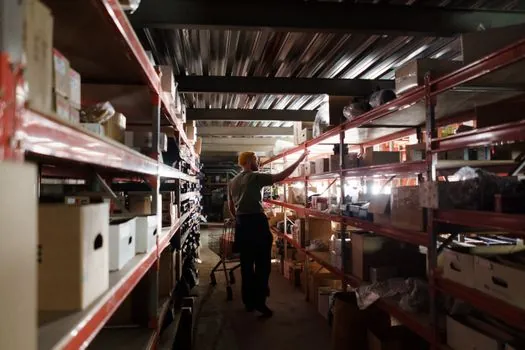
Manual shelving is a person-to-goods system: workers walk aisles, identify SKUs visually or on paper, and carry items to a packing station, and every step introduces a chance for a wrong pick, a missed pick, or a miscounted bin [S3]. Traditional systems rely on the workforce for productivity, so variability in worker availability and skill level translates directly into variability in order correctness, and that gap widens as inventory and throughput scale [S4].
Three structural weaknesses drive the loss. First, open shelves leave inventory exposed to dust, accidental damage, and unauthorized access, any of which can corrupt counts between cycle checks. Second, person-to-goods travel means search time and walking fatigue accumulate with SKU count, increasing the probability of a wrong selection under shift-end pressure. Third, the absence of a closed loop between physical pick and software record means inventory records drift from reality, forcing periodic wall-to-wall counts that take the operation offline. Together, these factors explain why manually managed accuracy trends downward over time on a chart, even when individual pickers are competent [S8].
How VLMs Enforce Accuracy Mechanically and in Software
A VLM is a fully enclosed automated storage and retrieval system: two columns of trays sit on either side of a central extractor, the unit measures each tray's contents on entry, and the extractor delivers the requested tray to a single ergonomic access opening at waist height on demand [S2]. Because picking happens at one window with software-controlled item delivery, the system can apply light-directed or guided picking, record the pick at the moment of withdrawal, and update the warehouse management system in real time [S5].
This closed loop is the core accuracy mechanism. The operator cannot reach the wrong tray, the software will not release the wrong SKU without an explicit override, and the inventory record updates as the tray is accessed, which removes the lag that causes manual count drift. The enclosed architecture also physically protects stock from dust, contamination, and opportunistic removal, which is a non-trivial source of phantom shrinkage in parts rooms and tool cribs [S5]. User authentication and retrieval logging further tighten the chain of custody for high-value or regulated SKUs [S4]. For a deeper mechanical breakdown of how goods-to-person delivery compares with carousels and horizontal carousels, the vertical lift module reference covers the engineering envelope in detail.
Throughput and Labor: The 66% Picking-Time Reduction
VLMs are reported to reduce picking times by up to 66% compared with manual systems, a figure that holds because goods-to-person delivery eliminates aisle travel and search time from every pick cycle [S7]. White Systems' published guidance puts achievable floor-space recovery in the 80% to 85% range, with a single VLM in a 25 ft ceiling facility able to replace up to 65 shelving sections and reclaim more than 600 sq ft of floor area; at 40 ft ceilings, the same installation can substitute up to 100 sections and return nearly 1,000 sq ft [S1][S2].
Carolina Handling quantifies the density gain differently: a single VLM can compress up to 9,050 sq ft of traditional shelving into a footprint of approximately 150 sq ft while using the available vertical ceiling height [S5]. The labor picture is consistent across vendors: a single operator at one access opening can service the same pick volume that previously required multiple pickers walking multiple aisles, and the ergonomic window position removes ladder climbs and repetitive reach, which lowers fatigue-driven error rates over a shift. The cumulative effect is fewer touches per order, fewer touches per SKU, and a tighter loop between physical and recorded state. For a side-by-side look at where the productivity delta shows up in a comparable goods-to-operator cell, the manual pallet jack reference offers useful baseline ergonomics data for the receiving and put-away steps that feed the VLM.
VLM vs Manual Shelving vs Vertical Carousel: A Criteria Comparison
The three options differ on dimensions that matter to a specifier: floor footprint, accuracy ceiling, picking time, and best-fit SKU profile. Manual shelving is the lowest-cost, most flexible option for bulky, irregular, or low-SKU stock, but it offers no software-enforced accuracy and the slowest pick cycle [S3]. Vertical carousels rotate shelves to bring items to the operator, which lifts ergonomics, but they typically offer lower storage density and less precise inventory control than VLMs because carousel indexing cannot match per-tray software tracking [S6].
VLMs sit at the high end on density, accuracy, and pick speed, with the trade-off being higher unit cost and a heavier integration lift with the host ERP, WMS, or DMS [S5]. The decision rule that emerges from the field data: use manual shelving for reserve stock, pallets, and slow movers; use carousels where rotating-shelf ergonomics help but density is not the binding constraint; and use VLMs for high-SKU small parts and frequently picked items where the per-pick labor and error costs dominate the operating budget [S1][S3][S6].
Where VLMs Are the Wrong Tool
VLMs are not a universal replacement for racking. Standard shelving remains the right answer for pallets, bulky items, and reserve stock that is accessed infrequently, because the VLM tray footprint and lift mechanism are not engineered for unit-load handling, and forcing such SKUs into trays wastes the unit's density advantage [S1]. Facilities with very low SKU counts, stable demand, and ample floor area will not recover the capital premium through labor or accuracy savings alone; the ROI case depends on enough pick volume and enough error cost to amortize the hardware [S9].
Hybrid layouts are the practical answer for most operations. A common pattern is to keep slow-moving and oversized items on traditional shelving while concentrating fast-moving, high-SKU, and high-value small parts inside one or more VLM cells, with the WMS treating both zones as a single logical inventory [S3]. The same approach lets a phased capital plan: pilot one VLM on the highest-error SKU family, measure the accuracy and labor delta, and scale only where the data supports it.
Integration, Sourcing, and Selection Signals
Specifying a VLM is less about the mechanical envelope and more about the software interface, the ceiling-height utilization, and the tray-size mix. The unit must integrate cleanly with the existing ERP, WMS, or DMS layer so that picks, puts, and cycle counts flow without double entry, and vendors such as White Systems publish inventory management software such as MILO™ that handles tray height optimization and per-item measurement on storage to help maximize vertical space [S2][S5].
Trackable signals for the next planning cycle: vendor-published case studies on mispick-rate reduction after VLM install, post-installation WMS cycle-count frequency, and the ratio of pick-window operators to total warehouse headcount. For adjacent automation context where sensor and feedback density affects comparable inventory cells, the linear module reference covers the motion-control envelope that often pairs with VLM extractors. Two trackable numbers to ask any vendor for, before signing: the demonstrated picking-time reduction against a defined SKU mix, and the measured inventory-accuracy percentage in a comparable installation.
Related analysis: 1024 PPR 5V RS-422 Rotary Encoder: Spec, Wiring, and Selection.