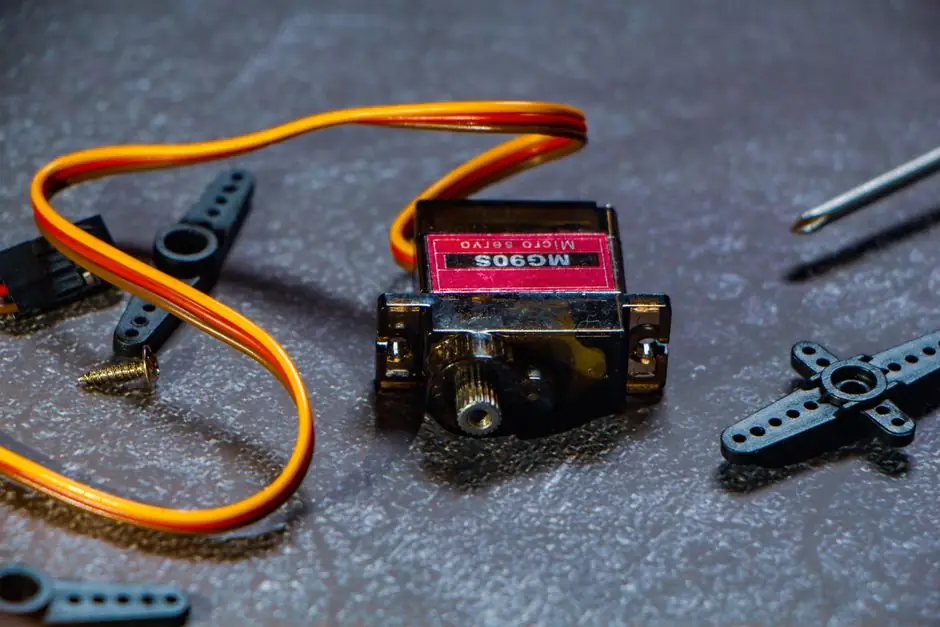
Six physical and electronic guidance methods dominate AGV path-following in 2026: magnetic tape laid on the floor, inductive wire embedded in the slab, magnet/QR spot grids, laser triangulation against reflectors, inertial measurement units, and vision-based feature recognition [S1][S4][S6].
Line-following variants (magnetic tape and inductive wire) remain the lowest-cost and most precisely repeatable options, while natural-navigation variants (laser and vision) are specified where routes must change without floor work [S4][S5]. A vehicle is rarely equipped with a single sensor: most production AGVs pair the primary guidance sensor with a 2D safety laser scanner for obstacle detection [S3].
Magnetic Tape Guidance: Lowest Capex, Fixed Path
Magnetic-tape AGVs follow a 25–50 mm wide polymer tape adhered to the floor; an array of Hall-effect sensors under the chassis reads the tape's magnetic field and steers the vehicle toward the centreline [S2][S4]. Reconfiguration is reduced to peeling up tape and re-laying it, which is the cheapest change-order available in the AGV robot class [S4].
The trade-off is mechanical: forklift and pallet-truck traffic cuts, lifts, or dirties the tape, so this method is best limited to light pedestrian and AGV-only aisles, with predictable stop-and-go routes in narrow-aisle pallet transfer [S4]. The vehicle cannot deviate around an obstruction; it auto-stops and waits for the path to clear [S4].
Inductive Wire Guidance: Durable but Costly to Reroute
Inductive-wire AGVs follow a current-carrying wire cut into a 5–10 mm floor slot and sealed with epoxy; two sense coils in the chassis measure the induced voltage and correct steering error to within a few millimetres of the wire centre [S2][S4]. Because the path is buried, it tolerates forklift abuse, oil, and wash-down environments that destroy magnetic tape [S4].
Radio-frequency sensing is largely immune to smoke, steam, and dust that can upset optical methods [S4]. The constraint is civil: altering the route means cutting new slots, pulling wire, and re-resining the floor, a process that typically shuts the aisle for days, so inductive wire is specified only for routes known to remain static for 5+ years, such as automotive assembly tracks [S4].
Spot Navigation: Magnet Grids and QR-Code Marker Fields
Spot-navigation AGVs move between discrete fiducials, either permanent magnets (~10–25 mm diameter, ~30 mm deep) or printed QR tags, installed in a 1–5 m grid across the floor [S4][S6]. The vehicle's underbody reader triggers a waypoint event at each tag, and the on-board controller sequences turns, lifts, and speed changes from a stored map indexed by tag ID [S4].
Spot grids decouple route definition from the physical line: changing a path means editing the tag-to-action table in the fleet software, not moving hardware, and the same grid supports multiple AGV types running different missions simultaneously [S4]. Magnet markers survive pallet-rack impacts better than QR tags, but QR codes carry richer payload data (aisle, level, destination), which simplifies WMS integration [S4].
Laser Triangulation and Natural Navigation
Laser-guided AGVs mount a rotating time-of-flight scanner (typically 270°–360° field, 10–30 m range) that measures the angle and distance to passive retroreflectors or to fixed structural features (walls, racks, columns) [S3][S5]. The vehicle localises against the stored feature map with sub-10 mm accuracy at update rates of 8–20 Hz, which is precise enough for racking interfaces without a separate fiducial layer [S3].
Natural-navigation laser is the dominant choice for new greenfield ASRS system integrations and for brownfield retrofits where floor cutting is unacceptable, because installation is reduced to a one-time site survey and a commissioning map-build [S3][S5]. The same safety-rated 2D laser scanner that performs obstacle detection is also the localisation sensor on most vehicles, which keeps bill-of-materials cost flat versus tape-guided builds.
Inertial and Vision Guidance
Inertial navigation pairs a gyroscope/accelerometer IMU with floor-embedded transponders or rare-earth magnets; the IMU dead-reckons between waypoints, and each transponder corrects accumulated drift [S6][S7]. This hybrid is specified for cold-storage aisles (down to -25 °C, where camera contrast drops) and for long, straight runs where installing reflectors every 5 m would be uneconomic [S6][S7].
Vision guidance uses downward or forward-facing cameras to read floor texture, ceiling lights, or 2D barcodes; it is increasingly common on smaller AMR robot platforms rather than heavy line-following AGVs, and is most cost-effective where lighting is controlled and route changes are frequent [S5][S7]. On a busy conveyor sorting line interface, vision-guided units can pick a free induction loop without physical tape changes [S5].
How the Guidance Methods Compare on Decision Criteria
On four selection criteria, the methods rank very differently. (1) Installed cost: magnetic tape and QR grids are lowest, laser and vision are mid-range, inductive wire is highest because of the floor work. (2) Reconfigurability: laser, vision, and QR are highest, magnetic tape is moderate (re-tape in hours), inductive wire is lowest (floor cutting in days). (3) Environmental tolerance: inductive wire is best for oil/washdown; laser is best for dusty or smoky air; tape fails under forklift abuse; vision fails in low-contrast cold storage. (4) Positional accuracy: inductive wire and laser triangulation reach ±10 mm; magnetic tape sits at ±20–30 mm; spot navigation accuracy depends on grid density, typically ±50 mm at 2 m spacing [S4][S5].
The right choice therefore depends on whether the site values path flexibility, mechanical durability, or absolute repeatability: a finished-vehicle plant running the same route for 15 years will still specify inductive wire, while a third-party logistics warehouse re-zoning aisles every quarter will move to laser or QR-grid [S4][S5].
Limitations and What the Guidance Stack Does Not Solve

Path-following guidance does not by itself handle dynamic traffic: most line-following AGVs will stop, not swerve, when an obstacle sits on the route, and recovery requires fleet software to reroute via a parallel loop or to queue the vehicle [S4]. A VDA 5050 fleet manager is increasingly specified so that guidance-method choice is decoupled from WMS or MES task dispatch, and mixed fleets of line-following AGVs and natural-navigation AMRs can share the same map and traffic rules [S5].
Floor condition, lighting, and electromagnetic noise cap the achievable accuracy of any method; a magnet-tape path crossing a steel floor expansion joint, or a laser map of a curtain-walled building that flexes in wind, will both drift in service, and the only fix is a periodic re-survey of the reference environment [S3][S4].
Trackable signals to watch: vendor datasheets disclosing IMU drift spec in mm per metre of dead-reckoning, and adoption of VDA 5050 in tenders for mixed AGV/AMR fleets, both of which sharpen the procurement picture for new 2026 builds.