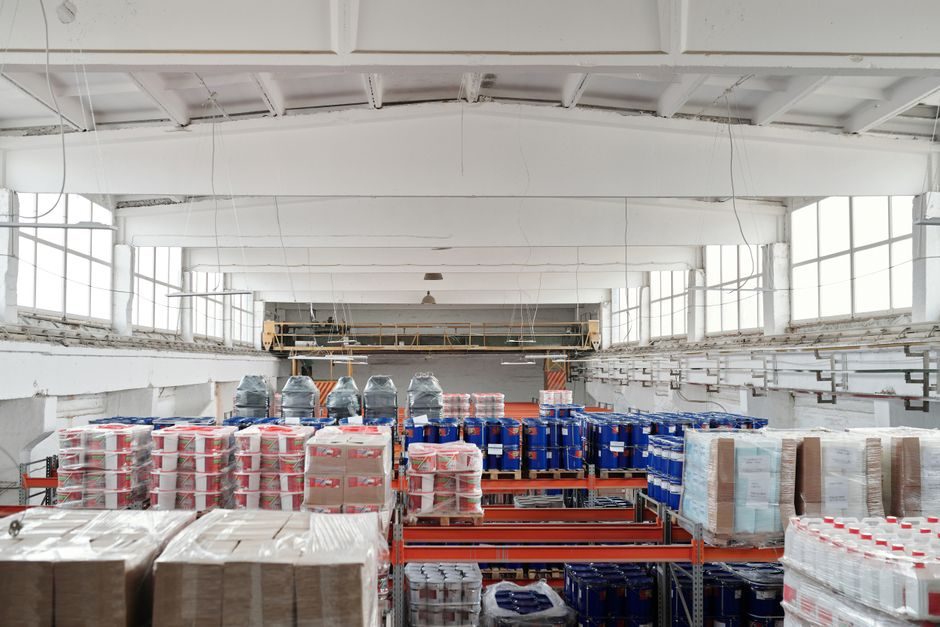
The core decision is throughput per cubic metre, not brand. Vertical Lift Modules compress an enclosed column of totes into roughly 1/10 the floor footprint of a wide-aisle pallet rack layout and deliver SKUs to an operator at waist height, with the global VLM market projected to grow from US$ 950.19 million in 2024 to US$ 1,766.08 million by 2031 [S1]. Pallet rack still owns the bulk of warehouse volume because the unit load is one or more pallets, not a tote, and gravity does the work.
A vertical lift module is essentially two columns of trays with a powered extractor shuttling between them; a pallet rack is a structural steel portal supporting pallets loaded and unloaded by forklift. The first is a SKU-retrieval machine with software, the second is a passive structural frame. That hardware delta drives every downstream spec.
Footprint, Height and Storage Density Envelope
Standard selective pallet rack bays run 2.7–3.0 m column-to-column with 4–6 pallet positions vertically; floor-to-floor height consumption is similar, but pick density is gated by aisle width. Narrow-aisle and drive-in configurations can compress that, but the trade is forklift class and operator certification, not storage ratio. VLM and rack are not competing in the same unit load: a standard tote is 600×400 mm, a standard pallet is 1,200×1,000 mm — three orders of magnitude on the base unit.
If your inventory item is single-SKU, deep-stack, and rotated by full pallet, rack is the right primitive. If your inventory item is small-part, high-SKU-count, and picked at piece level, the VLM geometry is the right primitive. Warehouses trying to mix both usually run a mezzanine over a rack footprint, with VLMs on the mezzanine for slow-movers and reserve rack below for pallets, the configuration visible in commercial deployments across Florida industrial sites [S4].
Throughput and Order Profile: Where Each Wins
VLM throughput is mechanically limited to roughly 60–120 tray presentations per hour per extractor at a single operator station, with dual-extractor cells reaching the upper end of that range when orders are clustered [S1]. A ride-on pallet truck on a standard selective rack can pull 80–150 pallet positions per hour per operator, and a wire-guided turret truck on narrow-aisle rack pushes that to 180–250 pallet positions per hour per operator. The crossover point in mixed operations is usually at the SKU-line threshold: above ~300–500 pick lines per order, the VLM double-handles the tote and rack-with-pt-to-cart wins on time; below that, the VLM's ergonomic delivery wins on labour cost per pick.
Order profile matters more than raw throughput. VLMs cluster inventory by access frequency and physical size, so A-items compress into the bottom of the column for fast extraction. Rack, by contrast, is FIFO or LIFO depending on configuration — drive-in and push-back are LIFO; selective and flow rack are FIFO. Choosing wrong on rotation rule is the most common commissioning mistake on both systems, and it shows up as pick-path deadhead kilometres on the WMS dashboard long before it shows up on the rack.
Capital Cost, Lead Time and Payback Window

VLM unit pricing varies with height, tray count and extractor count, but a mid-size cell configured for industrial spares in 2024–2025 listing data sits in the high five-figures to low six-figures USD band per cell [S5]. Selective pallet rack per bay, by contrast, runs from roughly US$ 80–200 per pallet position installed, depending on seismic zone, deck type and beam capacity. A 1,000-position selective rack project, fully installed, is therefore a fraction of a four-cell VLM installation covering the same SKU count, although the VLM includes the extractor, controls, and pick-to-light hardware the rack version requires separately.
Payback maths flips when the alternative is a building expansion. A VLM can deliver the equivalent storage capacity of a 1,500–3,000 m² rack layout in roughly 60–100 m² of floor, and the marginal cost of building a new warehouse in tier-one US logistics markets is the dominant line item in any capacity-expansion business case [S1]. For greenfield, the frame is capex-per-position vs capex-per-square-metre-of-warehouse. For retrofit, the frame is lease-cost-of-freed-up-floor vs VLM-amortisation. A common engineering rule is to model the VLM scenario only when freed floor area is monetisable as revenue-generating or leased space, not when it would simply be empty.
Who VLM Is For, and Who It Is Not For
VLM fits operations with these characteristics: SKU count above ~2,000 in active rotation, average pick quantity under one case, parts weighing under ~50 kg per tray, and a ceiling clear height above 6 m that the building can structurally support with the VLM's distributed floor load, which typically runs 800–1,200 kg/m² fully loaded. It also fits operations where ergonomic risk on repetitive bending and reaching is a measurable cost driver — insurance, RIR, lost-time incidents — because the extractor delivers every tray at waist height. [S1]
VLM does not fit operations built around full-pallet outbound, single-SKU-per-pallet storage, or a low ceiling. It also does not fit operations where picking is dominated by case-level quantities, because tray volume cap becomes the bottleneck. A VLM cell typically caps at 60–100 kg per tray and 500–700 mm tray height, with a ceiling of around 12 m on standard designs; outside that envelope the engineering becomes a special, and special pricing breaks the payback model. For those flows, pallet rack — selective, drive-in, push-back, or flow — remains the lower-cost, higher-throughput primitive.
Comparison Frame: VLM vs Pallet Rack Across Four Decision Criteria
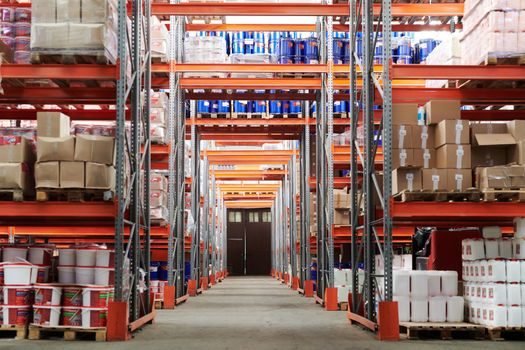
The right answer is therefore a hybrid: VLM for slow-to-medium velocity piece-pick, rack for fast full-pallet flow, and — increasingly — an autonomous mobile robot fleet shuttling between the two for case picking that does not warrant either a forklift round-trip or a VLM tray presentation. [S2]
Storage density is best measured in tray-positions or pallet-positions per square metre, not in cubic-metre-per-dollar, because the operator still needs working aisle space in either system. Throughput is best measured in lines-per-operator-hour at peak, because peak — not average — drives headcount and shift count. Capex is best measured per storage position including installation and seismic anchorage, because the headline rack price per bay almost never includes anchoring, deck and end-row protection. Ergonomics is best measured in picks per RIR-relevant motion, not in vendor brochures.
Failure Modes, Constraints and What Spec Sheets Quietly Skip
VLM failure modes are dominated by the extractor, lift chain, and software integration with the WMS: a stuck tray in a 10 m column is not a forklift-fixable problem, so mean-time-to-recovery is a contract line item, not a hope. Pallet rack failure modes are dominated by fork impact, over-loaded beams, and unanchored baseplates — anchor bolt torque verification is the single most-cited OSHA citation in warehouse rack installations. Either system fails the same way under seismic event if it was not engineered for the zone in the first place; rack and VLM both need stamped seismic calculations, and a VLM cell typically needs a structural review of the slab because the rolling load is concentrated. [S3]
Spec sheets on VLM cells list tray dimensions and lift speed but usually omit the maximum recommended mixed-rotation order size, the access time penalty when an A-item is stored on a high tray versus a low tray, and the throughput dropoff when multiple operators share one cell. Spec sheets on rack list load capacity per beam pair but usually omit the deflection class — a beam rated 4,500 kg may deflect enough to unseat a pallet under impact, which is a separate problem from capacity. Asking for both numbers up front prevents the standard commissioning dispute.
Sourcing, Standards and What to Verify Before Signing
RMI's ANSI MH16.1 governs the design and load application of industrial steel storage rack in North America; AISE earthquake design guidance and EN 15635 govern in Europe. VLM cells are typically CE-marked machinery with a Declaration of Conformity under the Machinery Directive; check the DoC is product-specific, not a generic portfolio document. For any VLM, demand the cycle-test data, the maintenance contract response-time clause, and the WMS integration reference list. For any rack, demand the seismic calc, the anchor pattern, and the engineered drawings stamped for the project address, not for a generic warehouse footprint. [S4]
Watch the residual list: beam-end locking pins, column protectors, row-end guards, and floor-rail kick-back on VLM extractor bases are usually priced as accessories. Lead time in 2025–2026 for VLM cells runs roughly 16–28 weeks ex-works for standard heights, and selective rack 6–12 weeks for standard colours. Where lead time and seismic approvals push rack past 16 weeks, VLM's longer horizon stops being a penalty and starts being neutral — a non-obvious way the comparison flips project by project.
Closing reference: pick the storage primitive by storage unit (pallet vs tote), then by throughput per operator at peak, then by capex per position including seismic and install, and only then by vendor — and run the hybrid scenario where a fleet of autonomous mobile robots moves case quantities between reserve rack and forward-pick VLM cells, the configuration now standard in 2025–2026 greenfield fulfilment builds.
For component-level specifications, see storage rack.