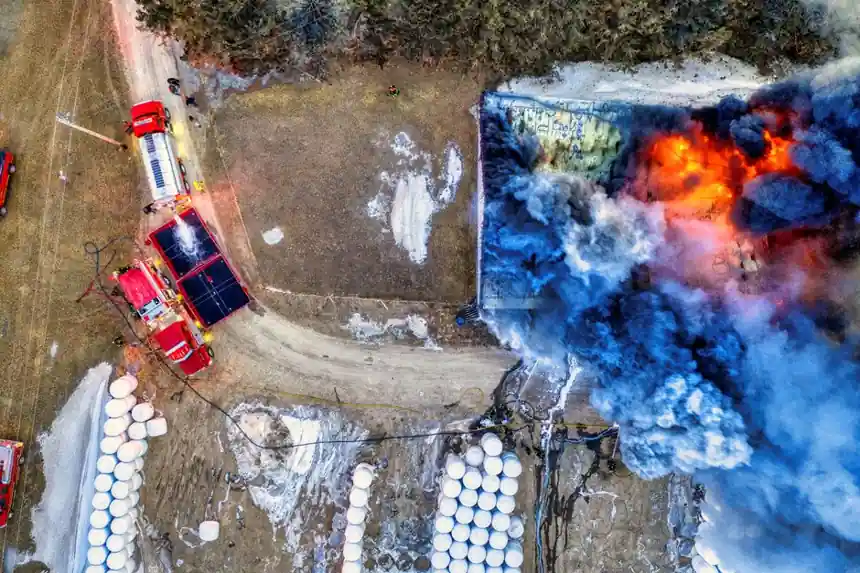
ABC dry chemical extinguishers are the dominant choice for warehouse storage aisles, with 10-lb units commonly specified for general rack storage and 20-lb units for heavy commercial and fuel storage areas, sized against OSHA 1910.157(d) travel distances of 75 ft for Class A hazards and 50 ft for Class B hazards [S3][S4].
The five standard extinguisher agents in commercial service are water, foam, dry powder (ABC), carbon dioxide, and wet chemical, with clean-agent variants added for electronics-dense rooms [S5]. A warehouse rarely gets by on a single class: rack storage of cardboard, wooden pallets, and plastic film creates Class A risk, while forklift charging stations, battery rooms, and switchgear add Class C, and any flammable-liquid cage or solvent closet adds Class B [S1][S2].
Match the Agent to the Zone, Not the Building
A fire extinguisher plan should match the extinguisher rating to the hazard, with machinery zones typically requiring dry chemical powder or CO2 units depending on equipment, and flammable liquid storage requiring Class B-rated units [S2]. For rack and pallet storage, the practical default is 10-lb ABC at 75 ft travel, with 5-lb ABC acceptable in office corners inside the same building and 20-lb ABC at fuel docks and chemical cages [S3].
ABC dry chemical uses monoammonium phosphate to interrupt the combustion chain reaction, is non-conductive (safe on energized electrical), and is the standard for OSHA construction-site requirements, though it leaves corrosive residue that damages electronics, limits operator vision during discharge, and can clump from humidity over a 6-year maintenance cycle [S3]. CO2 leaves no residue and is non-conductive, making it the right pick for server rooms, control panels, charging stations, and any electronics bay inside the warehouse footprint, but it has limited Class A capability because the gas dissipates before fully extinguishing deep-seated pallet fires [S3][S2].
Class-by-Class Agent and Size Matrix
The five fire classes map to distinct warehouse zones. Class A covers ordinary combustibles (paper, cardboard, wood pallets, many plastics) and is commonly found in office buildings, schools, retail, healthcare, and apartment buildings, typically addressed with water or multipurpose dry chemical [S1]. Class B covers flammable liquids (gasoline, diesel, oil, paint, solvents, alcohol, hydraulic fluids) and applies in manufacturing, automotive service, maintenance shops, and fuel storage, using foam, CO2, or dry chemical agents [S1][S2].
Class C covers energized electrical equipment (panels, switchgear, server rooms, transformers, control panels) and requires non-conductive agents such as CO2 or dry chemical [S1]. Class D is for combustible metals (magnesium, titanium, sodium, potassium, lithium) and is rare outside dedicated metal-processing operations [S1]. Class K covers commercial cooking oils and fats and only applies if the warehouse has an in-house commercial kitchen or staff food prep area [S2].
Size selection then layers on top: 5-lb ABC for most office and retail spaces, 10-lb ABC for warehouses and light manufacturing, 20-lb ABC for heavy commercial and fuel storage areas, with UL rating labels governing the actual fire-suppression capability rather than cylinder size alone [S3]. A typical 5-lb ABC unit runs $40-$80 retail or $25-$45 wholesale, while a 10-lb CO2 unit runs $200-$300 with higher refill costs, so spec sheets usually mix ABC and CO2 rather than standardizing on one agent [S3].
OSHA 1910.157 Placement and Mounting Rules
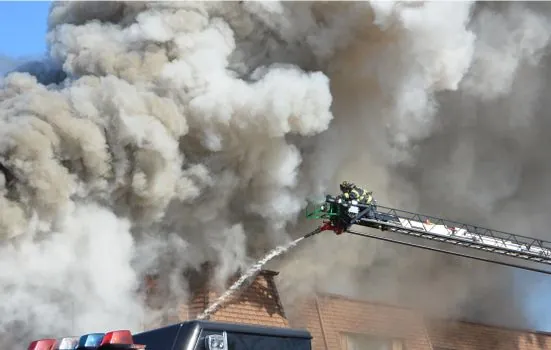
OSHA 1910.157 requires extinguishers to be mounted with handles no higher than 5 ft (60 in) above the floor for units weighing 40 lb or less, and no higher than 3.5 ft (42 in) for units over 40 lb, with a 4-in minimum floor clearance to keep the cylinder above standing water, cleaning chemicals, corrosive spills, and forklift traffic [S4]. These heights derive from NFPA 10, Section 6.1.3.8, which OSHA enforces through 1910.157(c)(1) [S4].
Distribution is governed by travel distance: 75 ft for Class A hazards and 50 ft for Class B hazards, with monthly visual inspections, annual professional maintenance, internal examinations, and hydrostatic testing at prescribed intervals all required under 1910.157(e)(2)-(4) and (f) [S4]. Extinguishers must remain fully charged and operable in their designated places at all times except during use [S4]. The 2026 maximum penalty per violation is $16,550 per instance, which makes the monthly visual inspection the cheapest line item in any warehouse safety budget [S4].
Zoning a Real Warehouse Layout
For a typical 100,000 sq ft warehouse with racked pallet storage, three zones drive the extinguisher schedule. Zone 1, the rack aisles, is dominated by Class A risk from cardboard, wood pallets, and plastic film, and gets 10-lb ABC units at 75 ft travel along each aisle with a 4-in floor clearance and 5-ft handle height [S2][S4]. Zone 2, the loading bay and forklift charging area, adds Class B (diesel, hydraulic fluid) and Class C (battery chargers) risk and gets 20-lb ABC plus a 10-lb CO2 within reach of the switchgear [S2][S3].
Zone 3, any in-line flammable-liquid cage, gets dedicated Class B foam or dry chemical units at 50 ft travel, never an ABC alone, because ABC residue on solvent-contaminated surfaces creates cleanup and slip hazards [S1][S2]. If the facility includes a commercial kitchen, that sub-area needs a wet chemical Class K unit, separate from the ABC and CO2 in the main hall [S5]. One common layout failure in warehouses is the extinguisher placed on the floor rather than mounted, which is one of the three most-cited violation patterns under the OSHA mounting rules [S4].
Selection Criteria vs Building Type
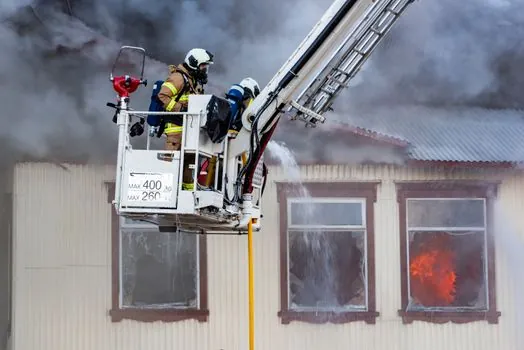
Comparing the main options against four decision criteria clarifies the call. ABC dry chemical scores high on coverage (covers A, B, C in one unit), high on cost (5-lb at $40-$80 retail, 10-lb at $25-$45 wholesale), low on residue (corrosive powder that damages electronics and limits operator vision during discharge), and low on Class K and Class D capability [S3]. CO2 scores high on residue (none, non-conductive), high on electronics safety, low on Class A capability (gas dissipates before deep-seated fires are out), and high on cost (10-lb unit at $200-$300 with higher refill cost) [S3].
Class K wet chemical is mandatory for commercial cooking media, ineffective on Class A, and only relevant where a warehouse has its own kitchen [S1][S3]. Class D agents are specialty items for combustible metals and do not belong in a general warehouse unless magnesium, titanium, sodium, potassium, or lithium are stored on site [S1]. Foam units fit Class B liquid storage and aircraft-hangar-style risks but lose to ABC on coverage and to CO2 on electronics, so they appear mostly in dedicated flammable-liquid rooms [S1]. The short version: ABC for the rack aisles, CO2 for the electrical rooms, foam or extra-large ABC for the solvent cage, and K only where cooking happens.
Inspection, Training, and Documentation
Portable extinguishers must be selected, installed, and maintained to match the specific fire hazards, occupancy group, and location conditions present, not just the building label [S7]. OSHA 1910.157(g) requires hands-on training for designated employees upon initial assignment and at least annually thereafter, with maintenance dates, inspection records, and hydrostatic test results documented and retained under 1910.157(e)(3) and (f)(16) [S4].
For a deeper read on zoned extinguisher planning in higher-hazard process facilities, the spec map in Fire Extinguisher Selection for Oil and Gas Facilities carries the same OSHA 1910.157 framework into flammable-liquid and hydrocarbon-class warehouses. A broader reference on the equipment itself sits at fire extinguisher, while facility-level coverage of suppression, alarms, and egress is at fire safety and rated compartmentation at fire door for any warehouse with rated separation walls.
Trackable signals for the next spec review: any 2026 update to NFPA 10 Section 6.1.3.8 mounting figures (currently enforced by reference through OSHA 1910.157), and any revision to OSHA 1910.157 penalty amounts, which sat at $16,550 per instance as of March 2026 [S4].