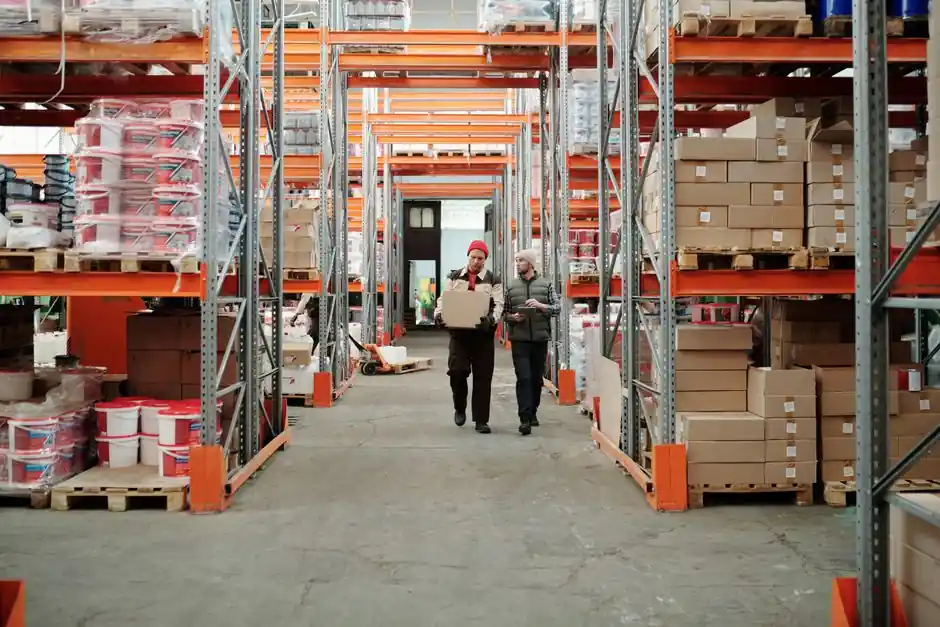
Modified bitumen membrane selection for warehouse roofs hinges on three engineering gates: thermal range the building will actually see, expected substrate movement, and whether the install is torch-applied, hot-adhesive, or self-adhesive. SBS-modified torch-on sheet with a 200 g/m² polyester mat at 4.0 mm thickness is the reference spec most Chinese and Middle-Eastern warehouses are quoted against in 2026 [S2][S5].
A warehouse is not a cleanroom and not a planted roof, so the spec sits between the two extremes: it needs more puncture resistance than a cleanroom sub-floor under screed and more UV-tolerant surfacing than a buried tanking job. Most roof leaks in steel-clad warehouses trace back to detail failures at gutters, pipe roots, and expansion joints, not to the field sheet itself, so the modified bitumen membrane decision should always be made alongside a detailing plan, not in isolation.
Core Specs: Thickness, Reinforcement, Surface Finish
For non-exposed warehouse roofs, the common stock thicknesses are 3.0 mm and 4.0 mm, supplied in 1.0 m × 10 m rolls covering 10 m² per roll [S1][S5]. The elastomer (SBS) modified bitumen waterproofing membrane range from Hubei Huayu specifies 3.0/4.0/5.0 mm thicknesses with 7.5 m and 10 m lengths, using polyester mat (PY) as the reinforcement and PE film, fine sand (S), or mineral granules (M) as the upper-surface isolation [S5].
For HDPE-reinforced cold-stock sheets such as the Yosaite BM041A, the upper and lower surfaces are both finished with polyethylene film and the reinforcement is HDPE film rather than polyester; this construction targets acidic or alkaline environments, planting areas, and high water-vapour zones, with thicknesses of 3.0 mm and 4.0 mm in 10 m × 1.0 m rolls [S1]. When the warehouse has a high internal humidity load, a vapour-control layer of self-adhesive SBS bitumen at 1.5 mm is often placed under the torch-on cap sheet to block interstitial condensation.
Decision Matrix: SBS Torch-On vs APP vs Self-Adhesive vs HDPE
SBS-modified torch-on with polyester mat is the most widely specified option for warehouse field areas. Hubei Huayu's elastomer SBS data sheet reports tensile strength ≥ 800 N/50 mm (typical 1195 N/50 mm), elongation ≥ 40% (typical 51), low-temperature flexibility at -25°C with no cracking, and heat resistance at 105°C with no flow or dripping, and soluble matter content (4 mm) ≥ 2900 g/m² (typical 3074 g/m²) [S5]. That combination covers almost every climate band a logistics warehouse will see, from cold-storage adjacencies to sun-exposed steel decks in summer.
Self-adhesive polymer modified bitumen membranes using SBS and SBR with tackifying resin are limited to a use range of -20°C to 70°C, with elongation ≥ 30% and lap width specified at 100 mm [S3]. They are the right pick where open-flame torching is prohibited, for example inside plant rooms with stored fuels or near sprinkler risers, and where the substrate is dry enough to let the silicone release film bond at ≥ 5°C. The trade-off is lower upper-temperature resistance, so a self-adhesive cap sheet is usually paired with a torch-on base sheet in two-layer systems over warehouse field areas.
HDPE-reinforced cold-stock sheets (BM041A-class) target a different problem: deformation, vibration, acidic or alkaline substrate conditions, and heavy water-vapour loads. They are not a torch-on field sheet; they are the right answer where chemical exposure or condensation rules out a naked bitumen cap sheet [S1]. APP-modified membranes sit between SBS torch-on and self-adhesive on temperature tolerance, with the SBS chemistry generally preferred in colder climates because of the -25°C flexibility ceiling [S5]. For a waterproof membrane spec across the full building envelope, the same selection logic recurs in school roof waterproofing, with the same SBS-PY 4.0 mm default and the same self-adhesive detail-strip fallback.
Selection Criteria by Warehouse Type
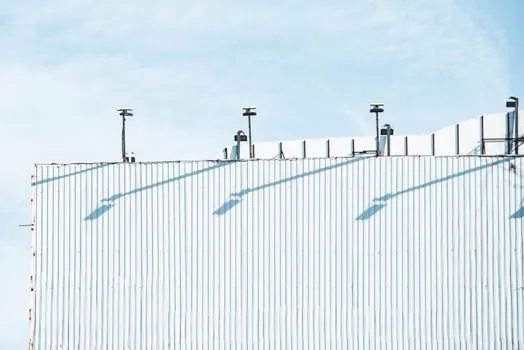
Standard logistics warehouse (steel deck, ≥ 8 m clear height, dry goods): a two-layer system of 3.0 mm SBS-modified polyester-reinforced base sheet plus a 4.0 mm SBS-modified polyester-reinforced mineral-granule cap sheet is the common 2026 Chinese-export reference build-up [S5]. Soluble matter content on the 4 mm sheet is specified ≥ 2900 g/m², with heat resistance 105°C and low-temperature flexibility -25°C.
Chemical or process warehouse with acid/alkaline exposure: an HDPE-film-reinforced modified bitumen sheet with PE-film upper and lower surfaces (BM041A class, 3.0–4.0 mm) is the appropriate membrane, executed to GB 18967-2009 [S1]. The HDPE reinforcement provides the chemical barrier that a polyester mat cannot deliver. Where a 200 g/m² polyester protection board is needed above the primary waterproofing, a product such as Bitumat BITUTECT-I at 4.8 kg/m² and 4 mm thickness can be loose-laid as a protection layer on roofs, reservoirs, basements, tunnels, and car parks [S2].
Cold-storage or temperature-cycling warehouse: stay with SBS torch-on and avoid APP; the -25°C low-temperature flexibility rating on PY-reinforced SBS sheet is the relevant ceiling, and the same chemistry that protects against cold-storage contraction also handles summer steel-deck temperatures above 70°C [S3][S5]. Plant-room roofs and any zone within 6 m of a fuel-fired appliance should default to self-adhesive SBS, accepting the lower 70°C upper limit in exchange for eliminating the torch flame [S3].
Installation Method and Detail Strips
For SBS torch-on, the sequence is subgrade preparation, primer, additional layer treatment at corners, pipe roots, gutters, and expansion joints, large-area hot-melt lay-down with simultaneous heating of membrane underside and substrate, lap-joint sealing at 100 mm width with a 3–5 mm molten bitumen fillet at the lap, and a 24-hour water-tightness test before protection boards go on [S5]. Self-adhesive construction follows the same sequencing without the torch, using primer-only adhesion once the substrate is dry and the surface temperature is at or above 5°C [S3].
Detail failure drives most warehouse roof leaks, not field-sheet failure. Pipe penetrations, internal gutters, parapet upstands, and expansion joints each need a pre-cut additional layer of the same membrane chemistry, not a generic aluminium flashing. Where the warehouse has rooftop solar arrays or HVAC condenser supports, the bitumen membrane should be specified separately from the support-frame waterproofing flange so that each can be replaced independently over the service life.
Standards, Compliance, and Procurement Notes

The HDPE-reinforced cold-stock range is published to GB 18967-2009 as the executive standard for technical data [S1]. Across Chinese-export products, the same modified-bitumen product family is repeatedly described as a 1.0 m × 10 m roll with 3.0/4.0 mm thickness and a self-adhesive or torch-on installation method [S1][S2][S3][S5][S6]. The minimum-order quantum on generic self-adhesive modified bituminous membrane is published at 5000 m² with a monthly supply capability of 100000 m² out of China main ports [S6], a useful planning figure for cross-border warehouse projects sized above 10000 m² of roof area.
For procurement, three checkpoints catch most field problems before delivery: confirm the soluble matter content of the 4 mm sheet is ≥ 2900 g/m² with a reported test value, confirm low-temperature flexibility at -25°C with no crack and heat resistance at 105°C with no flow, and confirm the lap-joint specification of 100 mm width plus 3–5 mm molten bitumen fillet [S5]. Anything weaker on any of those three numbers is the wrong membrane for a warehouse envelope.
Track the next two signals: the rate at which 5.0 mm SBS-PY torch-on cap sheets displace 4.0 mm on logistics-warehouse field areas in Middle-East and Central-Asia projects, and whether self-adhesive SBS-bitumen vapour-control layers at 1.2–1.5 mm start appearing in Chinese OEM datasheets as a stocked item rather than a custom run [S3][S5].
Spec-level background on the components involved: pressure transmitter.