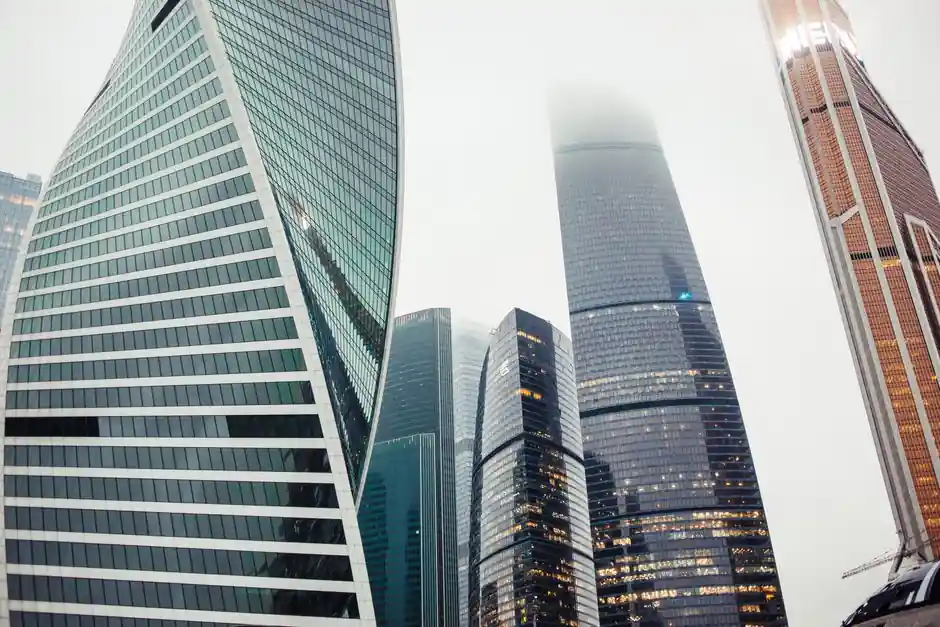
Modified bitumen membrane selection on a high-rise project is driven less by cost and more by redundancy, elongation, and detailing tolerance, because tall buildings concentrate thermal cycling, parapet movement, and penetration density on a relatively small roof footprint [S1][S4].
The global modified bitumen market was projected at USD 49.52 billion in 2026, on track to USD 83.19 billion by 2034 at a 6.70% CAGR, with high-rise commercial construction cited as a structural demand driver [S5]. On a 2025-08 industry baseline, multi-ply modified bitumen roofs typically deploy 2 to 4 plies, built from a base sheet, intermediate plies, and a granulated cap sheet, with each ply acting as a redundant waterproofing barrier [S4].
Why Multi-Ply SBS Is the Default for Tall-Building Podiums
SBS (Styrene-Butadiene-Styrene) modified bitumen delivers rubber-like elastic behaviour, so the sheet can stretch as the roof slab expands and contracts through diurnal and seasonal cycles, an essential property for exposed concrete decks above occupied floors [S1].
High-rise specifiers benefit from three concrete SBS attributes: ultimate elongation well above base asphalt, retention of elasticity over a long service life because high polymer content counteracts oxidative embrittlement, and a softening point tuned by adjusting SBS dosage rather than by air blowing [S1]. For tall buildings, this translates into fewer shrinkage splits at parapet upstands and at mechanical-equipment curbs, the two most common leak paths on a podium slab.
Multi-ply SBS systems also support a layered redundancy pattern: if the cap sheet is mechanically damaged during HVAC service, the underlying base and intermediate plies continue to hold water out, a redundancy that single-ply alternatives cannot match [S3][S4]. This is one reason biennial inspection, rather than annual, is often sufficient for SBS roofs in commercial service, though walk-pad protection is still recommended in high-traffic zones [S8].
Reinforcement Choice: Polyester vs Fibreglass Mats
The reinforcement mat inside a modified bitumen sheet is the second spec gate after polymer type, and it directly controls tensile strength, tear resistance, and dimensional stability under heat soak. [S1]
Polyester mat gives higher elongation and puncture resistance, which suits high-rise podiums with high movement and foot-traffic risk from maintenance crews [S1][S4]. Fibreglass mat gives better dimensional stability and fire performance because it does not stretch under heat, making it a stronger choice for exposed cap sheets in hot climates [S1]. A combined polyester/fibreglass hybrid is also commercially available and is often used where the spec calls for both tear strength and dimensional control in a single sheet.
For readers cross-checking the broader product category, the modified bitumen membrane encyclopedia entry summarises the same reinforcement and polymer taxonomy in a longer-form reference. Related roofing context, including waterproof membrane selection for plaza and podium inversion layers, is covered in the adjacent encyclopedia page.
SBS vs APP vs Oxidised Bitumen: A Criteria Comparison
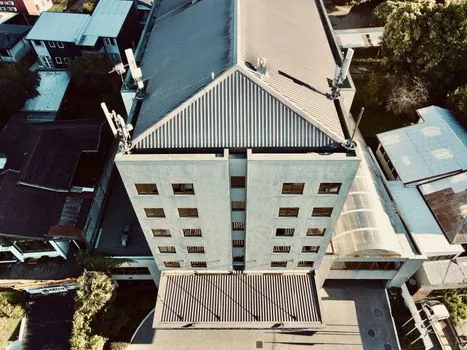
The three main bitumen families used on high-rise roofs are oxidised bitumen (often called blown asphalt), SBS-modified, and APP-modified, and they are not drop-in substitutes. [S2]
Oxidised bitumen is the feedstock and the historical reference: softening point rises from roughly 50 deg C to 85 to 155 deg C during air blowing, while penetration falls from 60 to 80 dmm to 5 to 40 dmm, producing a rigid, low-temperature-susceptibility binder used in ASTM D312 Type I to IV built-up roofing and many membrane base sheets [S2]. SBS-modified bitumen is the elastomeric option, with cold-flexibility, elongation, and multi-ply redundancy suited to high-movement and long-service-life roofs [S1][S2]. APP-modified bitumen is the plastomeric option, with a higher softening point and better UV/heat tolerance on exposed surfaces, but lower cold-flex and elongation than SBS [S2].
On a decision matrix, SBS wins where cold-climate flexibility, dynamic movement, and redundancy dominate; APP wins where exposed heat and UV dominate; oxidised bitumen wins only on cost-sensitive, low-movement, traditional BUR overlays. For a high-rise podium that sits above conditioned space and sees both summer heat soak and winter cold snaps, SBS multi-ply remains the conservative call, while APP can be specified for the upper exposed cap sheet in hot-climate zones [S2].
Installation Method and Detailing Risk on Tall Buildings
Modified bitumen installation falls into three families, and method choice on a high-rise is as much a fire-safety decision as a productivity decision. [S3]
Torch-applied SBS remains the dominant commercial method because it produces the strongest ply-to-ply bond, but it carries open-flame risk that is increasingly restricted near occupied towers and on combustible decks [S4][S7]. Cold-adhesive application removes the torch risk at the cost of slower placement and tighter weather windows. Self-adhered membranes are the safest option on occupied high-rises and on wooden or steel substrates, with peel-and-stick cold-flow adhesive that bonds under pressure, and they are now widely used on retrofit podiums in dense urban sites [S4][S6][S7].
High-rise detailing concentrates risk at four points: parapet upstands, equipment curbs, drainage sumps, and through-roof penetrations. Multi-ply SBS allows a base ply, a cant strip, and a granulated cap, each turned up the upstand a minimum of 200 mm (or to code), so any one ply can fail without breach [S3]. The same redundancy logic, base plus cap with self-healing modified bitumen, is increasingly used where minor rooftop-equipment damage is expected, because the polymer network can self-seal small cuts under heat soak [S6].
Compatibility, Standards, and Inspection Cadence
Material standards are the third spec gate. Oxidised bitumen grades (85/25, 90/40, 95/25, 105/35, 115/15, 150/5) are referenced against ASTM D312 Types I to IV, BS 3690, and EN 13304; SBS and APP modified membranes are covered by separate ASTM D6162 to D6164 series for SBS, D6222 to D6223 for APP, and by EN 13707 in the European market [S2].
Quality control on the SBS line is a frequent test point: hourly to every 90 minutes blend testing during production is the published benchmark for high-quality SBS sheet, and the binder test that matters most is the asphalt-to-polymer ratio, because too little polymer produces a brittle aged sheet and too much produces a soft, dimensionally unstable sheet [S1].
For project specification, high-rise owners should require: written confirmation of polymer type and dosage, reinforcement mat type and weight per square metre, ply count and lap detail, and a torch or self-adhered application method matched to the deck's fire classification. Maintenance intervals in published guidance are typically biennial, not annual, with attention to terminations, penetrations, and walkway pad condition [S8]. TPO can be a legitimate alternative on large open high-rise decks because wide rolls cut labour, but it is more puncture-sensitive under foot traffic than multi-ply modified bitumen, so TPO wins on speed and reflectivity while modified bitumen wins on redundancy and impact resistance [S3][S9].
For a related residential spec path that covers the same SBS versus APP decision on lower-rise housing, the article Modified Bitumen Membrane Selection for Residential Roofs: APP vs SBS Spec Path walks the same polymer comparison from a sloped-roof perspective. For wet-zone and hospital podiums, where self-healing and detailing tolerance matter even more, see Modified Bitumen Membrane Selection for Hospital Roofs and Wet Zones. Readers comparing roofing to other envelope and industrial coatings decisions can use Industrial Coating Selection for Construction: 2026 Spec Map as a cross-reference for substrate prep and inspection cadence.
Two trackable signals to watch in the next 6 to 12 months: APP and SBS product data sheets publishing verified ASTM D6222 / D6164 / EN 13707 lot-level test values for elongation and cold-flex, rather than only generic range claims, and code-side clarification of torch-applied SBS rules on tall combustible decks in dense urban jurisdictions, which would push more high-rise podiums toward self-adhered multi-ply SBS.
For component-level specifications, see high voltage tester.