
A warehouse sprinkler system is selected by matching commodity class, storage configuration, and ceiling height to a discharge density, typically 0.20 to 0.60 GPM over a design area of 1,500 to 3,000 sq ft, with ESFR ceiling-only or CMSA plus in-rack as the two principal architecture choices [S1][S2].
Warehousing and distribution-center growth continues to drive demand for high-piled storage protection, where vertical flame spread, combustible packaging, and large ceiling volumes all push designs toward high-K-factor ESFR or CMSA heads rather than standard spray layouts [S6][S8]. For a process engineer specifying a new build or retrofit, the decision tree narrows quickly once commodity class, maximum storage height, and available water supply are locked in.
Commodity Classification as the First Filter
Commodity classification under NFPA 13 is the first filter, because it sets the ceiling density, the maximum permitted storage height, and whether in-rack sprinklers are mandatory [S1][S3]. Class I covers non-combustible goods in non-combustible packaging, Class II adds combustible packaging, Class III adds wooden crates or paperboard cartons, and Class IV introduces Group B plastics and other higher heat-release commodities [S3][S5].
Group A plastics, expanded or unexpanded, exposed or in cartons, plus idle wood pallets and flammable liquids sit outside the Class I-IV ladder and trigger the most demanding design points, with 0.20 GPM densities limiting Class I-IV rack or pile storage to 12 ft and the same density holding flammable liquids, Group A plastics, and idle pallets to 6 ft of maximum storage height [S1]. High-piled storage is formally defined as solid-piled, palletized, rack, bin-box, or shelf storage above 12 ft (3.7 m), which is where ESFR economics start to pay off [S5].
ESFR vs CMSA: Two Architectures, Different Operating Logic
ESFR (Early Suppression Fast Response) and CMSA (Control Mode Specific Application) heads both use high K-factors and large droplets to penetrate fire plumes, but their operating logic differs: ESFR aims to suppress the fire at the ceiling and remove the need for in-rack sprinklers, while CMSA controls the fire and often still needs in-rack protection on tall or high-challenge commodities [S2][S4].
Typical warehouse heads in this category run brass-bodied with a K25 (K363 metric) discharge coefficient, available in upright or pendent installation, 1 inch (DN25) BSP thread, and CMSA response with a 74 degrees C (165 degrees F) temperature rating; spacing typically sits at 2.4 to 3.7 m, with listed maximum mounting heights of 7.5 m, 9 m, and 12 m depending on the model variant [S2][S4]. Standard temperature ratings span ordinary (57 to 77 degrees C / 135 to 170 degrees F), intermediate (79 to 107 degrees C / 175 to 225 degrees F), and high (121 to 149 degrees C / 250 to 300 degrees F), with selection driven by ambient warehouse temperature and any localized heat sources [S2][S4].
Density and Design Area at a Glance

The density table below summarizes the most common ceiling-only design points for conventional (non-ESFR) sprinklers, all assuming minimum 8 ft aisles, non-encapsulated commodities, and conventional wood pallets, and all with no in-rack sprinklers required [S1].
At 0.20 GPM over 1,500 sq ft, Class I-IV rack or pile storage is limited to 12 ft maximum, and flammable liquids, Group A plastics, and idle pallets to 6 ft. At 0.33 GPM over 3,000 sq ft, Class III storage can reach 20 ft. At 0.45 GPM over 3,000 sq ft, Class IV storage reaches 20 ft. At 0.60 GPM over 3,000 sq ft, Class III can go to 25 ft and Class IV to 22 ft. ESFR systems bypass this density ladder by delivering a high-volume discharge to suppress the fire directly, which is why they are the default for high-bay Class I-IV storage up to 40 ft [S1][S7].
Selection Criteria and Decision Flow
Five inputs drive the system choice: stored material and packaging, storage height and arrangement (rack, pallet, bin-box, shelf, or solid pile), building ceiling height and structure, available water supply pressure and flow, and the applicable fire code (NFPA 13 or FM Global are the dominant references cited in the manufacturer literature) [S2][S3][S4].
A practical flow for a 30 to 40 ft clear-height distribution center looks like this: if commodity is Class I-IV, storage is below 40 ft, aisles are 8 ft or wider, and water supply can deliver ESFR demand, specify ESFR ceiling-only with no in-rack. If commodity is Group A plastic, idle pallets, or flammable liquids, or storage exceeds ESFR limits, move to CMSA ceiling plus in-rack sprinklers, or raise density on the ceiling-only design and add in-rack at intermediate rack tiers [S1][S7]. Cold-storage warehouses with sub-freezing ambient temperatures shift the choice toward dry pipe, preaction, or deluge systems to avoid frozen piping, with dry sprinklers used at low-temperature ceiling zones [S2][S8]. Ceiling height itself is a primary driver of sprinkler type selection, because higher ceilings lengthen the drop time of water droplets and reduce suppression effectiveness unless larger, higher-K heads are used [S9].
When ESFR Ceiling-Only Is Not Enough
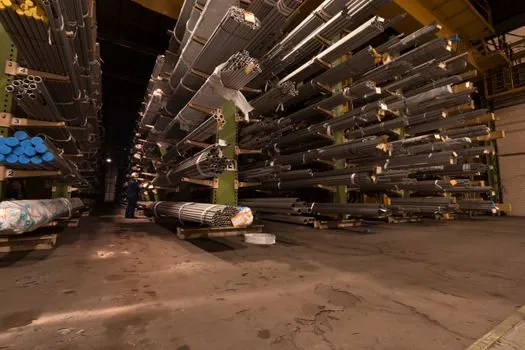
ESFR ceiling-only systems are commonly used for high-bay warehouses storing Class I-IV commodities up to 40 ft, but in-rack sprinklers become mandatory once storage height, commodity type, or aisle configuration exceeds the ESFR envelope, which is the typical case for high-piled Group A plastics, idle pallets, and rubber tires [S7]. Encapsulated commodities, defined as a pallet load fully enclosed in plastic stretch or shrink wrap, change the fire profile and typically force a step up in density or the addition of in-rack protection because the plastic film holds heat in and changes the burning behavior [S5].
Free-flowing plastic materials present a separate failure mode: they fall out of broken containers during a fire, fill flue spaces, and can smother a ceiling-only discharge, which is why dense rack storage of unexpanded plastics often needs intermediate-tier in-rack heads in addition to the ceiling design [S5]. Reinforced plastic pallets (RPP) incorporate steel or fiberglass and can be treated differently from all-plastic pallets in some design paths, although the safe move is to assume the higher commodity class until the AHJ confirms otherwise [S5].
Adjacent Building Types and Code Overlap
For laboratories, NFPA 45 Class and the relevant NFPA 13 hazard group drive a different mix of pre-action triggers, density, and water delivery; a side-by-side read of the lab selection path is useful when a warehouse site has an adjacent QC or chemical-sample room, and that path is mapped in lab sprinkler selection [S8]. Electrical work sites with live equipment use a different guard set, and the constrained-clearance cases there are covered in sprinkler system selection for electrical work sites, which is worth scanning for any battery-storage or charging annex attached to a warehouse [S2][S3]. For background on the wider protection envelope, the sprinkler system reference summarizes wet, dry, preaction, and deluge valve trim across these occupancies.
Verification, Water Supply, and Closeout

Once the architecture is chosen, the remaining checks are hydraulic: confirm the available water supply curve (static pressure, residual pressure at design flow, and duration) supports the worst-case ceiling plus in-rack demand, verify pipe sizing against NFPA 13 or FM Global data sheets, and lock the temperature rating against the highest expected ambient or localized heat plume at each head location [S2][S3].
Two trackable signals to watch: (1) any AHJ request to step up from CMSA to ESFR on retrofits where the existing feed main can be re-rated upward, since ESFR removal of in-rack heads can offset the hydraulic cost; (2) FM Global data sheet revisions on encapsulated and free-flowing plastic commodities, which historically force density step-ups faster than the underlying NFPA 13 text. A wider read on rack and shuttle integration, where sprinkler zoning must coordinate with ASRS aisle and shuttle blocking, sits in the ASRS system and shuttle system references.