
Laboratory sprinkler specification is a two-axis decision: NFPA 45 laboratory unit class (A, B, C, D) drives the construction envelope, and NFPA 13 hazard group (OH2 or EH1) drives the hydraulic design density and design area [S2].
For a typical analytical or teaching lab, the design point lands at Ordinary Hazard Group 2 (OH2), 0.20 gpm/sq ft over 1,500 sq ft, with a 250 gpm hose allowance. A Class A lab carrying more than 10 gal of flammable liquids in use jumps to Extra Hazard Group 1 (EH1) at 0.30 gpm/sq ft over 2,500 sq ft, the same density curve used for Group A plastics occupancies [S2].
NFPA 45 Lab Unit Classes and the Density That Follows
NFPA 45 Chapter 5 splits laboratories into four unit classes on flammable and combustible liquid inventory, not on building size [S2]. Class A covers more than 10 gal in use or more than 2 gal per 100 sq ft stored, the organic chemistry and petroleum testing profile. Class B holds the general analytical bench at 10 gal or less in use, 2 gal or less per 100 sq ft stored. Class C drops to 1 gal or less in use, 1 gal or less per 100 sq ft stored, the clinical and teaching range. Class D is zero flammable liquids, the electronics and physics lab.
That class cascades straight into the NFPA 13 design point. A Class A unit in an unsprinklered building needs 2-hour fire-rated construction; once you sprinkler it correctly, the construction drops, but the system has to be sized to the higher density [S2]. For Class A with EH1, expect ceiling-only sprinkler spacing at 100 sq ft per head with a 0.30 gpm/sq ft density, and a 250 gpm hose stream. For Class B/C/D, OH2 at 0.20 gpm/sq ft over 1,500 sq ft covers the same 130 sq ft per head ceiling layout most general labs already have.
Sprinkler Type vs. Hazard: QR, ESFR, CMSA, and Pre-Action
Quick-response (QR) pendent or upright sprinklers with a RTI under 50 (m·s)^0.5 are the default for OH2 laboratory ceilings, and the 1989 NISTIR 89-4200 fire test series confirmed they suppress an acetone spill fire in a typical bench layout faster than standard upright sprinklers at the same spacing [S1]. The same NISTIR work tested QR pendent on plastic CPVC piping as a substitute for steel in non-IRC jurisdictions, an important note where acid fumes would attack black steel within a few years.
ESFR (Early Suppression Fast Response) K=14.0 or K=25.2 pendents at a maximum ceiling of 40 ft are the right call only when the lab has a high-challenge storage profile, mostly Class A plastics or flammable liquid drum storage; the 0.30 gpm/sq ft EH1 ceiling-only design still applies, but ESFR replaces the in-rack layer. CMSA (Control Mode Specific Application) K=16.8 sprinklers fill the niche between OH2 pendents and ESFR for labs with high-piled solvent storage above 12 ft.
Pre-action systems sit in a different category: they are a triggering architecture, not a hazard group, and they pair with the same QR or ESFR pendent at the ceiling. A single-interlock pre-action (the most common laboratory spec) holds water out of the piping until a detection event (smoke or heat) trips the solenoid, then the sprinkler must also fuse before water discharges [S3]. That two-fault tolerance is why pre-action dominates water-sensitive lab occupancies: electronics test, metrology, vivarium, GMP pharmaceutical fill suites, and any room with a server rack inside the lab envelope.
Selection Criteria: What Pushes You Off OH2 to EH1, and Off Wet to Pre-Action
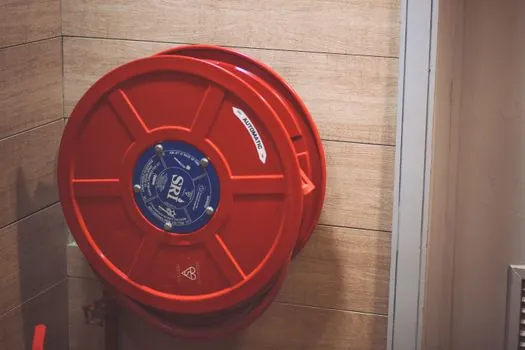
The decision is data-driven, not preference-driven. Five inputs determine the spec, and only the fifth picks a pre-action trigger. [S3]
1) Flammable liquid inventory per 100 sq ft: more than 2 gal stored or 10 gal in use forces Class A and EH1 [S2]. Below that, OH2 holds for the bench chemistry profile.
2) Maximum ceiling height: 20 ft or less keeps QR pendents on a 130-150 sq ft spacing. 20-30 ft ceilings need extended-coverage QR pendents at 196-300 sq ft spacing, which means fewer heads and lower hydraulic demand. Above 30 ft, you leave QR pendent territory and move to ESFR or CMSA, both of which carry a higher minimum operating pressure (ESFR K=14.0 at 25 psi minimum, K=25.2 at 15 psi minimum for the most common ceiling heights).
3) Commodity class in storage: lab gas cylinder racks, solvent drums, and Class IV commodity boxes each carry their own NFPA 13 commodity classification and design curves. A B-class lab with 5 gal of acetone in use on the bench but 60 gal in a UL-listed flammable cabinet does not force EH1, the cabinet is treated as a separate storage occupancy.
4) Draft curtains and bay spacing: NFPA 13 allows 40 ft bays without draft curtains under OH2 ceiling-only design; EH1 requires draft curtains or a 25,000 sq ft unsuppressed area limit, whichever is more restrictive for the AHJ.
5) Water damage tolerance: this is the only input that justifies a pre-action architecture. Server racks inside the lab, HPLC and mass-spec clusters, vivarium cages, GMP fill lines, and any room with a single-event water damage cost above the insurer's threshold are the standard pre-action candidates [S3]. A double-interlock pre-action (requires both detection AND sprinkler fusing) is the conservative pick for unattended high-value rooms; a single-interlock pre-action is acceptable for normally-occupied lab space.
Comparison: Wet QR vs. Pre-Action QR vs. ESFR for the Same Lab
Lining the three architectures against the criteria a lab project actually weighs: cost, water-damage risk, ceiling height, and detection dependency, a direct spec table reads cleaner than prose.
Wet QR pendent on steel at OH2 (0.20 gpm/sq ft, 1,500 sq ft design area): lowest installed cost, no detection dependency, water in the piping at all times. Best for Class B/C/D analytical and teaching labs without water-sensitive assets.
Pre-action QR pendent on steel at OH2 (same density, same design area): 25-40% higher installed cost due to the detection loop, air compressor (for single-interlock dry pipe side) or nitrogen supervisory pressure, and the solenoid valve package. Eliminates accidental discharge from mechanical damage to the piping. Best for Class B/C labs with high-value instruments, vivarium space, and GMP suites.
ESFR K=14.0 pendent at EH1 (0.30 gpm/sq ft effective, suppression-mode design, 2,500 sq ft design area): highest hydraulic demand on the floor, requires a 4 in. dedicated riser, eliminates the need for in-rack sprinklers. Best for Class A labs with high-piled solvent storage up to 25 ft ceiling height, or any lab with a 30+ ft ceiling that needs fast suppression rather than control-mode cooling.
Cross-Reference to Adjacent Spec Topics

Laboratory sprinkler spec rarely lives alone; the welding bay next door has its own temperature-class and pipe-sizing map under NFPA 13, and the construction-site trailer that the lab staff walks through on day one runs a separate temporary-water spec. Both share the same NFPA 13 base but pick different sprinklers, which is why the adjacent spec maps for welding-bay sprinklers and construction-site sprinklers read as complements, not overlaps, to this lab guide. [S2]
Failure Modes and Inspection Traps
Three failure modes dominate post-commissioning callbacks. First, plastic CPVC piping in a lab with routine acetone vapor exposure degrades faster than the manufacturer's chemical-resistance table predicts; the NISTIR 89-4200 plastic-piping test passed the fire performance check but the long-term chemical compatibility is a separate question that has to be answered against the lab's specific solvent list, not against a generic chemical chart [S1]. Second, single-interlock pre-action systems that share a detection loop with the building fire alarm get nuisance-trapped into dry mode when the alarm is silenced, leaving the lab with a pre-action valve held open by a signal that no longer exists; the cure is a dedicated detection circuit, not a shared one. Third, EH1 ceiling-only design that pairs with deep draft bays above 40 ft silently fails the 25,000 sq ft unsuppressed area rule; the AHJ will flag it at first inspection and the rework is expensive.
Standards to Confirm With the AHJ Before Final Spec
The code stack the AHJ enforces has to be confirmed edition by edition before hydraulic calculations freeze. NFPA 45 (2024 edition is the most recently published) drives laboratory unit classification, NFPA 13 drives sprinkler spacing and density, NFPA 30 governs flammable liquid storage cabinets and the MAQ tables, NFPA 55 covers compressed gas and cryogenic inventory, NFPA 318 is mandatory for semiconductor fabs, and NFPA 2001 covers clean-agent total flooding for the water-free zones that a pre-action system cannot serve [S2]. OSHA 29 CFR 1910.1450 (laboratory standard) is the chemical hygiene layer and gets enforced by state OSHA, not the fire AHJ, so its requirements land on the chemical hygiene plan, not on the sprinkler drawing.
Track two signals before issuing a bid package: the AHJ-adopted edition of NFPA 45 (the 2024 edition tightened Class A MAQs relative to the 2015 edition, and several jurisdictions have not yet completed the adoption cycle), and the lab's confirmed solvent inventory at the time of hydraulic calc (a 5-gal shift in stored acetone can reclassify the unit from Class B to Class A and force the EH1 design point). The chemistry inventory is the single document that most often invalidates a finished sprinkler drawing.
The underlying component specifications are covered under sprinkler system, asrs system, and shuttle system.