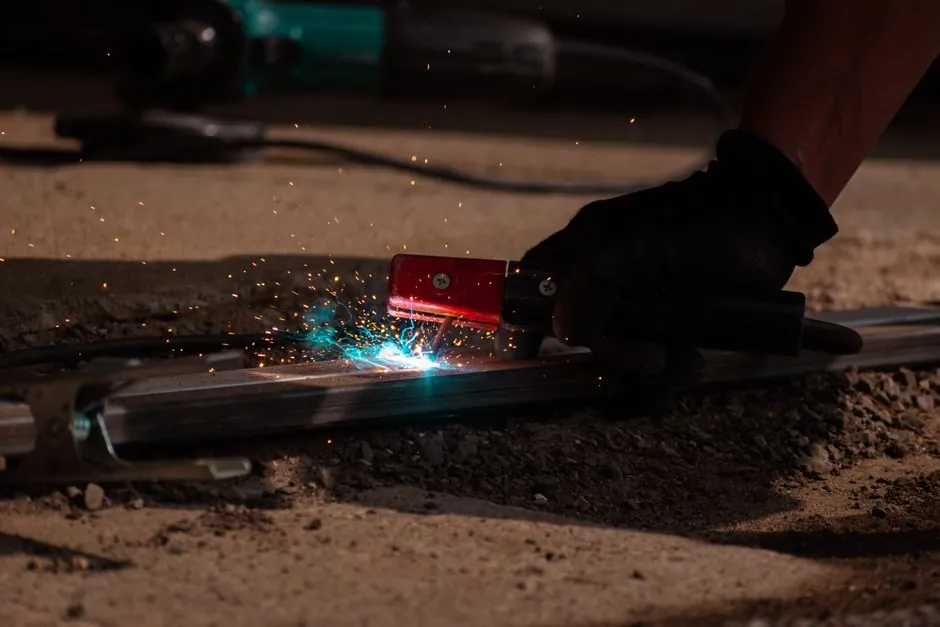
Welding near automatic sprinklers is governed by NFPA 13 temperature-class selection: at a maximum anticipated ceiling temperature of 80°F (26°C), the Ordinary classification, with a 135°F (57°C) activation rating, is the default ceiling-temperature match [S3]. The same source frames the rule as: sprinkler temperature classification is selected to maintain a safe differential below the maximum anticipated ceiling temperature, which prevents accidental activation under normal thermal conditions [S3].
The selection pivot, however, is rarely the weld puddle itself; it is the proximity of the arc, slag, and post-weld heat to the fusible link or glass bulb. Summit Fire & Security's published field guidance states that the 135°F (57°C) Ordinary rating is the most common ceiling-temperature match, and that the controlling factor in welding environments is how close the sprinkler is to the work, not the theoretical maximum ambient [S1]. On the fabrication side, AWL's July 2026 launch of its second-generation sprinkler-pipe machine (Sprinkler Machine 2.0) raised automated outlet-welding throughput to 80 outlets per hour at the 2-outlet baseline, with pipe-rotation welding to keep size-on-size outlet welds consistent [S2].
NFPA 13 Temperature Classifications: Which Class Fits a Welding Bay
NFPA 13 groups automatic sprinklers into Ordinary, Intermediate, and High temperature classifications, with Ordinary sprinklers rated at 135°F (57°C) to 170°F (77°C) and typically color-coded uncolored or black [S3]. A bay that holds steady at or below 100°F (38°C) ceiling temperature can be specified Ordinary without ambiguity; the published NFPA 13 selection rule applies when welding is performed on or near sprinkler piping, and the most common exam and field answer is the Ordinary classification [S3].
For welding cells, the practical ceiling-temperature read is not the room thermostat; it is the localized plume above the arc, the preheat station, and the post-weld slow-cool rack. Summit's field Q&A notes that sprinkler activation risk around welding tracks the physical distance between the heat source and the sensing element, with 135°F (57°C) the lowest commonly specified rating and the one most often called out as the activation threshold near hot work [S1]. That is why most welding-bay specifications stop at Ordinary, and only escalate to Intermediate (175–225°F / 79–107°C) or High (250–300°F / 121–149°C) when a documented engineering analysis justifies the jump, for example under a localized preheat hood, near a stress-relief oven, or above a forge. None of the cited guidance permits specifying a higher temperature class purely to silence nuisance trips; the move must be tied to the maximum anticipated ceiling temperature, not to operational convenience.
Distance, Shielding, and Hot-Work Permits: Decision Criteria Beyond the Class Letter
Distance from the arc to the sprinkler deflector is the first discriminator, and Summit's published Q&A frames it as the deciding question: the closer the welding, the higher the trip risk at 135°F (57°C) [S1]. A common engineering rule of thumb, repeated across manufacturer literature, is to keep open arc and slag at least 36 inches (≈900 mm) below any Ordinary sprinkler, with combustible coverings (welding blankets, fire-resistant drop cloths) used to catch spatter before it reaches the sensing element.
The second discriminator is shielding. Welding blankets rated to NFPA 701 or ISO 11611 do not block radiant heat at the fusible link; they contain spatter and reduce the localized heat-flux footprint. The third is administrative: NFPA 51B (Hot Work) and the facility's own permit-of-record require a pre-shift check that the sprinkler directly above the work cell is not obstructed and that the temperature classification matches the posted hot-work permit. Where welding is performed directly on the sprinkler piping itself, the welding procedure specification (WPS) for the outlet-to-pipe joint is what controls weld quality; AWL's new pipe-rotation welding cell delivers outlet welds at a consistent angle even for size-on-size joints where the outlet outer diameter matches the pipe outer diameter, eliminating gravity-driven weld-pool sag [S2].
Pipe Prefabrication: Why Welded-Outlet Quality Has Become a Spec Issue
On the supply side, sprinkler-pipe prefabrication has shifted from manual welding cells to integrated robotic cells, and the spec consequences reach the welding engineer as much as the fire-protection engineer. AWL's Sprinkler Machine 2.0, launched 15 July 2026, processes standard pipes at up to 80 outlets per hour and holds that 80-outlet baseline even when welding only two outlets per pipe, where competitor cells see a sharp throughput drop in low-outlet runs [S2]. The machine also handles pipes weighing 770 lb (350 kg) and over 20 ft (6 m) long by locking them between two grooving machines, removing the operator from above the weld arc and from direct fume exposure [S2].
Throughput scaling is meaningful for the welding engineer because prefab shops quote welded-outlet sprinkler assemblies by the joint, and joint consistency drives hydraulic-calculation tolerance downstream. AWL's 2.0 cell replaces the output of three to four semi-automated units, or six manual welders, while every pipe is logged for full traceability and the system supports remote diagnostics by any AWL programmer [S2]. A prefab shop that quotes NFPA 13-compliant welded-outlet assemblies with documented WPS, PQR, and WPQ records becomes a lower-risk supplier than a site-welded cell, particularly on high-rise jobs where the standpipe demand is capped at 1,000 gpm (3,785 L/min) for fully sprinklered buildings under NFPA 14 §7.10.1.1.2 [S3]. The same remote-diagnostic posture is becoming a procurement checkbox, because any line stop on a prefab cell is now a fire-protection schedule risk, not just a fab-shop problem.
Selection Criteria Compared: Ordinary vs Intermediate vs High, and When to Move Up
For a documented comparison, three decision criteria line up cleanly: maximum anticipated ceiling temperature, distance from arc/slag to the sprinkler, and administrative posture (hot-work permit, WPS, NFPA 13 listing). Ordinary (135–170°F / 57–77°C) is the default for ambient bays up to 100°F (38°C) ceiling and is the answer NFPA 13 examiners select when welding is performed on sprinkler piping and the ceiling stays in the normal-occupancy range [S3]. Intermediate (175–225°F / 79–107°C) is the right call when a localized heat source pushes the ceiling-temperature envelope above 100°F but below 150°F (66°C), for example under a preheat hood or above a stress-relief oven that is part of the welding process.
High (250–300°F / 121–149°C) belongs only where the maximum anticipated ceiling temperature is documented above 150°F (66°C), which is rare in general welding bays but common in forge shops, heat-treat cells, and certain boiler rooms. A blind spot in most specs is failing to anchor the temperature-class choice to the maximum anticipated ceiling temperature, as NFPA 13 requires, rather than to the maximum credible accident temperature [S3]. That distinction is the audit question, and it is the one an Authority Having Jurisdiction (AHJ) will press on during plan review.
Failure Modes and Field Pitfalls: Where Welding Specs Go Wrong
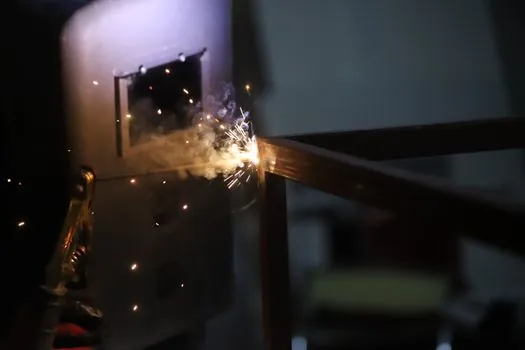
Three failure modes recur in welding-bay sprinkler incidents. The first ismis-classification: an Ordinary sprinkler installed above a preheat station trips on every shift. The second ismis-shielding: welding blanket draped over the sprinkler to stop nuisance trips, which both conceals the element from inspection and is itself a code violation in most jurisdictions. The third ismis-procurement: welded-outlet sprinkler assemblies sourced from a shop without a documented WPS, which fails the AHJ's material-of-construction submittal on the first plan review. [S2]
On the fabrication side, AWL's engineering team flagged size-on-size outlet welds (where the outlet's outer diameter matches the pipe's outer diameter) as the highest-defect joint geometry in manual cells, because gravity sags the weld pool when the pipe cannot be rotated; the 2.0 machine's pipe-rotation welding cell is the direct engineering response [S2]. For the welding engineer writing a procurement spec, the right submittal language is a per-joint WPS reference, an outlet-weld sample coupon, and traceability records that name the machine, the operator, and the date, exactly the data the 2.0 cell logs automatically [S2].
Related Reading and Sourcing
For the oil-and-gas-specific overlay (hazard classification, hydrocarbon fires, and NACE MR0175 considerations on sprinkler-pipe materials), the cross-link is Sprinkler System Selection for Oil and Gas Facilities: Hazard, Standard, and Spec Map. For electrical-work-site proximity rules, especially where welding coexists with energized panels, the companion piece is Sprinkler System Selection for Electrical Work Sites. Background on the sprinkler system temperature-class framework and on the welding and cutting tool classifications that govern the WPS side is anchored in the encyclopedia entries. [S1]
Two trackable signals close the loop. First, AWL's stated industry figure: an estimated 300,000-welder shortage by 2028, which is the commercial case driving robotic prefab cells like Sprinkler Machine 2.0 [S2]. Second, the NFPA 14 demand cap of 1,000 gpm (3,785 L/min) for fully sprinklered high-rises, which is the hydraulic boundary every welded-outlet assembly on a standpipe riser must support under NFPA 14 §7.10.1.1.2 [S3]. Both numbers are the kind of hard constraint that should appear on the next revision of a welding-bay sprinkler specification.
Detailed specification references: asrs system.