Warning signs in 2026 are purchased as engineered assemblies, not printed sheets, with MUTCD 11th edition guidance issued in April 2026 reaffirming yellow as the permanent hazard warning color and orange as the temporary traffic control marker [S6].
Plant buyers, facility managers, and roadway specifiers are the three audiences driving the bulk of 2026 demand, and each pulls from a different compliance chain: OSHA 1910.145 for general industry, ANSI Z535.2 for product and machinery, and MUTCD 11th edition for right-of-way. Average homeowner roof repair is a useful cost anchor at roughly $6,600 per project, illustrating why a $40 sign is cheap insurance against a $20,000 structural mistake [S4].
What a Warning Sign Actually Is in 2026
A 2026-spec warning sign is the triad of substrate, graphic, and retroreflective sheeting bonded to a single panel, with each layer carrying a standard designation. Per the MUTCD 2026 update, warning signs use a black legend and border on a yellow background, the temporary traffic control variant uses black on orange, and guide signs use white on green, a separation that buyers must respect when sourcing from mixed inventories [S6].
Traffic sign catalogs in 2026 classify signs into three families: regulatory (red/white/black), warning (yellow), and informational/guide (green/blue/brown), and the MUTCD 11th edition continues to govern the shape and color conventions across U.S. public roadways [S7]. For industrial buyers, the ANSI Z535 family adds a fourth tier of hazard severity color codes, red for danger, orange for warning, yellow for caution, and blue for notice, that runs parallel to MUTCD on private property.
Selection Criteria: Match Sign to Hazard Class and Viewing Distance
Selection starts with three numbers: the hazard class per OSHA 1910.145 or ANSI Z535.2, the maximum viewing distance the sign must be legible at, and the expected duty cycle indoors versus outdoors. MUTCD's W-series sign sizing tables tie letter height to posted speed, ranging from 5 inch Series A for low-speed local roads to 20 inch Series E and F for expressways, and 2026 buyers are expected to size upward, not downward, when ambiguity exists [S7].
Retroreflective sheeting grade is the second decision, with ASTM D4956 Type I (engineering grade) for low-traffic or non-roadway use, Type IV (high-intensity prismatic) for the bulk of public roadway warning signs, and Type XI (diamond grade) for high-speed expressway and critical hazard callouts. The warning sign spec page documents the substrate and sheeting combinations that survive a 10 year UV and salt-spray duty cycle without legend delamination.
Substrate choice tracks environment: 0.063 inch aluminum is the workhorse for permanent outdoor warning signs, 0.080 inch aluminum is reserved for larger 48 inch and 60 inch panels where wind load and panel sag matter, and high-density polyethylene (HDPE) or composite panels are specified for chemical plants where aluminum is incompatible with the ambient corrosion class.
Material and Sheeting Comparison
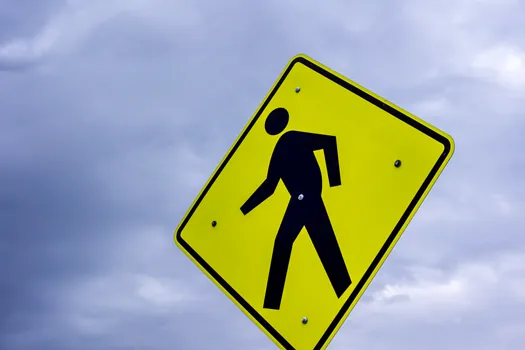
Buyers comparing substrate options line up against four criteria, corrosion resistance, impact survival, panel weight, and unit cost, and the realistic 2026 shortlist runs 0.063 aluminum, 0.080 aluminum, HDPE composite, and steel with a hot-dip galvanized finish. Aluminum wins on weight and corrosion, galvanized steel wins on impact and vandalism resistance for ground-mounted signs in high-abuse areas, and HDPE wins where stray-current or chloride exposure would attack aluminum. Specifiers working near linear guide machinery or robotic cells should also confirm that the chosen substrate will not generate a galvanic path to grounded machine frames. [S3]
On sheeting, the criteria-based shortlist looks like this: Type I (engineering grade, ~7 year outdoor life, lowest cost), Type IV (high-intensity prismatic, ~10 year life, mid cost, the default for most public roadway warning signs), and Type XI (diamond grade, ~12 year life, premium cost, mandatory for high-speed expressway gore points). Buyers who default to Type I to save budget on a public roadway sign in 2026 are routinely failing MUTCD conformance inspections, because the MUTCD 11th edition retains the requirement for high-speed right-of-way warning signs to meet prismatic-grade retroreflectivity [S6].
Who Warning Signs Are For, and Who Should Not Use Stock Variants
Warning signs are for any site where a transient or untrained observer must be alerted to a hazard they cannot otherwise see, which covers roughly every plant, dock, and public roadway in service. Stock catalog signs are appropriate for general purpose OSHA 1910.145 callouts, electrical shock, hard hat area, eye protection required, and the bulk of MUTCD W1 through W11 roadway callouts, with MUTCD's own guide listing pedestrian, bicycle, and roadway configurations across the W11 family [S7].
Custom-fabricated signs are required when a hazard cannot be expressed by an MUTCD W-series or ANSI Z535 stock legend, when a viewing distance exceeds the catalog sizing, or when the sign must integrate a pictogram unique to the facility. Buyers who try to force a custom hazard into a stock "Danger" header with a hand-written vinyl legend are accepting a non-conforming sign that will fail an OSHA inspection under 1910.145(d) and will not survive a 2026 ANSI Z535.2 audit.
Common Failure Modes and Inspection Traps
The three most frequent 2026 specification failures are undersized legends, wrong sheeting grade, and color/meaning collisions between OSHA and MUTCD on shared sites. Undersized legends fail at the posted viewing distance within 18 to 24 months of install as retroreflectivity degrades, and MUTCD's W-series sizing tables remain the reference for minimum letter height at each speed band [S7].
Wrong sheeting grade is the second trap, with MUTCD 2026 reaffirming that orange is reserved for temporary traffic control, including work zones, detours, and TTC plan callouts, and that permanent hazard callouts must use yellow background with black legend and border [S6]. A yellow background applied to a temporary work zone sign, or an orange background applied to a permanent hazard callout, will draw a non-conformance citation in 2026 audits.
Color collisions with other safety markers are the third trap, and industrial sites that already deploy warning tape for buried cable or floor demarcation must coordinate color so that a yellow "Caution" tape zone does not visually compete with a yellow "Caution" overhead sign at the same workstation.
Codes, Standards, and Sourcing Checklist
Five documents govern the 2026 warning sign buy: OSHA 29 CFR 1910.145 for accident prevention tags and signs in general industry, ANSI Z535.2 for environmental and facility safety signs, MUTCD 11th edition (April 2026 update) for public roadway signs, ASTM D4956 for retroreflective sheeting, and the Buy American Act / Build America Buy America clauses for federally funded roadway work. A compliant submittal package includes the substrate alloy or HDPE data sheet, the sheeting Type designation, the legend artwork proof, the panel drawing with hole pattern, and a 10 year retroreflectivity warranty. [S5]
Trackable signals to watch over the next 12 months include the FHWA MUTCD 11th edition compliance grace period for non-conforming legacy signs, the ASTM D4956 revision cycle for Type XI sheeting photometric tables, and any OSHA 1910.145 updates tied to the broader industrial safety stack. Buyers comparing this category against adjacent 2026 guides, including safety fence and safety relay procurement, should align hazard-class color codes and viewing-distance tables across the entire safety stack so that an orange "Warning" sign, an orange machine guard, and an orange relay status LED all read as the same severity level to a floor operator.