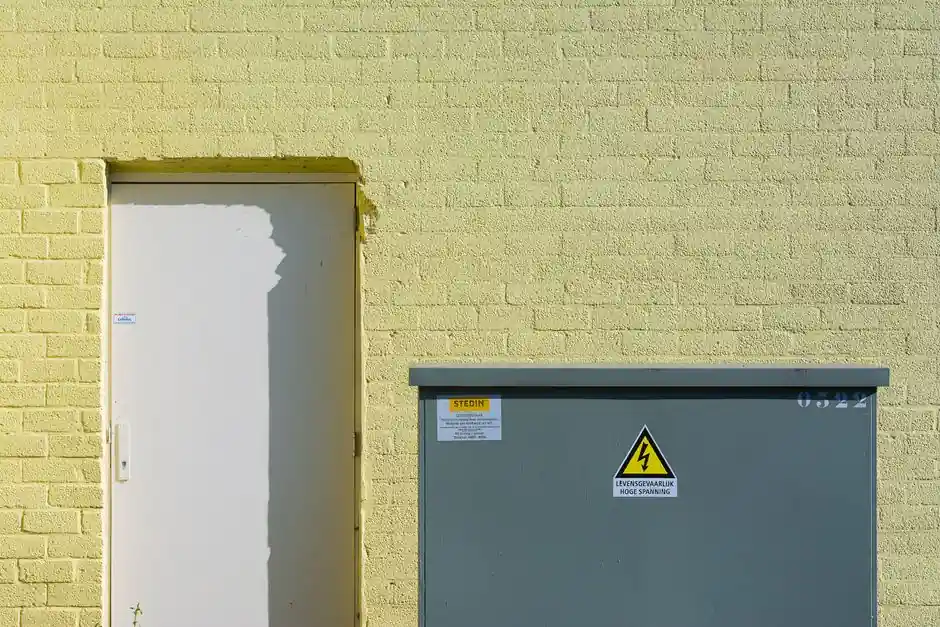
A warning sign and a first aid sign differ in three observable ways: shape, color, and pictogram. ANSI Z535 color codes and ISO 7010 standard graphics assign yellow-and-black to hazard warning, red-and-white to fire/prohibition, blue to mandatory action, and green to safety/condition, and the green first aid pictogram (E003) is the only sign type legally permitted to use that white cross on green field on US facility equipment [S8][S6].
This matters for any EHS buyer, facility manager, or OSHA 1910.145 / ANSI Z535.2 specifier, because mixing a hazard warning sign over a first aid station creates a compliance gap and slows response time during an incident. First aid signs typically retail at $5.29 to $43.67 per unit [S1][S2], while 10 in x 14 in ANSI Z535 warning signs cover hazard zones in chemical, electrical, and construction areas.
ISO 7010 and ANSI Z535 Color and Shape Codes
ISO 7010 and ANSI Z535 separate the four safety message types by color and geometry, and the codes are non-negotiable in most US plant audits. Warning uses a yellow equilateral triangle with a black border, prohibition uses a red circle with a diagonal bar, mandatory action uses a blue solid circle, and safe condition (including first aid) uses a green rectangle or square [S8][S6].
The first aid symbol itself is graphic E003 in ISO 7010, a white cross on a green background, distinct from the legally protected red cross emblem that is reserved for the International Red Cross and Red Crescent Movement [S8]. The red cross cannot be used on commercial safety signs; the green ISO 7010 white cross is the only specifiable option for marking a first aid kit on a US facility wall.
ANSI Z535.2 sets the header word for hazard communication: DANGER (red, immediate), WARNING (orange, possible), CAUTION (yellow, potential). First aid signs do not use a header word, because they mark a safe location rather than a hazard [S6]. That distinction is what separates a warning sign from a first aid sign at first glance on a plant tour.
When a Warning Sign Is the Correct Choice
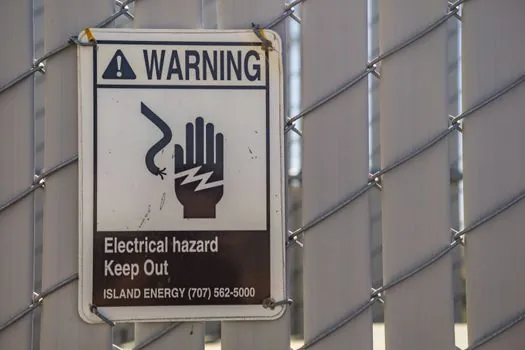
Warning signs apply where a hazard condition exists and a behavioral response is required: arc flash, chemical exposure, pinch points, hot surfaces, overhead loads. OSHA 29 CFR 1910.145 specifies that danger signs must be used only where an immediate hazard exists, warning signs where the hazard can cause serious injury, and caution signs where the hazard will only cause minor injury [S6].
Sign construction for hazard warning typically uses rigid aluminum (0.04 in to 0.08 in) for outdoor service, reflective aluminum for low-light zones, or photoluminescent vinyl for power-outage legibility. Reflective aluminum signs from Brady and Graphic Products carry 7- to 10-year outdoor UV ratings, with adhesive backing tested to BS 5609 for marine and chemical plant exposure.
A warning sign is NOT the right call when the message is positive (a first aid station, an assembly point, an AED), because the yellow triangle semantically codes the location as a hazard, not a resource. Misapplying a yellow warning sign to a first aid station contradicts ISO 7010 and slows the responder in a real incident by tens of seconds, which is the precise interval that decides a tourniquet outcome.
When a First Aid Sign Is the Correct Choice

First aid signs apply where the message is a positive condition, specifically the location of a first aid kit, AED, eye-wash station, safety shower, or trauma kit. OSHA 1910.151 and ANSI Z308.1 require that first aid supplies be readily accessible, and the standard practice (industry guidance, not a federal mandate) is to mark that location with a green ISO 7010 E003 sign visible from 25 ft to 50 ft, depending on facility size [S6][S3].
Standard first aid sign SKUs at SafetySign.com range from $8.24 to $11.09 for InfiniStick mounted plastic signs (items F3084, F3085, F3079), with projecting or V-shaped directional signs (F3080, F3111) at $8.32 to $21.90 for hallway corners where the kit sits perpendicular to the line of sight [S1][S2]. Floor-standing keep-clear floor signs (SF-1342) run $73.94 per kit, used to keep the cabinet approach path unblocked by carts or pallets [S2].
Bilingual English/Spanish variants (F3086BI, F3112BI, F3090BI) are also stocked at the same $8.24 to $8.32 price point, which closes a practical OSHA training gap on US sites with mixed-language workforces [S1]. For wall-mounted placement next to a first aid kit, the 7 in x 10 in or 10 in x 14 in plastic or vinyl sign is the specifier's default; acrylic and aluminum variants ship for harsher environments.
Material and Size Comparison: Picking the Right Construction
Material selection for safety signs is driven by environment, not aesthetics, and the price spread across materials is roughly 3x to 5x for the same message. Vinyl adhesive labels at $5.29 to $7.06 suit clean indoor walls, plastic signs at $8.24 to $15.97 suit general indoor use, and aluminum or reflective aluminum at $21.90 to $43.67 suit outdoor and high-abuse locations [S1][S2].
Size selection follows viewing distance. A 3.5 in x 5 in label is readable from 5 ft to 10 ft and goes on the cabinet door; a 7 in x 10 in plastic sign is readable from 25 ft and goes above the cabinet; a 10 in x 14 in or 12 in x 18 in sign is readable from 50 ft and goes on the wall opposite the station or at a corridor junction [S2]. Projecting V-shaped signs (90-degree wall projection) solve line-of-sight blind spots in T-intersections and are specifiable in the same SKU family.
For chemical and outdoor process plants, the material hierarchy is: polyester-laminated vinyl for cabinets near corrosive wash-down, aluminum (0.04 in) for general outdoor, heavy-duty aluminum (0.063 in) for high-traffic forklift zones, and reflective aluminum for low-light or outdoor perimeter marking. Acrylic (3 SKUs in the Brady catalog) sits between plastic and aluminum for indoor cleanrooms where a washable surface matters [S2][S3].
Pricing, Sourcing, and Lead Time Benchmarks
First aid sign pricing as of September 2026 is tightly clustered between $5.29 and $11.09 for the most common wall-mount SKUs at SafetySign.com and MySafetySign, with 40+ active SKU codes for first aid kit alone [S1][S2]. Floor-standing keep-clear kits are the outlier at $73.94 per unit, because the SKU ships as a complete floor sign kit with weighted base [S2].
Warning sign pricing tracks a similar range for 10 in x 14 in plastic ($8 to $15) but climbs sharply for 12 in x 18 in reflective aluminum ($25 to $45) and large 24 in x 24 in outdoor aluminum ($40 to $80) at Brady, Accuform, and Graphic Products. Brady's 888-250-3082 sales line and Graphic Products' duralabel.com site both stock ANSI Z535 header versions (DANGER / WARNING / CAUTION) with custom text on 1- to 3-day lead time for stock SKUs [S3][S5].
Lead time for custom header text or bilingual variants is typically 3 to 5 business days at SafetySign.com, with free shipping on orders over $29.95 and same-day ship on stock InfiniStick SKUs [S2]. For facility-wide rollouts (200+ signs), Brady and Accuform run 2- to 4-week lead times with custom header and corporate-logo print options. An emergency stop button rollout follows a similar 3- to 5-day custom-text lead, which is useful when staging a multi-device safety walkdown.
Compliance and Audit Considerations
OSHA 1910.145(d)(2) requires that danger signs use red, black, and white; 1910.145(d)(4) requires caution signs use yellow with black letters; and 1910.145(d)(6) requires that the sign be visible at all times when work is being performed. First aid signs, by contrast, fall under 1910.151 (medical services and first aid) and ANSI Z308.1 (minimum requirements for workplace first aid kits and supplies), neither of which prescribe a specific sign graphic but which OSHA inspectors commonly test for visibility during a walkaround [S6].
ANSI Z535.2-2017 (current industry revision referenced in compliance guidance) sets the header format (signal word, message panel, symbol panel) and is the design basis used by Brady, Accuform, and SafetySign.com for all warning and caution SKUs. The green first aid safe-condition graphic is governed by ISO 7010 E003, which is harmonized globally and avoids the need for region-specific artwork on multinational sites [S8].
For a hazard-marking sign on an arc flash or chemical exposure zone, the specifier should pull from the warning sign family and verify the symbol against ISO 7010 W-series (W01 general warning, W04 laser, W06 vehicle traffic, W22 sharp element). For a first aid kit location, the specifier pulls E003 green and confirms size against the maximum viewing distance in the room, since undersized signs are the single most common audit finding in 2025-2026 OSHA inspections.
Selection Workflow: From Hazard Analysis to SKU
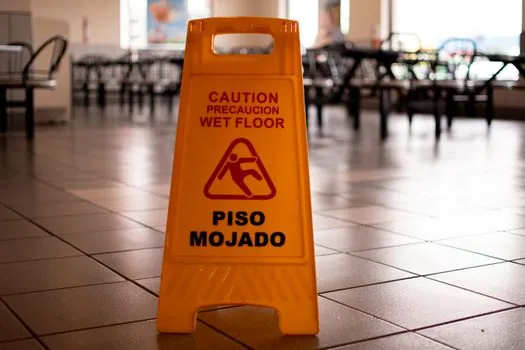
Step 1: classify the message. If the location presents a hazard, use a yellow triangle (warning) or red oval (danger). If the location is a safe condition (kit, AED, shower, assembly point), use a green square (first aid / safe condition). Step 2: measure viewing distance and select size to meet ANSI Z535.2 legibility (10 in x 14 in covers 50 ft, 7 in x 10 in covers 25 ft) [S2].
Step 3: match material to environment: vinyl indoors, plastic for clean walls, aluminum outdoors, reflective aluminum for low-light, acrylic for wash-down cleanrooms. Step 4: order 10% to 15% overage for breakages and future moves. Step 5: confirm bilingual needs for the workforce; bilingual first aid signs (English/Spanish) ship at the same $8.24 price point as English-only at SafetySign.com [S1].
Trackable signals: monitor OSHA's 2026 regulatory agenda for any update to 1910.145 (signs and tags) and ANSI Z308.1 (minimum first aid kit and supply requirements) revisions, both of which can shift the size and material specs. Reference the emergency stop pricing spec tier mapping if the facility is also rolling out a parallel ANSI Z535.6 product safety sign system, since the same vendor SKU families typically cover both.
