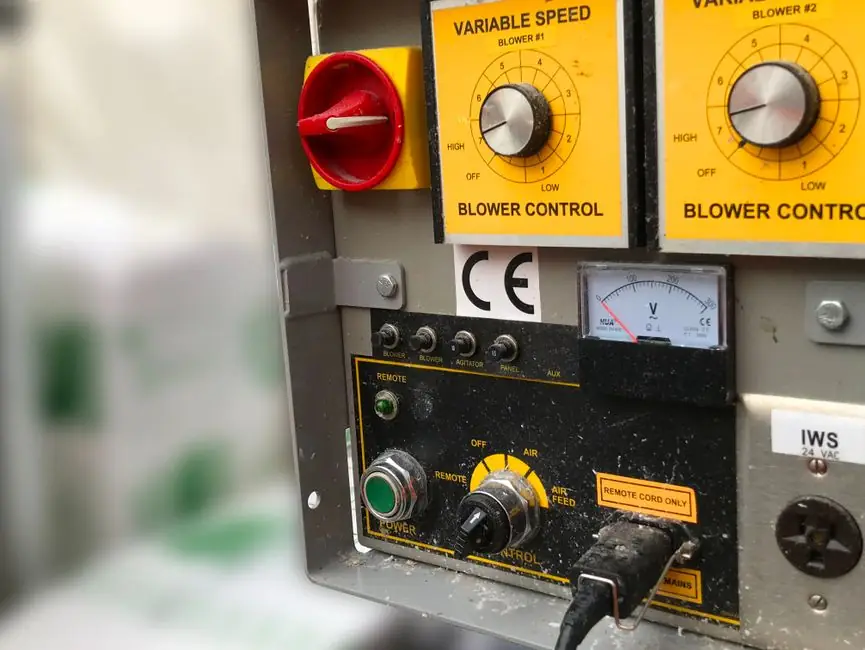
Momentary E-stop push buttons on US industrial supply catalogs list a typical price band of $5 to $50 per unit, with the upper end reserved for illuminated, keyed, or higher-IP-rated modular heads [S3]. Complete modular safety devices, where the operator, contact blocks, and enclosure are priced as a system, routinely run $80 to $200 per station on EU/US catalogs stocking ABB, Schneider Electric, Banner, and Honeywell lines [S1][S4].
The price spread is governed less by the mushroom-head actuator and more by the contact-block count, the ingress rating, and whether the unit carries a third-party safety certification suitable for ISO 13850 and IEC 60947-5-5 machinery circuits [S5][S6]. Buyers who treat the E-stop as a commodity usually under-spec the contact arrangement; buyers who treat it as a safety function tend to over-spec the enclosure.
What Actually Drives the Price: Actuator, Contacts, and IP Rating
An E-stop station is a stack of three purchased parts: the panel-mount or surface-mount actuator (mushroom, palm, twist-to-release, pull-to-release, key-reset), the contact blocks (1NO/1NC, 2NC, or 1NO/2NC for Category 3/PL d or Category 4/PL e safety circuits), and the housing or enclosure [S1][S5]. The bare plastic-head actuator is the cheapest item, often $3 to $15 on a US e-commerce listing; adding a 2NC positive-opening contact block typically doubles the per-station cost.
Ingress protection is the next cost lever. The current rating of the contact block (commonly 6 A, 10 A, or 16 A at 250/400 V AC) and the voltage rating the block is listed for are the third price axis, and the published spec sheet should be checked against the inrush of the downstream contactor or relay coil.
Cost Comparison Across the Main E-Stop Form Factors
Four form factors cover almost every industrial panel: panel-mount 22 mm and 30 mm modular pilot devices, panel-mount 16 mm miniature E-stops, surface-mount enclosed stations, and cable-pull (rope-pull) E-stops that trip from anywhere along a conveyor run [S1][S6]. The 22 mm modular format, in plastic or metal head, is the lowest-cost option for control-cabinet builders and is the format most stocked by ABB, Eaton, Schneider, and IDEC.
The 30 mm format, often called the "heavy-duty" or NEMA-style pilot-device size, is preferred in North American process plants and on legacy retrofit work; it tends to price 20% to 40% above a 22 mm equivalent because the contact blocks and the panel cutout are larger [S1][S5]. Enclosed surface-mount stations with a yellow/red polyamide or metal housing and pre-wired 1NO/2NC contacts are specified where a standalone trip point is needed outside a cabinet; ONPOW's new-energy industry guide flags this form factor as the default for solar combiner boxes, BESS cabinets, and EV charger pedestals [S2].
Cable-pull E-stops add 2x to 5x to the per-station price but cover a run of 10 m to 200 m with a single trip line, so for a long conveyor the per-metre installed cost is competitive against stringing individual mushroom buttons [S6]. Miniature 16 mm panel-mount E-stops, used on compact medical and laboratory equipment, sit at the bottom of the modular price ladder but are restricted to low-current logic-level switching.
Selection Criteria That Change the Specification (and the Cost)
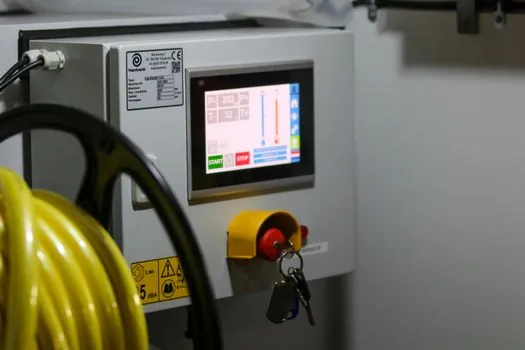
Five buyer-facing criteria decide the SKU: (1) reset method, which is a regulatory choice under ISO 13850 (twist-to-release, pull-to-release, or key-reset are all acceptable; automatic reset is generally not for Category 3/4 circuits); (2) contact arrangement (1NC for the simplest trip; 2NC or 1NO/2NC for redundant, force-guided safety circuits); (3) voltage and current rating matched to the contactor coil; (4) IP rating matched to washdown, dust, or outdoor exposure; (5) safety certification (UL listed, TÜV, CCC, CE) accepted by the end-customer jurisdiction [S5][S6][S7].
Buyers who focus only on the panel cutout size and the color (red on yellow) routinely receive a part that is mechanically correct but electrically insufficient, because the contact block is sized for 6 A resistive but the downstream contactor draws a 10x inrush [S5]. Buyers in the new-energy sector (PV inverter stations, BESS containers, EV DC fast chargers) should also confirm the operating-temperature window, since rooftop PV combiner boxes routinely see 70 to 85 C internal cabinet temperatures and a standard polyamide head will creep over time [S2].
Where the Spend Hides: Enclosures, Cabling, and Total Installed Cost
The line-item price on a distributor page is the actuator and contact blocks only; the per-station installed cost is usually 1.8x to 2.5x that figure once you add the enclosure (fiberglass, stainless, or polyamide), the cable gland, the conduit or M12 connector, the legend plate, and the labor to cut the panel, wire the contact blocks, and label the function [S3][S4]. For an IP67/IP69K food-line station, the stainless-steel or reinforced polyamide enclosure alone is often more expensive than the operator head inside it.
Total cost of ownership is dominated by three downstream items: spare-parts inventory (carrying a 10% replacement stock of the same SKU avoids line stoppages), mean time between failure of the contact block (typically 100,000 to 1,000,000 mechanical cycles depending on the load), and the cost of compliance documentation if a safety audit traces back to an unlisted component [S6]. Specifying a UL-listed or TÜV-certified head and contact block from one of the major lines (ABB, Eaton, Schneider, Banner, Honeywell) is the cheapest way to keep that documentation cost close to zero.
Who Should Spend More, and Who Should Not

Process plants, conveyor lines, machine tools, and any installation covered by ISO 13849-1 Category 3 or higher, or by IEC 62061 SIL 2 and above, should spec force-guided 2NC contact blocks and a third-party-listed head; the price premium is roughly 30% over a generic 1NC SKU and it buys you documented safety integrity [S5][S6]. Outdoor, washdown, or explosive-atmosphere installations (ATEX/IECEx zones) compound the spend because the enclosure, the cable entry, and the certification tier all step up together; a hazardous-area E-stop station can reach $400 to $800 per point, and there is no economy in substituting a non-rated component.
Low-risk bench equipment, training rigs, and laboratory instruments are the cases where the $5 to $15 commodity E-stop is genuinely fit-for-purpose, provided the downstream contactor is correctly de-rated and the device is wired into the safety circuit, not just the stop coil [S3]. Commodity panel-mount E-stops sold on generalist marketplaces without a manufacturer datasheet should be treated as prototyping parts only; the failure mode in that segment is documented but inconsistent, and the price advantage disappears the first time the device fails a customer FAT.
Sourcing Map: Catalog Stock, Specialist Distributors, and OEM Channels
Three channels move most industrial E-stop volume. General industrial distributors (RS Components / RS Online, DigiKey, Mouser, Allied, AutomationDirect) stock the major modular lines and publish live pricing and datasheets; RS Online's emergency-stop category explicitly lists ABB, Banner, Honeywell, and Schneider Electric as stocked brands, and DigiKey's 2023 selection guide remains the most-cited parameter checklist for mounting type, reset operation, circuit, IP rating, current/voltage rating, and panel cutout [S4][S5].
Specialist safety distributors (Banner Engineering's own channel, EU safety specialists) carry the higher-IP, higher-certification, and cable-pull SKUs that generalist catalogs list only on long lead times.
Trackable signals worth watching over the next two quarters: the rollout of IEC 60204-1 and ISO 13850 revisions as they filter into distributor datasheets, and the convergence of E-stop and safety-relay diagnostics (EtherCAT Safety, CIP Safety, and IO-Link Safety) which is moving the E-stop from a passive contact block into a smart safety sensor with its own price tier.
The underlying component specifications are covered under emergency stop, emergency stop button, and linear guide.
Background reading: How to Choose a Gas Chromatograph: Detector, Column, and Duty Match.