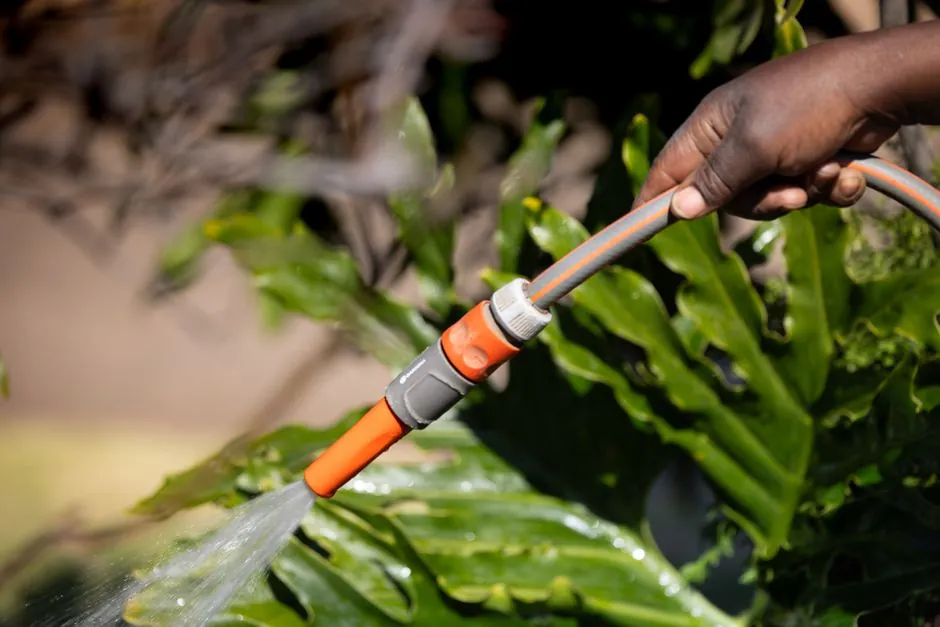
A water level, a length of clear vinyl tubing (commonly 5/16 in or 3/8 in inside diameter, 100 to 150 ft long) filled with water or windshield-washer fluid, is the only one of the four common jobsite leveling tools (line level, laser level, water level, builder's level) that can transfer a datum around a solid obstruction, because it needs no line of sight at all [S3][S4].
The trade-off is time: a self-leveling rotary laser sets up in seconds, projects a level reference 360° at ranges over 200 ft with about 1/8 in accuracy, and lets a single operator work a layout, while a water level needs a second person at the far end, careful filling to clear bubbles, and a hose path that is not kinked or stepped on [S2][S3].
Why a hose beats a laser once a wall is in the way
The water level is the only standard leveling tool that "sees through" obstructions, because it relies on the hydrostatic principle that a connected fluid settles to the same elevation at both open ends of a filled tube, regardless of what sits between them [S3].
For a footing, foundation wall, or deck where the reference point and the point being set are separated by a framed wall, a tree line, or an existing building, this is the deciding factor: a line level, a builder's level, and any laser all need an unobstructed sight line to the receiver or rod, and once that line is broken, none of them can return a reading [S4]. A 5/8 in garden hose run from a 5 gal bucket is enough to demonstrate the principle on a residential footing, and adding a few drops of food dye makes the meniscus readable across a 50 ft span [S1][S3].
Where the laser pulls ahead, and the numbers behind it
A self-leveling rotary laser eliminates the two failure modes a hose still has: it is not affected by air bubbles trapped in the line, and it cannot be thrown off by someone stepping on the tube [S2][S3].
Johnson's contractor field data (high-end residential and commercial office work in the New York metro area) cites a working range above 200 ft and a level accuracy of about 1/8 in at that range when the unit is set up over a stable pad; the unit also re-levels itself automatically and signals the operator if it has been bumped, so a single layout person can both emit and read the beam with a handheld receiver [S2]. For excavation stake-out, footer marking, and setting the top of foundation walls on a clean pad with no overhead rebar or shoring, that combination of accuracy, range, and one-person operation is hard to beat with any hose-based method. The same source notes that a transit (the older optical instrument) is more accurate than a hose at a point but is "fatally" sensitive to tripod bumps and vial-reading error, which is why lasers have largely replaced transits on residential foundation work [S2].
Decision matrix: water level vs laser level vs line level vs builder's level
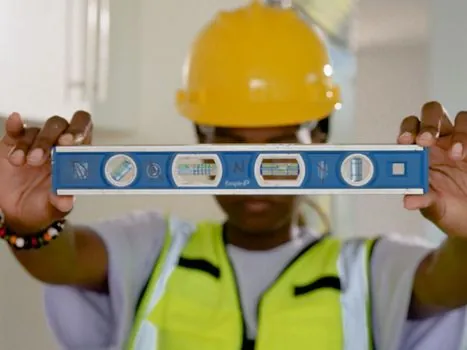
Line level: a short bubble vial clipped to a taut string; only good for short runs and a clear string path, useless around obstructions [S4]. Builder's level (optical/dumpy): accurate for elevation differences at a point, but needs the operator to read a rod at every shot, and any obstacle between instrument and rod kills the reading [S2][S4]. Water level: no line of sight needed, accuracy limited mainly by meniscus readability (typically 1/16 in to 1/8 in over 50 to 100 ft when the tube is bubble-free), no power, no calibration, but it is a two-person tool and slow over long runs [S1][S3]. Self-leveling rotary laser: 1/8 in accuracy at 200+ ft, one-person operation, automatic re-leveling and bump alert, but it loses the reference the moment a solid object (stud, tree, excavator cab) blocks the beam [S2].
For a site where the reference point and the far point are in the same open pad, the rotary laser wins on speed. For a site where the path between them crosses a wall, a mature hedge, or a neighbouring structure, the water level is the only one of the four that will work without moving the instrument [S3][S4].
Field setup that actually keeps the hose accurate
Three failure modes kill a water level in practice: air bubbles in the line, kinks in the tube, and fluid loss when the end is uncapped. All three are mechanical, and all three are avoidable [S3].
Bubbles form when the tube is filled quickly, especially with plain water; the fix is to siphon the fluid in slowly (a jug of windshield-washer antifreeze set on the truck roof is the field method most carpenters use) and to top up rather than pour. Kinks come from someone stepping on the hose or running it around a sharp corner; the fix is route the tube along a wall base or through a doorway, not across a footpath. Fluid loss happens when the operator uncaps the far end to take a reading; the fix is spring clamps on the tube ends, large enough to clip onto a 2x offcut so the hose can be hung in place while the carpenter marks the elevation [S3]. With those three controlled, a 125 ft run of 5/16 in vinyl tubing at roughly 15¢/ft (under $20 with tax) will hold level to the meniscus, and that is accurate enough for any footing, foundation, or deck ledger a residential crew will set in a day [S3].
Use cases that lock the choice
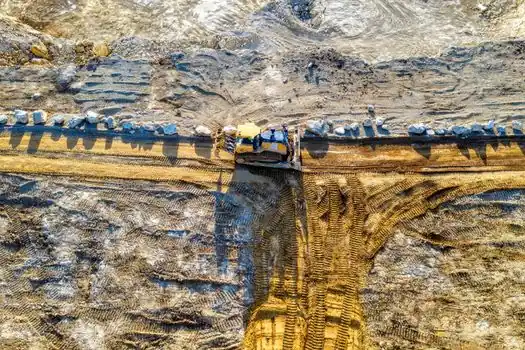
Setting footing forms on a tight urban lot with the house outline already framed: water level, because the perimeter is enclosed and a laser receiver cannot sit inside the form [S3][S4].
Marking grade around a single-storey slab where the laser sits on the slab and shoots outward: rotary laser, because there is no obstruction and one operator can run the receiver alone [S2].
Transferring a benchmark across a finished interior wall to set a kitchen island or a tub deck: water level, because the wall blocks every optical or laser path, and a 25 ft hose through the room is faster than drilling a sight line [S3][S4].
Laying out a long straight run of ceiling grid on an open commercial floor: rotary laser, because the 360° sweep lets one framer set multiple lines without re-setting the instrument, and a hose offers no advantage in an open space [S2].
Limitations, gotchas, and when to bring both tools
A water level cannot tell you anything about plumb, only level, and it is useless for transferring an elevation vertically up a building (above about one storey, the fluid column becomes hard to read and air pockets are hard to bleed out) [S3]. A laser level, even a self-leveling rotary unit, can be blinded by bright sunlight at the receiver, by reflective surfaces that scatter the beam, and by any physical barrier between emitter and receiver; it also needs a reasonably stable platform and a fresh battery to hold its 1/8 in spec [S2].
On most production foundation and deck jobs the working answer is to carry both: the laser for the open-pad layout, the hose for the corners, the inside corners, and any transfer through an existing wall. Crews that do this routinely report that the few dollars and 20 minutes spent building a 100 ft water level from a hardware-store tube, two spring clamps, and a jug of washer fluid pays for itself the first time a footing form has to be set inside an existing structure [S1][S3]. For a deeper look at how laser and optical tools compare on industrial alignment work, the laser screed reference covers the slab-side end of the same family, and shops that need a beam for profile measurement rather than flatness will want the laser profiler entry alongside it. Industrial buyers comparing similar spec-driven tooling decisions can also see how a parallel spec-level comparison is structured in the telescopic fork vs shuttle fork on stacker cranes: 2026 spec-level guide.